HVAC business owner salary guide: How much should you pay yourself in 2026?
You built the business. Now how much do you actually pay yourself? Real HVAC owner salary numbers by state and business size for 2026.


.jpg)
If you've ever looked at your bank account after a busy month and thought, "We did great – so why do I feel broke?" you're not alone. Compensation in the heating and cooling trade can swing hard from one company to the next, even when revenue looks similar. That's because your paycheck isn't just about how many calls you run – it's about how much money the business keeps after everything is paid.
This guide answers the big question: what should an HVAC business owner salary be? We'll cover real-world benchmarks for personal income, what a fair salary looks like at different stages, and why "sales" is not the same thing as "take-home." You'll also learn how contractors structure pay (W-2 vs. draw), what changes when you hire techs, and which numbers matter most if you want to increase what you keep.
By the end, you'll have clear compensation ranges, a simple way to set your pay without starving the business, and practical moves you can make this month to earn more – without working 80-hour weeks.
National average salary and income ranges
Let's start with the national picture – with one warning: average income can confuse more than it helps.
ZipRecruiter reports an average HVAC business owner salary of $86,197, with most listings falling between roughly $26,500 (25th percentile) and $125,000 (75th percentile). Top earners hit around $242,000 at the 90th percentile. Housecall Pro repeats the same ZipRecruiter-based average and notes many fall in a broader "real-world" range of $70,000–$150,000, with some clearing $200,000+.
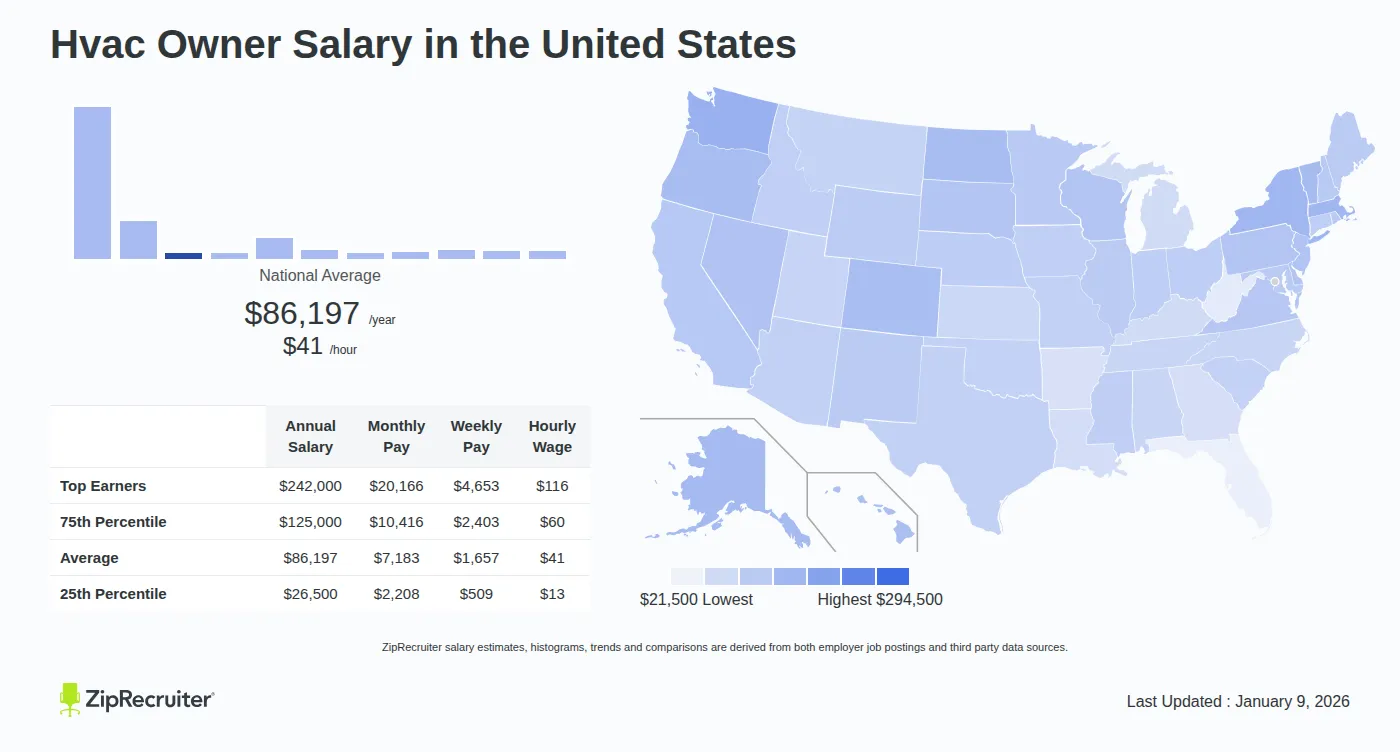
So what's the "true" number? It depends on what "pay" actually includes. Some sources only capture W-2 wages from job postings. Many contractors get paid through profit distributions or draws. Some reinvest heavily and keep salaries low on purpose. Understanding the salary for an HVAC business requires looking beyond simple averages.
That's why the phrase "average HVAC business owner's salary" can mean two different things: a paycheck for the role you perform (tech, manager, salesperson) and total compensation (paycheck + profits). Financially, your take-home comes out of revenue – but only after costs. That's why you must separate gross income (after direct job costs) from net income (after overhead and operating expenses).
Important: Why salary ranges vary so widely, two companies can both do $1M in revenue. If one runs 10% net and the other runs 3%, the first has over 3× more money available for compensation – before taxes and reinvestment.
How business size impacts HVAC owner income
Company size changes everything – especially what you can reliably pay yourself. Below are common revenue tiers, typical compensation ranges, and why the numbers shift. These are practical benchmarks (not promises), because markets, payments, and efficiency vary.
Under $500K revenue (solo operator): Typical take-home runs $40K–$90K, or about 15–30% of revenue. Overhead is "small" in dollars but high as a percentage because revenue is limited. Gross margin often swings job-to-job.
$500K–$1M revenue (first techs + growing demand): Typical take-home runs $70K–$130K, or about 10–20% of revenue. You start buying time: a dispatcher, a tech, better software. Compensation becomes more stable – if pricing is right.
$1M–$3M revenue (systems stage): Typical take-home runs $120K–$220K, or about 8–15% of revenue. This is where the "business" starts to act like a business. Better scheduling, higher close rates, and tighter job costing matter more than hustle.
$3M–$5M revenue (management + accountability): Typical take-home runs $180K–$300K+, or about 6–12% of revenue. Compensation rises because the company can produce profit without you on every call.
$5M+ revenue (leadership + scale): Typical take-home runs $250K–$500K+, or about 5–10% of revenue. Your job becomes leadership. Hiring, training, finance discipline, and culture drive profit.
In other words: growth often lowers your percentage of revenue – but increases dollars. The income of an HVAC business rises most when you move from "top technician" to "operator with systems." Understanding how much HVAC business owners make at each stage helps set realistic expectations.
HVAC owner salaries by state and location
Location hits earnings in three big ways: cost of living, competition, and workload driven by weather and climate. Hot summers and cold winters mean more calls, more replacements, and more maintenance opportunities. Regional demand for HVAC services directly impacts what the HVAC industry can support in terms of compensation.
ZipRecruiter's state-level data shows meaningful differences:
Higher-paying markets:
- Washington ($97,627)
- District of Columbia ($97,405)
- New York ($94,303)
- Massachusetts ($94,138)
- Alaska ($92,830)
Lower-paying regions:
- Florida ($64,414)
- West Virginia ($66,731)
- Arkansas ($71,277)
- Georgia ($72,783)
- Louisiana ($73,709)
At the city level, ZipRecruiter lists higher averages in places like Nome, AK; Berkeley, CA; and Aspen, CO. Use location data as a pricing and demand clue for HVAC owner salary expectations, not as a "you should earn X" guarantee. Every HVAC company owner must factor in their specific market conditions.
Get Tofu Field Service and start sending professional invoices in minutes
The difference between salary and total owner compensation
This is where many contractors get stuck: "My company made money, so why is my paycheck small?" Because a paycheck is only one way to get paid.
A W-2 salary is common when you treat yourself like an employee (especially in an S corporation). But you may also take profit distributions (common in an S-corp), draws (common for sole proprietors and single-member LLCs), payments structured like dividend income in certain setups, and benefits or perks paid through the company (vehicle, phone, etc.).
Your business structure matters: a C corporation has different rules than a passthrough entity, and a partnership splits profits across partners. And yes – tax planning changes what you "keep" at the end of the year.
Here's a simple example: Contractor A takes a $95,000 W-2 and zero distributions. Contractor B takes a $70,000 W-2 plus $60,000 in distributions. Same company performance, different take-home structure.
So when someone asks about "salary for an HVAC business," clarify what they mean. In real life, compensation often includes multiple lanes of payment.
How to determine your HVAC business owner salary
There are two practical ways to set how much HVAC business owners make without guessing.
Fixed salary method (stable paycheck): You pick a consistent amount based on the role you perform (lead tech, service manager, GM). This works well when the company has steady demand, your numbers are predictable, and you want personal budgeting simplicity. The downside: if cash flow dips, a fixed paycheck can strain the business.
Profit-percentage method (performance-based): You pay yourself based on what the company actually earns after expenses. A common starting guideline is taking 30–50% of net profit for your pay, then reinvesting the rest in marketing, hiring, trucks, and training.
This method forces you to watch cash flow (do you have money in the bank today?), profit margin (are you charging enough?), and break-even (how much revenue you need before profit starts).
A simple rule: pay yourself for the job you do, then add extra when the company proves it can afford it. That's how you make more without starving growth – and it's the mindset behind running a profitable HVAC business long-term. HVAC business owners typically balance personal compensation with reinvestment needs.
Key financial factors that impact owner income
Your income isn't about "paying yourself more" by force – it's about whether the numbers allow it. Contractors typically earn strong incomes when their companies are built on clear cost visibility, disciplined pricing, and controlled spending. When those fundamentals slip, your pay is usually the first thing to suffer.
- Operating costs & expense management (target: under 60% of revenue): Total business expenses – including labor, overhead, and variable costs – should ideally stay below 60% of revenue. When operating costs rise to 70–80%, even strong sales won't translate into take-home pay. Consistent monthly reviews and clear expense management are essential.
- Overhead targets (25–35%): Overhead includes office payroll, rent, insurance, admin, software, and non-billable support. Excessive overhead quickly compresses margins and limits compensation, especially during slow periods.
- Gross profit minimums (40%+): Gross margin is the foundation of profit. Sustainable HVAC businesses aim for at least 40%, with top performers reaching 45–55%. Lower margins usually point to finance issues, labor inefficiencies, or high material costs.
- Labor cost control & billable hours: Labor is the largest expense for most HVAC companies. Track fully loaded labor costs, control overtime, and focus on improving billable hours. Reducing drive time, callbacks, and idle time directly helps increase profit.
- Pricing strategies that support profit: Cost must be built on real operating costs, not competitor assumptions. Every job should cover labor, overhead, and profit. Underpricing often leads to full schedules but weak take-home.
In short, income is driven by systems, not volume alone. Businesses with disciplined expense control, smart charging strategies, and clear visibility into costs are far better positioned to increase profit consistently as they grow.
Stop chasing payments, start getting paid
Join thousands of contractors who trust Tofu for fast, easy invoicing. Sign up today and simplify your billing.
Maximizing your HVAC business income
If you want to take home more, there are only two real paths: increase revenue without breaking operational efficiency, and reduce waste so more money drops to the bottom line.
Successful contractors treat every change like an investment and ask, "What's the return on investment?" They also build operational efficiency so the company can grow without them doing everything.
Your pay doesn't improve from "being busier." It improves when you can do the same work with fewer mistakes, fewer callbacks, tighter scheduling, and better charging.
The next sections break down what consistently moves the needle: cost and service mix, overhead control, recurring revenue, technician productivity, and marketing that can be measured.
If your goal is to grow your HVAC business while improving take-home pay, you'll need systems that reduce admin time and keep your numbers clean – because that's what can actually help HVAC business owners make smart pay decisions.
Optimize your pricing and service mix
Smart costing is the fastest lever for profit because it changes what you earn on every job.
Understanding flat rate vs. hourly cost comes down to basic labor economics. To make charging work, you need three basics: your loaded labor cost (real cost per hour), your target gross margin, and your overhead and profit targets.
Then your service mix matters. Contractors who rely only on repairs often struggle with seasonal swings. Higher-margin work typically includes preventive maintenance, system replacements, indoor air quality add-ons, smart thermostats and upgrades, air conditioning installations, and light commercial HVAC service.
If you're not sure where you're leaking profit, start by tracking average ticket size by job type. You may find you're doing a lot of low-margin work that keeps you busy but doesn't actually pay.
Control costs and reduce overhead
Reducing overhead isn't about cutting quality – it's about eliminating waste that quietly drains your income. Every unnecessary cost compounds over time, while smart savings flow directly to profit. The focus is control, not austerity.
Proven ways to reduce business expenses without harming service or morale:
- Optimize routing and scheduling (better dispatching cuts fuel costs, unpaid drive time, and vehicle wear).
- Control inventory and shrink (approval rules and per-truck tracking prevent over-ordering and lost parts).
- Standardize truck stock (consistent inventory reduces duplicate purchases and improves first-call resolution).
- Audit software and admin tools (cancel subscriptions that don't clearly save time or generate revenue).
- Negotiate with suppliers (improved charging and payment terms reduce recurring material costs).
- Manage overtime intentionally (smarter scheduling protects margins without cutting wage rates).
⚠️ Where NOT to cut costs: Training, safety, or customer experience. One callback, accident, or bad review can wipe out weeks of savings and hurt long-term profitability.
Build recurring revenue with maintenance plans
Maintenance plans reduce revenue swings and make income more predictable. With recurring revenue, you can plan staffing, equipment, and cash flow with less stress.
The most effective plans stay simple: 1–2 visits per year, priority scheduling, small repair discounts, and clear value (safety, performance, fewer breakdowns).
Done right, maintenance plans stabilize cash flow, reduce slow-season panic, and support better recruitment and employee retention. A practical goal is to grow enough members to cover a meaningful portion of overhead – once overhead is covered, new revenue can turn into profit.
Improve team efficiency and productivity
Your income is driven by HVAC technician output, not headcount. Lost time, callbacks, or missed billing quietly erode profit. Improving efficiency is one of the fastest ways to increase income without raising prices or adding staff.
Strong contractors focus on daily execution: tighter scheduling to cut drive time, smarter dispatching for better first-call resolution, fewer callbacks, and clean documentation to prevent missed billables.
Key metrics to track: billable hours per HVAC tech, average ticket value, callback rate, and estimates sent vs. approved. These numbers reveal where training, processes, or technician matching need improvement – often solving profit leaks without more sales effort.
Small gains compound quickly. If each tech produces just one additional billable hour per day, that can add hundreds of billable hours per year – without increasing payroll. Many contractors rely on modern field service software to support scheduling, dispatching, and real-time performance tracking.
Invest in marketing that generates ROI
Marketing strategies should be measurable investments – not gambles. Effective approaches are tied to booked jobs and revenue, not just visibility. If results can't be tracked, marketing becomes an expense instead of a profit driver.
High-performing HVAC companies focus on intent-driven channels like Google Local Services Ads, local SEO, referrals, reputation management, and authentic social content. These channels should be evaluated by revenue produced, not impressions or clicks.
A common benchmark is spending 6–12% of revenue on marketing, but only with clear lead tracking. Monitor acquisition cost, average ticket value, close rate, and repeat customers. When customer lifetime value exceeds acquisition cost, marketing can scale confidently; when it doesn't, the issue is usually execution, not budget.
Your next invoice could take less than 60 seconds
Start using Tofu and create invoices faster than ever. No setup, no stress — just clean, professional billing.
6 common mistakes that reduce HVAC owner income
Many contractors lose income not because of low demand, but because of repeatable operational mistakes. These issues are common – and expensive – but each has a clear fix.
1. Underpricing to "win the job." Cost based on fear leads to high volume and low margins.
Fix: Price for profit, not activity. Every job must cover labor, overhead, and margin.
2. Not separating business and personal finances. Blended accounts hide performance issues and distort your pay.
Fix: Separate accounts and maintain clean business finances bookkeeping so income and expenses are clearly visible.
3. Poor cash flow management. Even profitable companies can fail due to bad timing. Many don't track receivables, upcoming expenses, or payroll closely enough.
Fix: Monitor weekly cash position, AR, and payroll obligations using solid cash flow management.
4. Not tracking job costs. Without job-level data, you guess instead of manage.
Fix: Track labor hours and materials by job type to understand true margins and adjust charging accurately.
5. Relying on busy seasons to "make the year." Seasonal dependence creates income volatility and stress.
Fix: Build maintenance plans and off-season demand to smooth revenue year-round.
Tax surprises from the IRS. Rising profits without planning often result in painful Internal Revenue Service bills.
Fix: Plan quarterly – not annually – especially as income grows.
⚠️ The most costly mistake? Not knowing true job profitability. If you don't know margins by service line, you can't fix cost – and staying busy won't move you forward.
What are some effective systems for running an HVAC business?
Systems are how you stop being the bottleneck.
At their core, systems are simply "how we do things here," written down so the business doesn't depend on your memory. This usually includes an operations manual, standardized checklists for HVAC service calls, job tracking, and clear closeout steps so nothing gets missed.
Common examples of effective systems include checklists for service and install jobs, job tracking and status updates, customer communication templates, and defined closeout and invoicing steps.
When work is documented, it becomes easier to delegate. Techs know expectations, office staff can manage workflows, and you can step away from daily fires to focus on cost, hiring, and growth.
✅ More time, more income: Buying back even a few hours a week allows you to sell higher-margin work or simply avoid burnout. Tools like field service management software help make that shift possible.
Start-up costs and initial investment considerations
Starting an HVAC business usually means a lean first year.
Initial costs often include licensing, bonding, and insurance, along with tools, equipment, and at least one service vehicle. Most contractors also need basic marketing to generate calls and enough working capital to cover payroll, fuel, and parts during slow periods.
Typical start-up expenses include licensing and insurance, tools, equipment, and vehicles, marketing and lead generation, and working capital.
💡 Reality check: Many contractors pay themselves less early on so the business can survive and grow. This is normal. The goal isn't a large salary right away – it's building a stable operation that can support consistent pay later.
How to track finances effectively
If you want predictable pay, you need numbers you can trust.
Three financial reports matter most: the Profit and Loss (P&L) shows monthly profitability, the cash flow statement shows actual cash movement, and the balance sheet shows assets, liabilities, and business value.
A simple routine works best:
- Weekly: check cash balance, receivables, payroll, and booked work.
- Monthly: review P&L, gross margin, overhead, and net profit.
- Quarterly: plan taxes, adjust charging, and update labor rates.
Software helps only if used consistently. Clean, current numbers allow you to spot problems early and make better pay decisions.
Using reliable accounting software, reviewing accurate financial statements, and streamlining billing with invoice software makes your income far more predictable.
Conclusion
Your pay isn't guesswork – it's the outcome of how the business is run. Income varies widely based on efficiency, cost, overhead control, and systems. Just as important, a W-2 salary reflects only part of the picture. True compensation includes profit distributions and long-term business value.
Income is driven by margins and systems, not just revenue. W-2 salary ≠ total compensation. Predictable operations lead to predictable pay.
To increase your pay sustainably, focus on the basics: track gross margin and net profit, separate salary from total compensation, and use a fixed salary with profit-based distributions. Reducing daily chaos through better systems is often the fastest path to higher, more stable income.
Pick one metric to track weekly (cash flow, margin, or billable hours) and one improvement to make this month – charging, maintenance plans, or overhead cleanup.