The HVAC market hit $333 billion in 2026, and there are over 120,000 contractors competing for those jobs. The ones winning aren't spending more on marketing. They're doing the basics consistently, with the right channels at the right time.
This guide breaks down 30+ tactics with real 2026 numbers: average cost per lead, expected conversion rates, what's working right now. Use the budget calculator below to plan, the FAQ to answer the questions you'll have, and the "Where to start" section to pick your next move.
What actually changed in 2026
Before you spend money on anything, here's what's different this year.
Repair revenue is up. Repair share of total HVAC revenue climbed from about 21% in 2021 to over 31% by end of 2025, according to Housecall Pro's platform data. Equipment replacement costs are high, so more homeowners are choosing to repair. That changes how you price, staff, and market your services.
Heat pumps are the default conversation. 42% of U.S. households now use electricity as their main heating fuel (up from 34% in 2010), according to U.S. Census data cited by the EIA. Federal tax credits and state rebates are accelerating the shift. If you're not talking about heat pumps in your marketing, you're missing the biggest topic homeowners are searching for.
A2L refrigerants are here. New equipment manufactured after January 2025 uses A2L refrigerants. Homeowners don't care about the chemistry, but they do ask about "future-ready" systems. Your marketing should address that in plain language.
AI search is changing how people find you. Google and other search engines now show AI-generated summaries above regular results. If you have a website, itneeds to clearly answer homeowner questions, or AI tools will pull answers from your competitors instead.
Google Ads costs keep climbing. Average cost per lead on Google Ads is about $104 in 2026. Non-branded campaigns average $149 per lead. Local Services Ads are cheaper at around $51 per lead with a 44% book rate. All numbers from the SearchLight HVAC Advertising Benchmark tracking $14.9M in spend across 816 contractors. Know your numbers before you budget.
Homeowners are skeptical of big brands. Private equity-backed HVAC companies are everywhere, and homeowners are noticing. Independent contractors who look local, real, and accountable have a trust advantage. Use it.
Start here if you have nothing set up
If your marketing is basically zero right now, focus on four things. Everything else can wait.
Claim and fill out your Google Business Profile. Free, highest-ROI action you can take. Complete every field. Upload at least 10 photos. Post weekly. Respond to every review within 24 hours.
Get your truck branded.A quality wrap runs $3,000 to $5,000 and lasts 5+ years. Under $100/month for constant local visibility with 30,000 to 70,000 daily impressions, according to OAAA data cited by Grand View Research.
Put up a basic website. Even a one-page site with your services, phone number, service area, and reviews is enough. Over 60% of HVAC searches happen on mobile, so make sure it loads fast on phones.
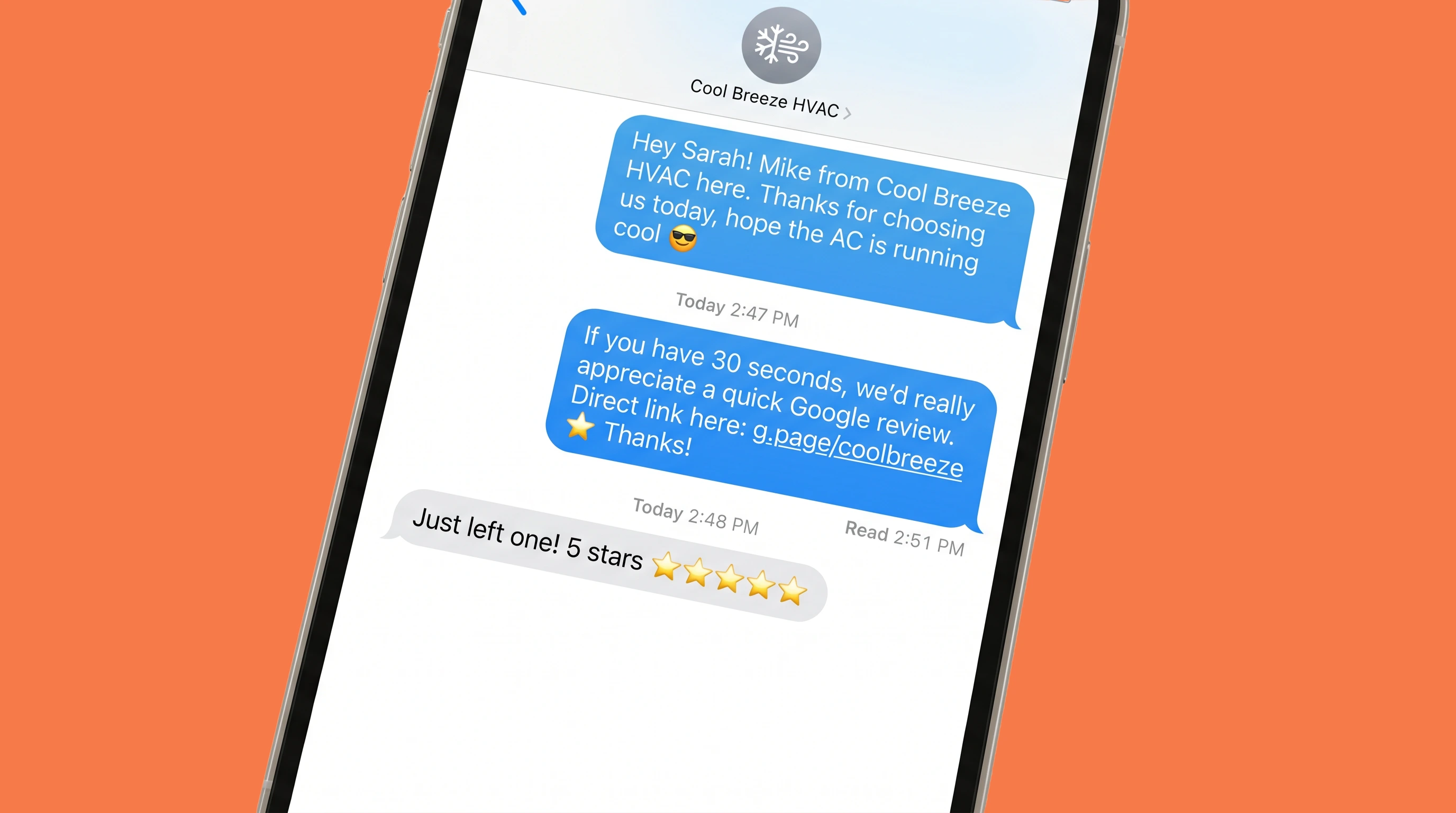
Ask for reviews after every job. Text or email customers the same day with a direct link to your Google review page.
These four things, done right, can generate steady calls without any ad spend. Give it 3 to 6 months.
💡 The order of operations matters
Before spending on ads, set up your GBP, Facebook page, and 3 directory listings (Angi, Nextdoor, Yelp). If someone Googles your name and finds nothing, they move to the next contractor
Google Business Profile: the most important free tool you have
When someone searches "HVAC near me" or "AC repair [city]," the businesses in the local map pack are Google Business Profiles. Most visible real estate in local search, and it costs nothing.
What a fully optimized profile looks like:
Every field complete: name, address, phone, hours, website, service areas
Detailed service list: "AC installation," "furnace repair," "duct cleaning," "heat pump installation" (not just "HVAC services")
10+ photos: your team, equipment, completed jobs, your branded truck
Every review responded to within 24 hours (positive and negative)
Messaging enabled
💡 Tip
Companies ranking in the top 3 Google map results average 40% lower cost per sale than paid ads. A properly optimized GBP generates 20 to 50 leads per month for established contractors.
SEO: show up when someone's furnace dies at midnight
SEO stands for search engine optimization. In plain English: it's what makes your website show up when someone Googles "AC repair near me" or "furnace not working." You're not paying for that click (that's ads). You're earning it by having a website that Google trusts enough to recommend.
Here's how it works in practice. A homeowner in Dallas types "how much does a new AC unit cost in Dallas" at 11pm. Google scans thousands of pages and picks the ones that best answer that question. If you have a page on your website that answers it clearly, with your local phone number and a few reviews, Google shows your page. The homeowner reads it, sees you're local, and calls you in the morning. You just got a lead without spending a dollar on ads.
That's SEO. It's slow to build (6 to 12 months), but once it works, it keeps bringing in leads long after you stop actively working on it. Think of it as compound interest for your HVAC website.
Focus on three things:
Create location pages. For every city or neighborhood you serve, create a dedicated page. "HVAC repair in [city name]." 300 to 500 words covering your services in that area, your phone number, a Google Map, and local reviews. Link from your homepage.
Answer the questions homeowners ask. Blog posts that answer real questions rank on Google and bring in traffic for years:
"How much does a new HVAC system cost in [your city]?"
"Should I repair or replace my AC unit?"
"What's a heat pump and is it worth it?"
"How often should I change my air filter?"
Aim for 1 to 2 posts per month.
Make sure your site works on phones. Test with any free tool available. Fast load time (under 3 seconds), click-to-call button at the top, simple navigation.
SEO takes 6 to 12 months to show full results, but keeps paying off after you stop actively spending on it.
Google Ads and Local Services Ads: when you need leads now
Local Services Ads (LSA)
Show up at the very top of Google, above regular ads. "Google Guaranteed" badge. You only pay when someone actually contacts you.
Standard text ads. You pay per click whether they call or not.
2026 benchmarks:
Performance Max: $72/lead
Blended average CPL: $104
Branded campaigns: $34/lead
Non-branded: $149/lead
Separating campaigns by service type ("heating repair" and "AC installation" in different campaigns) typically reduces CPL by 15 to 25%.
💡 Tip
Start with $50 to $100/day. Send traffic to a dedicated landing page (not your homepage). Track calls and form fills, not just clicks.
Reviews: your best free marketing tool
Your review count and rating directly affect whether you show up in local search and whether people call you.
How to build a review system:
Ask every customer at the end of every job, in person
Follow up same day with text or email containing a direct link to your Google review page
Make it one tap
Respond to every review within 24 hours
Make sure not to fake reviews or pay for them
For negative reviews: don't get defensive. Acknowledge, apologize if warranted, offer to make it right offline. A well-handled negative review often builds more trust than a five-star rating.
Speed to lead: the tactic most contractors ignore
78% of jobs go to the first company that responds. Most HVAC businesses take hours to respond to web form submissions. By that time, the homeowner had submitted the same form to two other companies.
What top contractors do differently: every web form submission triggers an automated text and email within 60 seconds. "Hi [Name], thanks for reaching out. We have openings this week. Tap here to book your preferred time." No human needed for the initial response.
This isn't expensive or complicated. Services like Podium, Hatch, or even simple Zapier automations can handle it. The ROI is immediate: if you're spending money on ads but taking hours to respond, you're burning that budget.
Email marketing: your cheapest lead source
Email returns roughly $36 to $40 for every dollar spent. And you already have a list: every customer who's ever called you.
The $150 email that made $4,845. One HVAC contractor sent a simple "winter prep" email to 2,000 past customers. Cost: $150 for platform and time. Result: 17 service calls averaging $285 each. Cost per sale: $8.82. (Source: Contractor Marketing Pros, based on audits of 200+ HVAC companies.)
Segment by: customers due for maintenance, customers who haven't booked in 12+ months, maintenance agreement holders, residential vs. commercial.
6 email types that work:
seasonal reminders,
maintenance follow-ups,
emergency tips (helpful content),
exclusive offers for past customers,
referral asks,
review requests.
Key timing insight: send AC tune-up promos in March, not July. When systems are already running constantly, it's too late. Early bird pricing fills your schedule during slower periods.
The Facebook Groups play
This is one of the most underrated tactics in HVAC marketing, and it's essentially free.
In most US metros, there are 10 to 30 active local Facebook groups: neighborhood groups, HOA groups, "Moms of [City]" groups. Homeowners ask for contractor recommendations in these groups daily.
How it works in practice: a Phoenix contractor posts helpful HVAC tips in 8 local Facebook groups weekly. Time investment: 2 hours. Monthly leads: 12 to 15. Close rate: 60%. Effective cost per sale: about $75. (Source: Contractor Marketing Pros)
Also worth setting up: Nextdoor. About 30% of Nextdoor posts are requests for recommendations, and recommendations there are more trusted than Google or Yelp because every member's name and address is verified. Claim your business page and participate in conversations.
Referral programs: 4x conversion at near-zero cost
Referred customers convert at about 4x the rate of cold leads. They cost less, close faster, and have 16% higher lifetime value. (Source: Marketing LTB, cited by Rivo.)
Four structures that work: cash/account credit ("give $25, get $25"), gift cards to local restaurants, charitable donations in the customer's name, free maintenance points.
The mistake most contractors make: assuming customers know the program exists. Mention it at the end of every job. Put it in your follow-up email. Print it on your invoice.
💡 Insider tip: the referral coin
One creative tactic: give happy customers a physical branded coin they can hand to a friend. It's tangible, memorable, and stands out from the sea of digital noise. The friend brings it in for a discount. Simple, clever, gets passed along.
People hire contractors they've seen on camera. And short-form video (Reels, TikTok, Shorts) gets 5 to 10x the organic reach of static photos right now.
Five videos you can shoot on your phone today: customer testimonials, before/after walkthroughs, day-in-the-life, quick DIY tips, common questions answered.
You don't need fancy gear. Phone + decent lighting + $20 lapel mic. Post on YouTube, repurpose everywhere.
💡 Tip
Before/after content outperforms everything else. An old rusted furnace next to a new install, dirty vs. clean ductwork, dramatic attic unit replacements. These get shared.
Social media: pick one platform and actually use it
Facebook: best for local reach and community groups
Post at least 3x/week. Consistency matters more than polish.
Paid social: Facebook/Instagram ads targeting homeowners within 10 miles, $5 to $10/day. Not a replacement for organic, but a good amplifier.
Maintenance agreements: the recurring revenue engine
A maintenance agreement is a simple deal: the customer pays a flat annual fee (usually $150 to $300), and in return you service their system twice a year, before cooling season and before heating season.
Why it matters: maintenance customers call you first when something breaks, spend more over their lifetime, and their fees smooth out the slow months between peak seasons. Renewal rates are typically 90%+, so once someone signs up, they tend to stay.
Service visits are also your best upselling opportunity, since you're already in the home and the customer trusts you. Common add-ons: indoor air quality products (a growing market in 2026, with homeowners treating clean air as a health decision), smart thermostats, duct cleaning, and heat pump upgrades.
A tool like Tofu lets you track service history per client and send invoices right from the job site, so nothing falls through the cracks between the tune-up and the follow-up.
Offer at the end of every service call. "Would you like to make sure you're covered for next season too?"
Strategic partnerships: warm leads for free
The fastest way to grow without ad spend is to get other people sending you customers. When a real estate agent tells their client "call this HVAC company," that's not a cold lead. The homeowner already trusts the agent, and that trust transfers to you. These referrals close faster and cost you nothing.
Who to build relationships with:
Real estate agents. Every home sale involves an HVAC inspection, and new homeowners often need repairs or upgrades right after moving in.
Home inspectors. They find HVAC problems before anyone else does, and can hand your card to the buyer.
Plumbers and electricians. Same customers, no service overlap. You refer them, they refer you.
General contractors. Renovations almost always touch the HVAC system.
Property managers. They oversee dozens of units needing year-round maintenance. One good relationship means steady work.
Roofers. Roof work often overlaps with attic units and ductwork.
How to do it: pick three or four potential partners in your area and reach out directly. Offer to send them business first, before asking for anything back. Make it easy for them to refer you (cards, your direct number), then follow up every month or two so you stay top of mind.
💡 Insider tip: the restaurant cross-promo
One contractor partnered with a local restaurant for a promotional giveaway: customers enter to win a system replacement while receiving a gift card to the restaurant. Both businesses get visibility and community trust. Creative partnerships like this cost almost nothing and create goodwill.
Traditional HVAC marketing strategies that still work
Digital gets all the attention, but offline marketing still pulls its weight for HVAC. Many of your customers are homeowners who aren't glued to their phones, and these tactics put your name right in the neighborhoods where you already work. Most cost little and keep working long after you've paid for them.
Vehicle wraps. 30,000 to 70,000 impressions/day per the Outdoor Advertising Association of America. Under $100/month over the wrap's life.
Door hangers. Hit 10 to 15 houses on the same block after every job. Those homes likely have similar-age HVAC systems.
The "sorry for the noise" trick. Give your installers door hangers to leave on surrounding doors with a note: "Sorry for the noise, we're upgrading your neighbor's heating system!" plus your phone number. Turns every job into a mini marketing opportunity.
Direct mail postcards. 2 to 5% response rates when well-targeted. Good for older homeowners who don't respond to digital.
Yard signs. At every job site, with permission. The neighbor sees your sign while you're inside working.
Local sponsorships. Youth sports, school fundraisers, community events.
Track results with a unique phone number or offer code on each piece.
HVAC calculator: how much should you actually spend
Every HVAC marketing article says "spend 8 to 12% of revenue." Nobody shows what that actually looks like in dollars, broken down by channel, with estimated leads. This calculator does. Enter your annual revenue, adjust the percentage, and see exactly where the money goes.
How much should your HVAC business spend on marketing?
Enter your annual revenue and see a recommended breakdown by channel with estimated leads based on 2026 benchmarks.
Annual revenue$500,000
Marketing budget (% of revenue)10%
under 5% minimal5-8% maintenance8-12% growth12%+ aggressive
Recommended allocation by channel
Agency vs. DIY: when to hire help
DIY if you're under $500k revenue or just starting out. Handle GBP, social media, email, and review requests yourself.
Hire an agency for technical work (SEO, PPC) once you have budget. Industry recommendation is 8 to 12% of revenue for marketing spend, with agencies typically running $1,500 to $5,000/month.
Questions to ask yourself: Do you work with competitors in my area? Can I see HVAC client results? What does the first 90 days look like? How do you report? What happens to my accounts if I leave?
Red flags: guaranteed top rankings, long contracts, can't explain what they're doing in plain language. Many HVAC companies report dissatisfaction with their SEO providers according to industry surveys. Vet carefully.
Using software to keep it all running
The biggest gap most small HVAC businesses have isn't marketing ideas. It's follow-up. A customer calls, you do the job, nobody reaches out again for 18 months. That's money left on the table.
A simple system that tracks customer history, automates follow-up reminders, handles invoicing, and sends review requests will do more for your bottom line than any ad campaign. It costs roughly 5x more to acquire a new customer than to keep an existing one.
The right tool depends on your size and how you work. We compared the best HVAC apps for technicians and contractors in a separate guide, from full field service platforms to simple invoicing apps.
Where to start based on where you are
Starting from zero
Google Business Profile, reviews, truck branding. Do these three well before anything else.
Have the basics but want more leads
Add email marketing, a referral program, Facebook groups, and start posting on one social platform.
Ready to invest in growth
SEO content (location pages + blog), Google LSA or Search Ads, maintenance agreements, and speed-to-lead automation.
One last thing: the best marketing for any HVAC business is still doing exceptional work. Everything in this guide just amplifies that.
FAQs
Everything you need to know about the product and billing
What's the single most important marketing action for a new HVAC business?
Do I really need a website for my HVAC business?
How do I market my HVAC business during slow seasons?
Is social media worth it for HVAC contractors?
How do I get more Google reviews for my HVAC business?
What's the difference between Google Ads and Local Services Ads for HVAC?
Should I hire an HVAC marketing agency or do it myself?
What is the best way to get HVAC leads without paying for ads?
How long does it take for HVAC marketing to show results?
How much should an HVAC company spend on marketing?
Bottom line
You don't need all 30+ tactics. Pick 3 to 5 that match where your business is, run them for 90 days, and track what drives calls.
The contractors who win this market aren't the ones with the biggest budgets. They're the ones doing the basics consistently: showing up on Google, answering the phone fast, doing great work, and asking for the review. Then doing it again next week.



.webp)
.webp)
