Pool service marketing: 11 effective strategies & tips for business owners
Pool service is a route business – here's how to market it like one. 11 tactics ranked by phase, cost, and what actually books recurring accounts.


Word-of-mouth fills a pool route at small scale. It just does not grow one. In this guide we break down 11 pool service marketing tactics that actually work for small pool service companies: how to get found online, which offline tactics pay off in a route business, how to turn happy clients into a referral engine, and how to price and retain accounts so the growth you win actually sticks. Pick the tactics that fit where you are now, run them for 60 to 90 days, and double down on what books recurring accounts.
The key insight most guides miss: pool service is a route business, not a lead business. Adding a client two streets away from an existing stop costs almost nothing to service, while a client across town eats your margin in drive time. And because a single recurring account at $150/month stays two years, you can afford a much higher cost per lead than a one-off trade.
Why pool service marketing matters for pool service business owners
The numbers favor you. There are roughly 10.7 million pools in the U.S., 10.4 million of them residential, and the average pool owner spends about $1,700 a year on maintenance, according to Skimmer's 2026 State of Pool Service report. Demand is not fading either: total annual search volume across major pool categories rose 22% from 2022 to 2025 (29.7M to 36.3M searches). Operators feel it too, with 64% expecting higher revenue this year and only 8% expecting a decrease. The catch is that pool service is no longer a "just show up and clean" business. The report's framing is that the winners in 2026 are the operators running with more discipline, and one telling shift is that owners are moving away from growth by piling on more stops toward "better revenue per stop."
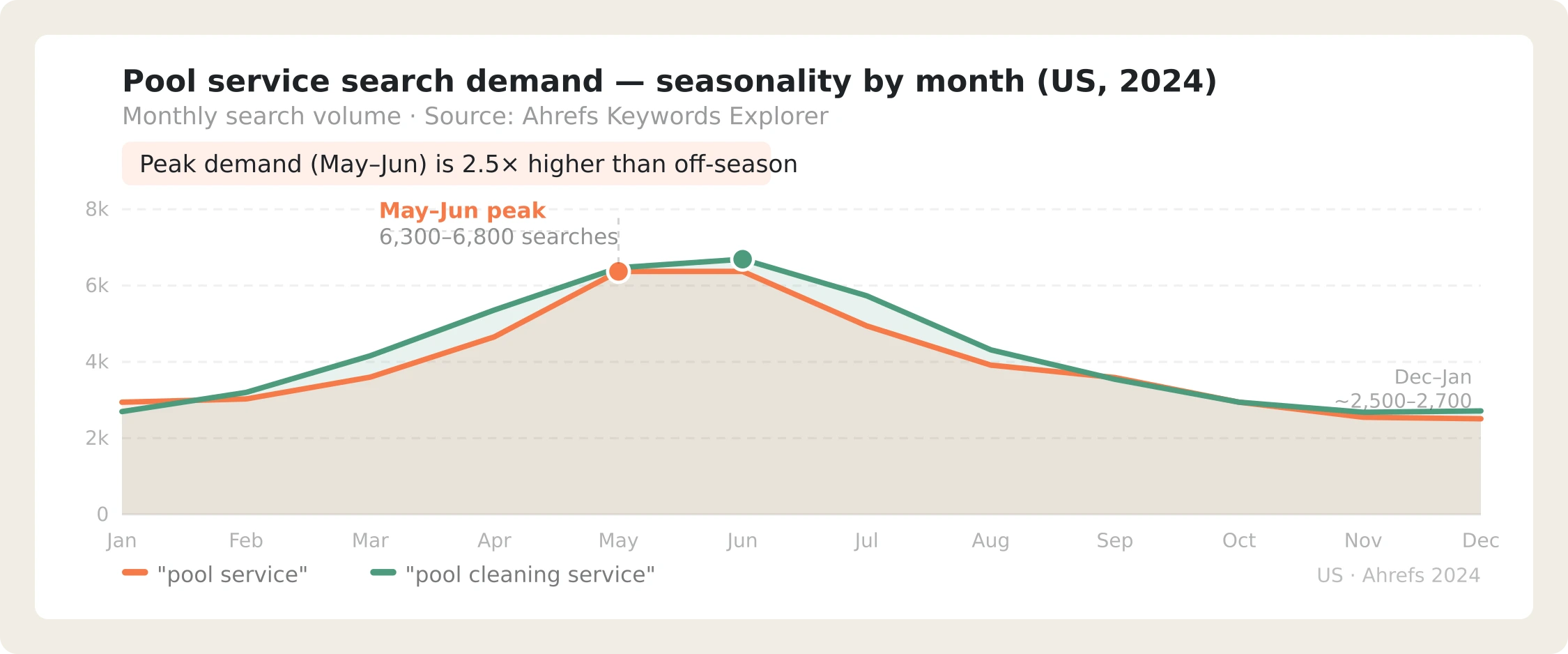
That demand is also intensely seasonal. Search interest for pool service climbs from late winter into a summer peak that runs about 2.5× higher than the December low, which means the operators who market year-round lock in clients before spring while their competitors are still offline.
That last point is the whole game. Pool service is a route business: your profit per visit rises when accounts cluster tightly and falls when they scatter across town. So the goal of marketing here is not just more leads, it is denser, higher-value routes. Word-of-mouth carries a route at small scale ("I don't pay for ads, the customer alone, they call us" is how operators describe it), but leaning on it forever caps your growth at the speed of your clients' social circles and leaves you invisible the moment a homeowner who does not know anyone you serve opens Google.
Build your pool service marketing foundation first
Before you spend a dollar on ads, get the foundation right. Channels amplify a foundation. They do not replace one.
Name and logo. Look the same everywhere a customer sees you: the truck, the invoice, the yard sign, the website. Consistency reads as professionalism.
A fast, mobile-friendly pool service website. You need a home base you own. Social platforms change their rules overnight. Your website cannot be taken from you.
A defined service area. Route density is where pool service profit lives. Your cost per stop drops sharply when accounts cluster tightly. Map the zip codes you already serve, target the streets around them first, and aim every local tactic there. Every new pool you add within a few blocks of an existing one is nearly free to service. With the average pool owner spending about $1,700 a year on maintenance, the customer you win near an existing route is worth far more than one across town.
Stop chasing leads. Start building a route.
Tofu Field Service keeps your jobs, invoices, and client records in one place — so you spend less time on admin and more time growing.
Digital marketing strategies for pool service companies
Digital marketing captures the homeowners that word-of-mouth never reaches: the ones who moved in last month, the ones whose regular tech just retired, the ones searching at 9 p.m. on a Tuesday.
1. Optimize your Google Business Profile
If you do one thing this week, do this. Your Google Business Profile is the single highest-leverage local move available, and it is free. Claim and fully complete it: the right categories (pool cleaning service, swimming pool repair service), a clear description of your pool services, your service area, hours, and real photos of your work. BrightLocal research found that only about 35% of small businesses even have a Google Business Profile, which means a complete, active profile already puts you ahead of most local competitors. Treat it as an ongoing habit: post seasonal updates, answer Q&A, collect reviews.
2. Use local SEO to rank in Google search results
Local SEO is about helping search engines understand where you work and what you do, so you show up when someone nearby searches. The fundamentals: location pages for the towns you serve, name/address/phone identical everywhere online, helpful service pages, listings in every relevant local directory. Done well, local SEO puts you in the Google search results next to the bigger local pool service companies. It is slower than ads but compounds: one ranking page can feed your route for seasons without a per-click cost.
3. Run Google Local Services Ads and PPC
When you want leads now, paid search delivers. Local Services Ads sit at the very top of Google search results and carry the Google Guaranteed badge. You pay per lead, not per click. Standard PPC (Google Ads) gives you more control over messaging once you have a campaign to scale. One note specific to pool service: because every account is recurring, you can afford a higher cost per lead than a one-off business. If a client stays two years at $150 a month, that account is worth thousands. Calculate lifetime value before you decide a lead is too expensive.
4. Build a website that converts and market on social media platforms
Every channel sends traffic somewhere. Make sure your website loads fast, works on a phone, has clear calls to action, real pages for each of your pool services, and high-quality photos of actual jobs. Before-and-after shots of a green pool turned crystal clear sell better than any paragraph.
Pool work is visual, which makes social media platforms a natural fit for the same reason. Pick one or two platforms like Facebook and Instagram, post before-and-after content consistently, and keep your social media handles identical everywhere. Do not overlook YouTube: as the second-largest search engine, short clips of pool maintenance tips let you demonstrate your expertise while quietly advertising your pool services. BrightLocal's review research shows that review research increasingly happens on visual and social channels too, with YouTube, Instagram, and TikTok all gaining ground as places consumers check a business before buying.
5. Use email and SMS automation to stay top-of-mind
You will never out-hustle follow-up by hand. Set up automated reminders and seasonal sequences so the right messages to customers go out on time without you lifting a finger. Use SMS marketing to send appointment confirmations and pool openings reminders. The same automation that confirms a weekly visit can nudge a client about a needed repair or an off-season upgrade, keeping you top-of-mind year-round.
Offline pool service marketing strategies that still work
Digital gets you found. Offline saturates a neighborhood and exploits route density. The tighter you cluster, the more efficient every visit becomes.
6. Place yard signs in serviced yards
Few tactics beat the yard sign for cost per impression in a route business. Every pool you service is a chance to advertise to the neighbors who already share a fence and a desire to keep up appearances. A sign that wins you the house next door adds a stop to a route you already drive. Keep each sign simple: your name and logo, a phone number, one clear offer.
7. Direct mail and flyers targeted to your route
Print works especially well for the older and affluent homeowners who make up a large share of pool owners. Send a postcard timed to pool openings season to the zip codes right next to your current routes. Drop a flyer in neighborhoods a few streets over. Print cuts through precisely because so many competitors have abandoned it.
8. Vehicle wraps and local presence
Your truck already drives your route every day. A vehicle wrap turns it into a moving billboard seen by the exact neighborhoods you want more of. One-time cost, years of impressions. Joining your local chamber of commerce and sponsoring local events builds the referral network of pool builders, landscapers, and real estate agents who send you new clients over time.
Word-of-mouth, referrals, and reviews
Since word-of-mouth already drives most pool routes, your job is not to invent demand but to systematize and accelerate it.
9. Build a referral program
Give your happy clients a reason to recommend your pool services: account credit, a free month of maintenance, or a cash thank-you for every new client who signs up. A free month is cheap against the lifetime value of the recurring account it brings in. Make the ask simple, and track where each lead came from.
10. Collect reviews and respond to them
BrightLocal's consumer research consistently finds that the large majority of consumers read reviews before choosing a local business, and many now check multiple platforms during a single research session. Ask for a review at the moment you have delivered visible value, like right after transforming a neglected pool. Send a direct link to your Google profile or Yelp page. Video testimonials go further still. And respond to every review you get: the same research shows the vast majority of consumers are more likely to use a business that replies to all of its reviews.
11. Partner with real estate agents and local businesses
New homeowners who just inherited a pool they have never maintained are some of your best leads: they convert into recurring accounts the day they move in. Find and contact real estate agents, property managers, pool builders, and landscapers whose customers overlap with yours. A brief arrangement to refer business to each other costs nothing and compounds over years.
Retention and pricing: where the real money is
This is where pool service marketing diverges most sharply from generic advice. Winning a client is expensive. Keeping one, in a business where every account bills every month, is where nearly all the profit lives.
Sell recurring maintenance plans that bundle weekly or biweekly pool cleaning, chemical balancing, and inspections. Run seasonal campaigns timed to pool openings in spring and closings in fall, with early-bird pricing to lock bookings before the rush. Cross-sell repairs and upgrades proactively: when a pump is aging, you are the obvious and trusted choice, and that work costs nothing to acquire.
On pricing: many operators price from memory or gut, and more than a few admit to second-guessing their own numbers before sending a quote. Undercharging in a recurring model means being underpaid every month for years. Bundle your pool services into named tiers (basic clean, standard plan, premium plan with equipment checks) rather than quoting à la carte. Clear tiers make the decision easier, raise average ticket, and convert more of the leads your marketing earns.
How to choose your marketing channels (a simple plan)
Do not try all 11 tactics at once. Start with four:
- Optimize your Google Business Profile. Free, fast, and the foundation of local visibility.
- Local SEO. Slower but compounding, so start now.
- Local Services Ads. Immediate leads while SEO matures.
- One offline channel. Yard signs or real estate agent partnerships, chosen to densify your existing routes.
Run those four for 60 to 90 days. Track cost-per-lead per channel and, more importantly, which channels book recurring accounts rather than just generate calls. Reallocate toward the two or three winners. Because a recurring account compounds, judge marketing channels by the revenue they create over time, not the leads they promise upfront. Different marketing strategies suit different stages of growth, so revisit the mix as you scale.
Here is how all 11 tactics stack up, sorted by when to roll them out:
Phase 1 tactics are cheap, fast, and where most of your early wins come from. Phase 2 builds the compounding engine (reviews, referrals, SEO). Phase 3 is for densifying routes once you know which neighborhoods convert. Retention and pricing run underneath all three phases, since the whole point is to keep the recurring accounts these tactics win.
How software ties your pool service marketing together
Marketing depends on follow-through, and that is where most pool operators quietly bleed time. A common setup: route software for scheduling, a separate invoicing tool, and a manual billing run at the start of each month. Operators describe spending three to four hours rebuilding invoices for a hundred-plus clients, then another couple chasing the ones who did not pay. That is time that should go into marketing.
The right field service management software keeps scheduling, invoicing, payments, and client records in one place. Photos attached at each job feed your before-and-after content directly. Automated reminders handle follow-up without manual work. The CRM records where each client came from, so you can see which channels actually pay off instead of guessing.
Final thoughts
Pool service marketing is not about doing everything. It is about understanding that you run a recurring-revenue, route-based business, choosing a few channels that densify your routes, and measuring what books accounts so you can do more of it. Start with your Google Business Profile and one paid channel, add referrals and reviews as your engine, price your pool services with confidence, and let retention compound.
The pool service companies that win are the ones who show up consistently, look professional everywhere a customer might find them, and follow up without fail. Build that, and the phone keeps ringing well past summer.