Tree service estimate templates
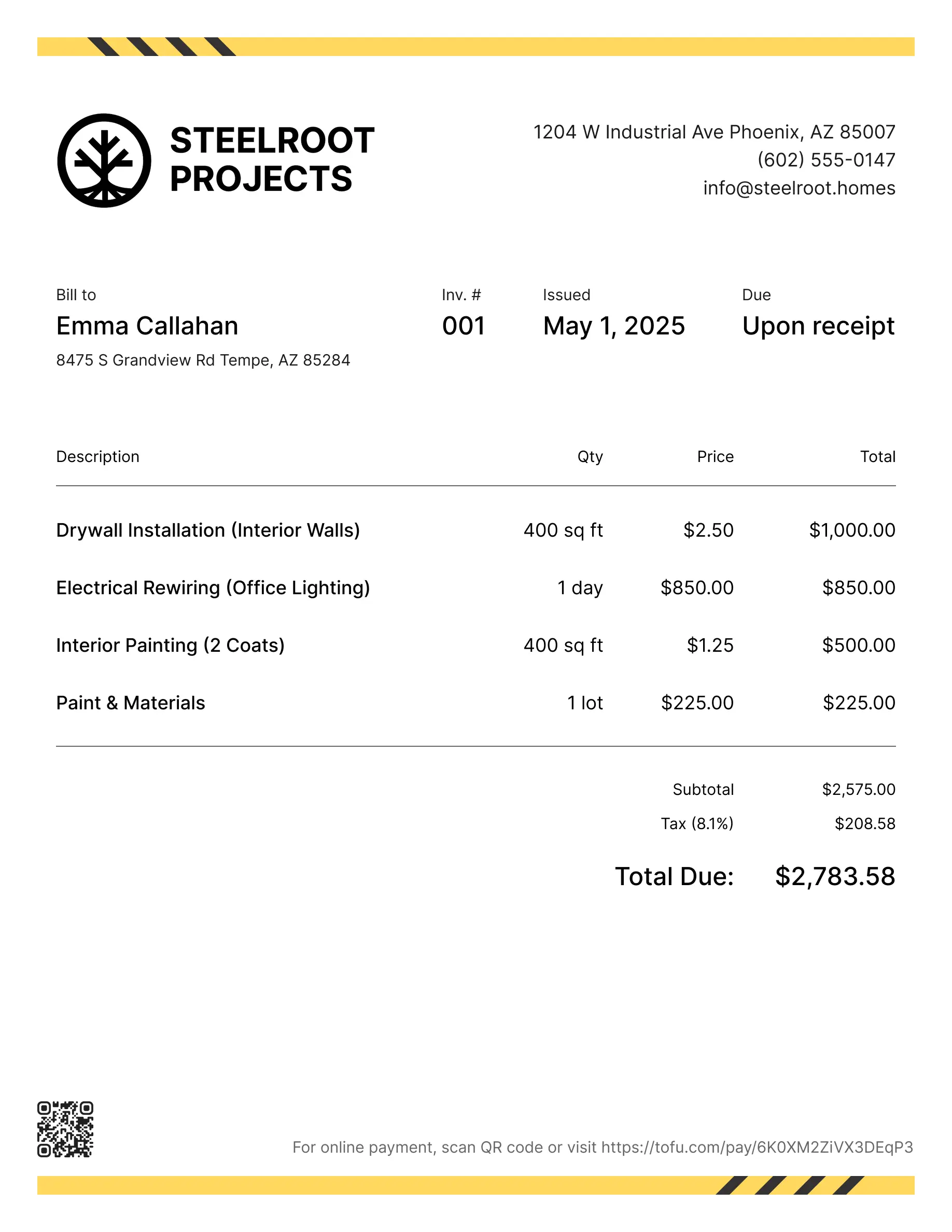
Estimate jobs for removals, trimming, stump grinding, or any tree work that starts with a quote. Tofu's ready-to-use tree service estimate templates make it simple. Choose your format, add your branding, and download.
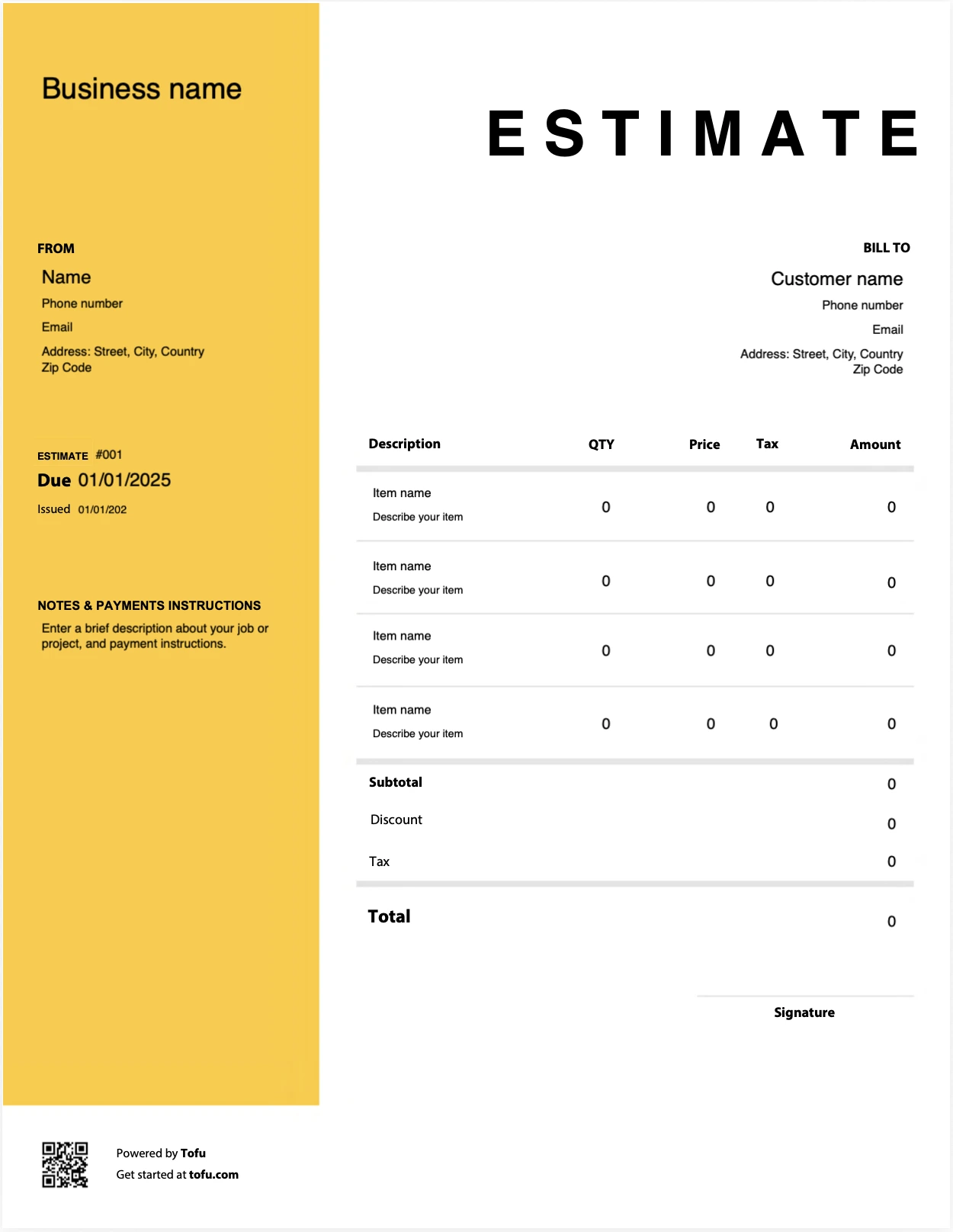
Estimate templates designed for tree service pros
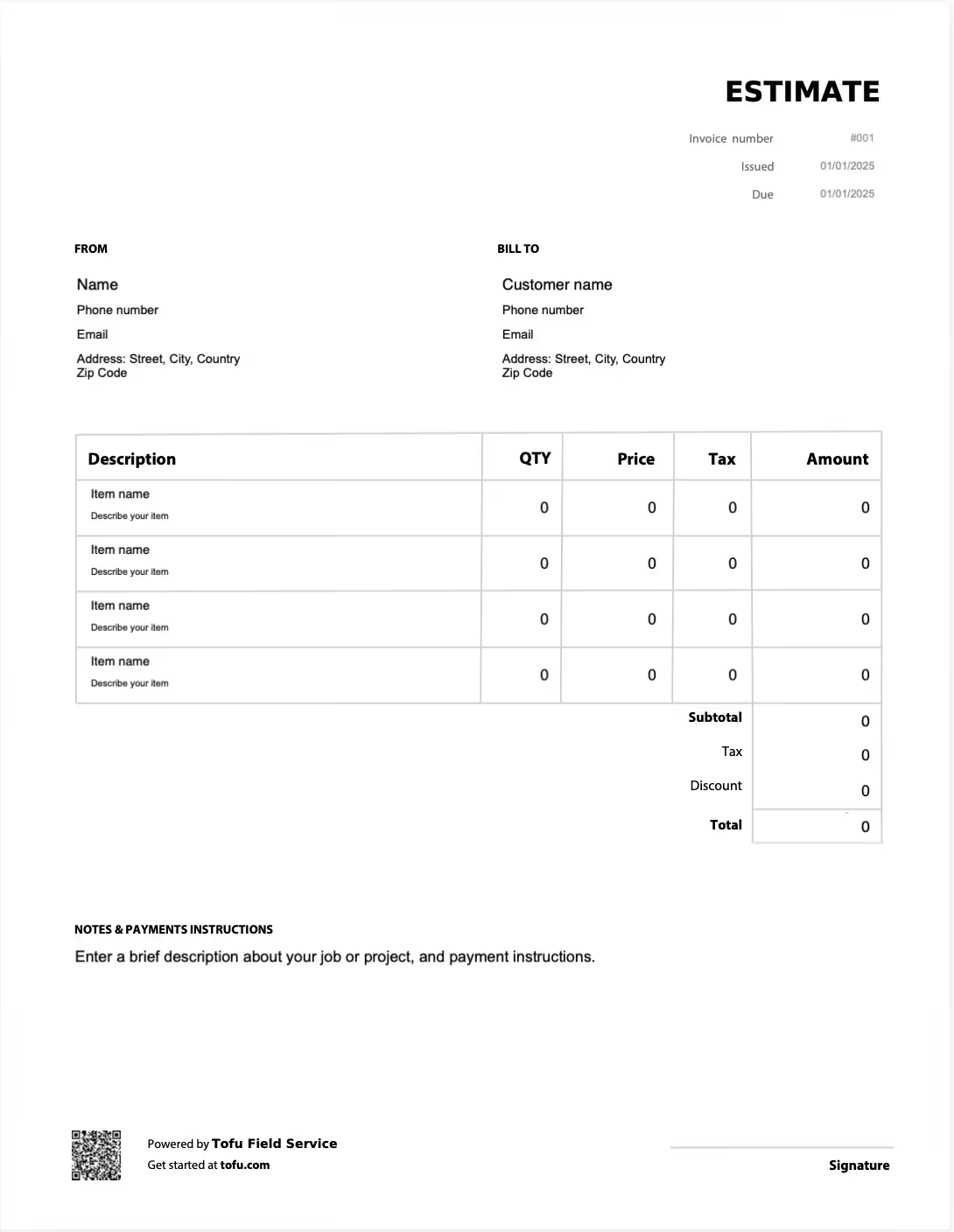
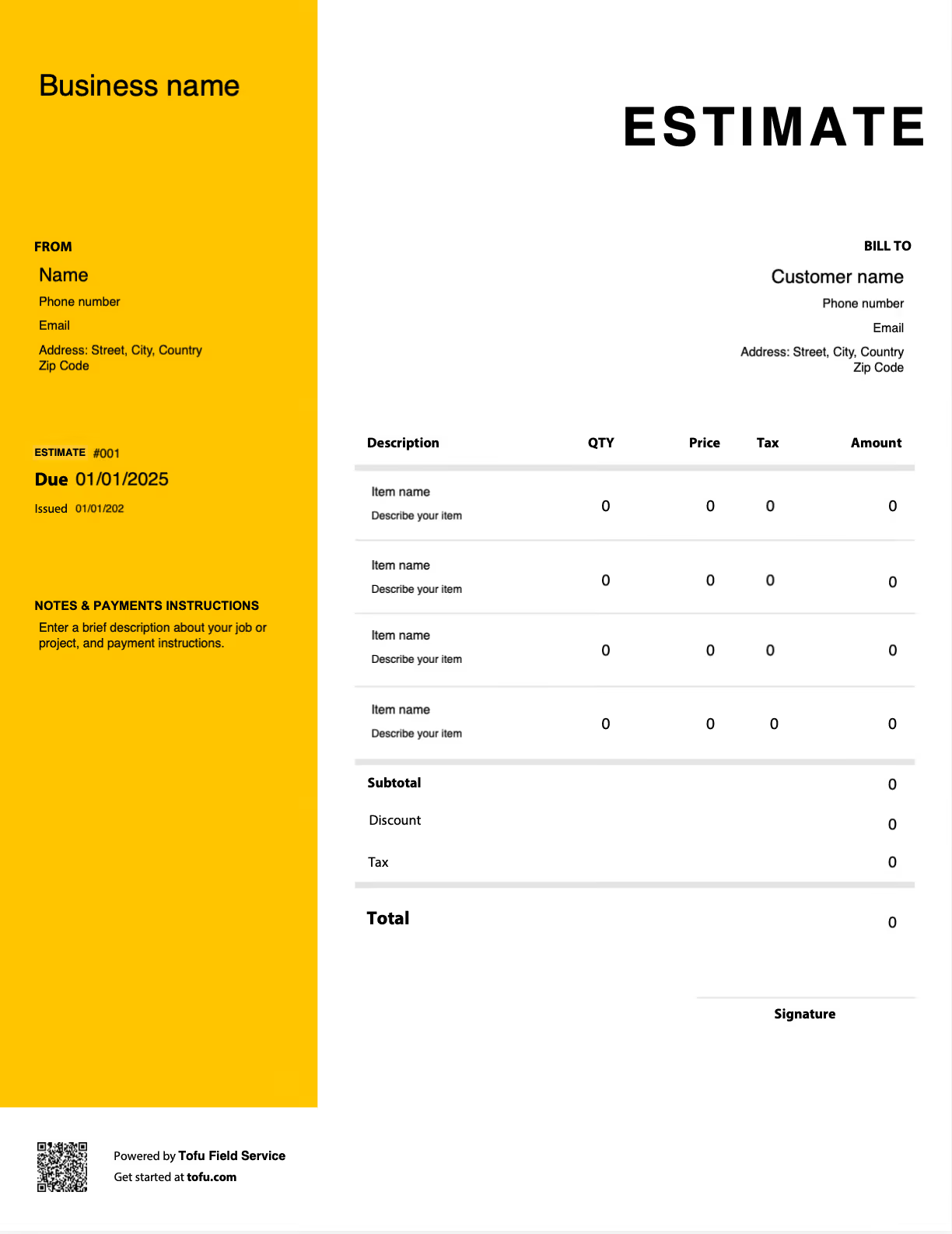
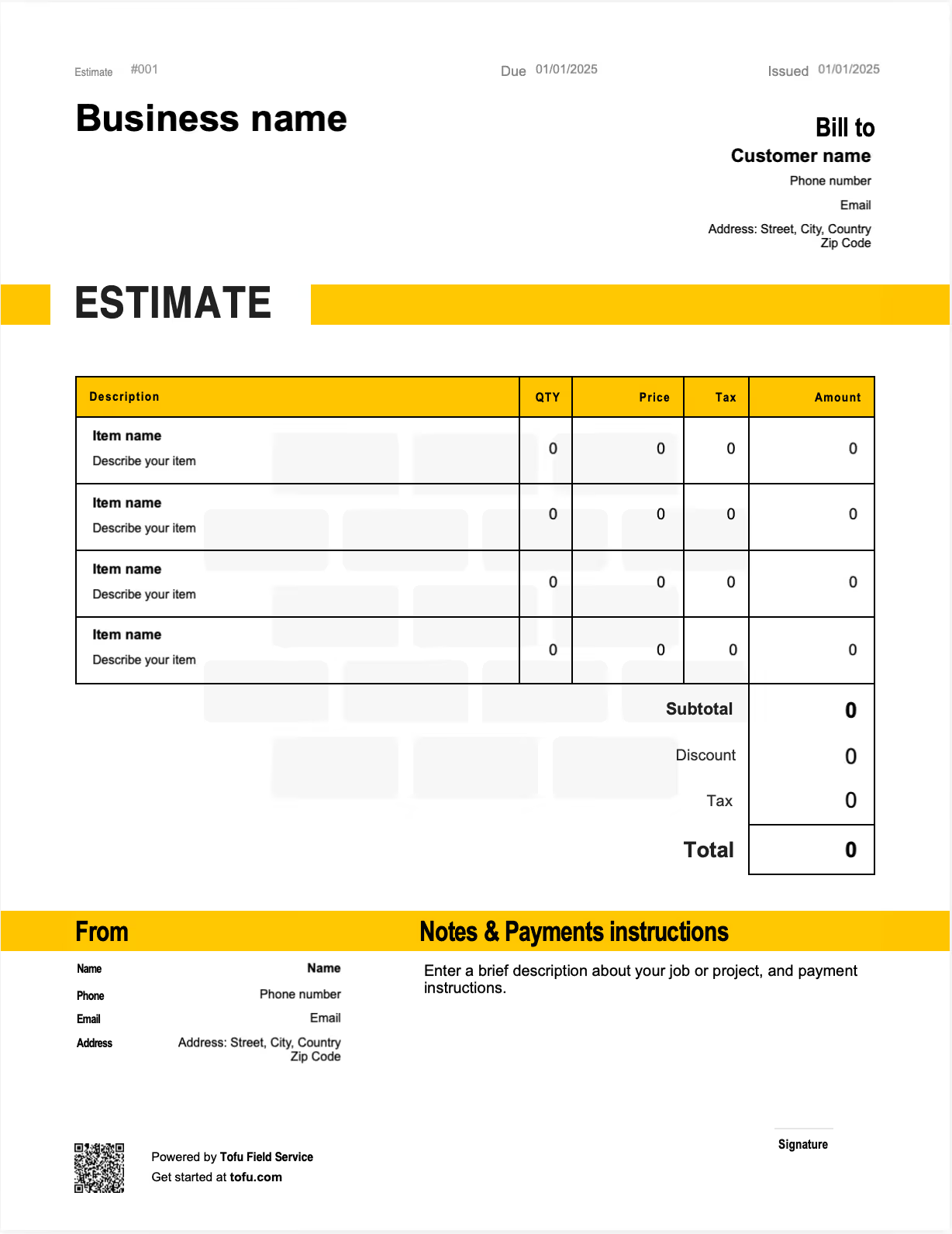
Quoting tree work is rarely simple. The price swings with size, height, access, and hazard, the job often needs a crane or a climbing-only approach, and the client is almost always holding two or three other bids while they decide. A tree service estimate template brings structure to all of it. It gives you a professional, repeatable document that lays out the tree, scope, equipment, disposal, and payment terms clearly, so you look established and the client knows exactly what they're paying for. In this guide you'll learn what to include, how tree work is priced, how to customize the template for removals versus trimming, and how a polished estimate helps you win more jobs and get paid faster.
What to include in a tree service estimate template
A complete tree service estimate has to be clear enough for the client to compare confidently and detailed enough to protect you once the job is underway. Every field below adds clarity or prevents a dispute. A strong estimate should capture:
- Contractor info and logo — identifies your business and looks professional: company name, logo, ISA certification, license, phone number
- Client information — ties the estimate to the right job: client name and property address
- Estimate number and date — tracks the document and sets a timeline
- Scope of work — defines exactly what the job covers, such as "remove one 60-foot oak, grind stump, haul all debris"
- Tree details — species, approximate DBH, and height for each tree, the basis for the pricing math
- Service line items — removal, trimming, and stump grinding, each priced separately
- Equipment line items — crane, bucket or aerial lift, chipper, listed apart from labor
- Disposal and haul-away — its own line, not folded into labor
- Total cost with tax — the client-facing figure
- Deposit and payment terms — deposit on signing for large jobs, balance on completion
- Permit note — where municipal permits apply, such as protected, heritage, or setback-zone trees
- Expiration date — protects against scheduling and price changes, such as "valid for 30 days from issue date"
Splitting the tree, equipment, and disposal into separate lines is the field that does the most work. When the client sees the crane and the haul-away priced apart from the cutting, the number stops feeling arbitrary and starts showing exactly what drives the cost.
Tree-service-specific fields that generic templates miss
A generic contractor estimate won't have a place for what actually drives a tree job's cost. These fields protect you from scope creep and give the client a clear picture:
- DBH and height per tree, since size is the single biggest price driver
- Access and hazard notes, such as open yard versus over a structure, near power lines, or dead and leaning, which can double the price
- Stump grinding depth, and whether it's included or excluded
- Crane or climbing-only designation, since the equipment changes the whole job
- Permit handling noted in the scope where the municipality requires it
Capturing these upfront is what separates a professional tree estimate from a number scribbled on a business card.
Your next tree service estimate is 60 seconds away
Open Tofu, add the job details, send it for approval. Your customer sees a clean, itemized estimate before any work begins.
Rated Excellent on Trustpilot

Absolutely amazing! It’s saves so much time and it gives you the professional touch needed to make you look good!
★ ★ ★ ★ ★
Tony W.It had made doing business much easier!
★ ★ ★ ★ ★
Michael S.
It works good in the field
★ ★ ★ ★ ★
David S.Awesome app, very easy and simple to use, while also keeping things looking professional. Can send and save invoices/quotes directly or save to sen after. Overall great app, no faults. 10/10
★ ★ ★ ★ ★
Raymond B.Easy to use and straightforward! Been using it for over a year now!
★ ★ ★ ★ ★
Manuela M.I was using it mostly for invoicing and a little for job management, the whole experience was really smooth and easy
★ ★ ★ ★ ★
Valeria N.How tree service estimates are priced
No two trees are alike, so no two estimates are either. These are the factors that drive the price up or down, and the two ways most pros structure their rates. (Ranges vary widely by region and job, so treat any figures as general context, not a fixed quote.)
- Size: DBH and height — the single biggest driver. A bigger tree means more crew, more time, heavier equipment, and far more debris to process and haul.
- Species — dense hardwoods like oak, elm, and pecan take longer to cut and process than lighter softwoods.
- Access — a tree in an open yard with truck access can often be felled, the cheapest method. Trees over a house, in a fenced yard, in a tight urban lot, or near power lines cost significantly more.
- Hazard — dead, diseased, or storm-damaged trees are more dangerous to climb and rig, so they carry a higher margin. Ironically, a dead tree can cost more to remove than a healthy one.
- Add-ons — crane assistance, stump grinding, disposal, and emergency or storm-response premiums each get their own line.
Most pros use one of two pricing models. Per-tree pricing assigns ranges by size bracket (small, medium, large), which is quick for quoting. Unit-based pricing charges per foot of height or per inch of DBH, which scales cleanly to any tree. Whichever you use, the most reliable estimates are written and made after an on-site visit, never quoted sight-unseen.
How to create a tree service estimate using a template
Working from a template means you build the estimate the same reliable way every time. Build it in this order:
- Assess the tree on site — note species, DBH, height, condition, and access
- Scope the job as a removal, trim, or stump grind before pricing anything
- List service and equipment line items separately using current rates
- Add disposal and any permit costs as their own lines
- Apply markup consistently and set the deposit and payment terms
- Assign an estimate number and review the document for completeness
- Send it to the client as a clean, professional document and keep a copy
💡 Pro tip: Never quote a removal sight-unseen. Walk the job before signing, ideally with the ground crew and not just the estimator, since the person doing the rigging is the one who spots the complications. Add a "valid for 30 days" line so a delayed start doesn't lock you into an old price.
Choosing the right format: PDF, Excel, or Word
The right format depends on how you work and who's receiving the estimate:
- PDF — best for sending a polished, non-editable estimate to clients. The layout stays fixed and nothing gets changed between you and the signature.
- Microsoft Excel or Google Sheets — best for contractors who want automatic totals and reusable line item rows. The spreadsheet handles the math on multi-tree jobs and is easy to reuse.
- Microsoft Word or Google Docs — best for those who prefer a simple, editable text document they can customize quickly.
Field crews often lean on mobile-friendly tools to quote on-site, while office-based teams tend to prefer spreadsheets. Many build in Excel or Sheets and export to PDF to send.
Removal estimates vs trimming and maintenance estimates
How you scope the job changes how the estimate is built.
Removal estimates
- Cover the full job: rigging, equipment, disposal, and stump grinding
- Often include an on-site hazard assessment, since access and condition drive the price
- Carry more line items and, for large trees, a deposit requirement
Trimming and maintenance estimates
- Cover a tighter scope: pruning, crown thinning, or deadwood removal
- Turn around faster and are often priced by tree count or crew hours
- Use a shorter line-item list overall
The key on either type is handling the unknowns in writing. A contingency line such as "if hidden rot or additional hazard is found, billed at $X" sets expectations before the climb and prevents a mid-job dispute. For commercial work, utility right-of-way clearance, or anything requiring a formal hazard report, the estimate often travels alongside a fuller proposal.
Benefits of using tree service estimate templates
A consistent template beats writing each bid from scratch:
- Saves time, so you can send professional estimates while the lead is still warm
- Nothing gets missed on any estimate, since the structure prompts every field
- A consistent, professional appearance that builds client trust and improves the customer experience
- Fewer disputes, because scope, equipment, and disposal are documented before work begins
- Faster client decisions, since a clear, itemized estimate is easy to compare and approve
- More bids won and steadier cash flow, from looking like the most organized contractor on the list
As volume climbs, many tree service companies graduate from templates to field service software that runs estimates, invoices, and client follow-up in one dashboard, often with a mobile app for the field. The habits you build with a template carry straight over when you grow.
Common tree service estimate mistakes to avoid
Most disputes and lost margin trace back to a few avoidable errors:
- Quoting sight-unseen → Always do an on-site assessment; access and hazard are impossible to judge over the phone
- Folding disposal and equipment into labor → List them as their own lines, they're real cost that's easy to absorb by accident
- Using vague scope language → Write specific scope so a trim doesn't quietly become a dispute over a full removal
- Omitting DBH, height, and access notes → Record them, they're what justify the price
- Leaving off an expiration date → Add a validity window so a delayed start doesn't lock in an old quote
- Skipping the deposit on large jobs → State your deposit policy up front, especially on crane work or removals over your threshold
Estimates are just the start
Every client, job, estimate, and payment lives in Tofu, ready to pull up in seconds, right from the job site.
FAQs
Everything you need to know about the product and billing

Still have questions?



Create the perfect estimate for your business
Get started for free