Landscaping marketing ideas: 30+ tactics that work in 2026
How to market a small landscaping business in 2026 – real numbers, 30+ tactics, and a clear starting point.



TL;DR: how to market a landscaping business in 2026. The highest-ROI marketing for a small landscaping crew is local and mostly free to start: claim and fully optimize your Google Business Profile, ask every customer for a Google review, and build a tight service route with yard signs and "5-arounds" door hangers (a hanger on the five houses nearest each finished job). Once that foundation is in place, add Local Services Ads and Google Search Ads (expect a cost per lead around $104 for landscaping, dropping to $40 to $50 in the spring peak), email and SMS to past customers, and a maintenance plan to lock in recurring revenue. Most landscapers should spend 8 to 12% of revenue on marketing for growth. Pick three to five channels, run them for 90 days, and track which ones actually drive calls. Let’s dive into the details.
This guide breaks down 30+ tactics with real 2026 numbers: cost per lead, close rates, what is working right now. Use the budget calculator to plan, the FAQ to answer the questions you will have, and the "where to start" section at the end to pick your next move.
The landscaping market in 2026 (what actually changed)
The U.S. lawn care and landscaping market is worth roughly $63 billion and growing, and you are competing against more than 600,000 other businesses, most of them small crews just like yours. The ones that win are not spending more on marketing. They are doing a handful of things consistently, on the right channels, at the right time of year.
Before you spend a dollar, here is what is different this year.
- It is a fragmented, local fight. There are roughly 600,000 to 726,000 landscaping businesses in the U.S., mostly small two to three person operations, and no single company controls more than about 5% of the market. Your real competition is other local crews, which means trust and visibility win, not budget.
- Recurring revenue now runs the industry. Subscription and contract work made up about 66% of the U.S. lawn care market in 2025. The lesson for your marketing: sell the plan, not the one-time visit.
- The money is in the add-ons. Lighting, hardscaping, firepits, drainage, and outdoor living are growing faster than basic maintenance. Your marketing should surface the high-margin work, not just mowing.
- AI search changed how people find you. Google now shows AI-generated summaries above the regular results. If your site clearly answers homeowner questions, AI tools pull from you. If it does not, they pull from your competitors.
- Google Ads costs climbed, and they swing with the season. Average cost per lead for landscaping sits around $85, but lawn care leads drop to $40 to $50 in late April and early May when demand peaks, then settle into the mid $80s. Year-round services cost more per lead than seasonal ones. (More on this in the paid section below.)
Start here if you have nothing set up
If your marketing is basically zero right now, focus on four things. Everything else can wait.
- Claim and fully complete your Google Business Profile. Free, and the highest-ROI action you can take. Fill every field, upload at least ten real photos, post weekly, and respond to every review within 24 hours.
- Get your truck or trailer wrapped. A quality wrap is a few thousand dollars, lasts years, and turns every drive and every job site into a moving billboard in the exact neighborhoods you serve.
- Put up a basic website. Even a one-page site with your services, service area, phone number, and a few reviews is enough to start. It has to load fast on phones and have a click-to-call button at the top.
- Ask for a review after every job. Text or email the customer the same day with a one-tap link to your Google review page.
The order of operations matters. Before spending on ads, set up your Google Business Profile, a Facebook page, and three directory listings (Angi, Nextdoor, Yelp). If someone Googles your name and finds nothing, they call the next crew on the list.
Google Business Profile: your most important free tool
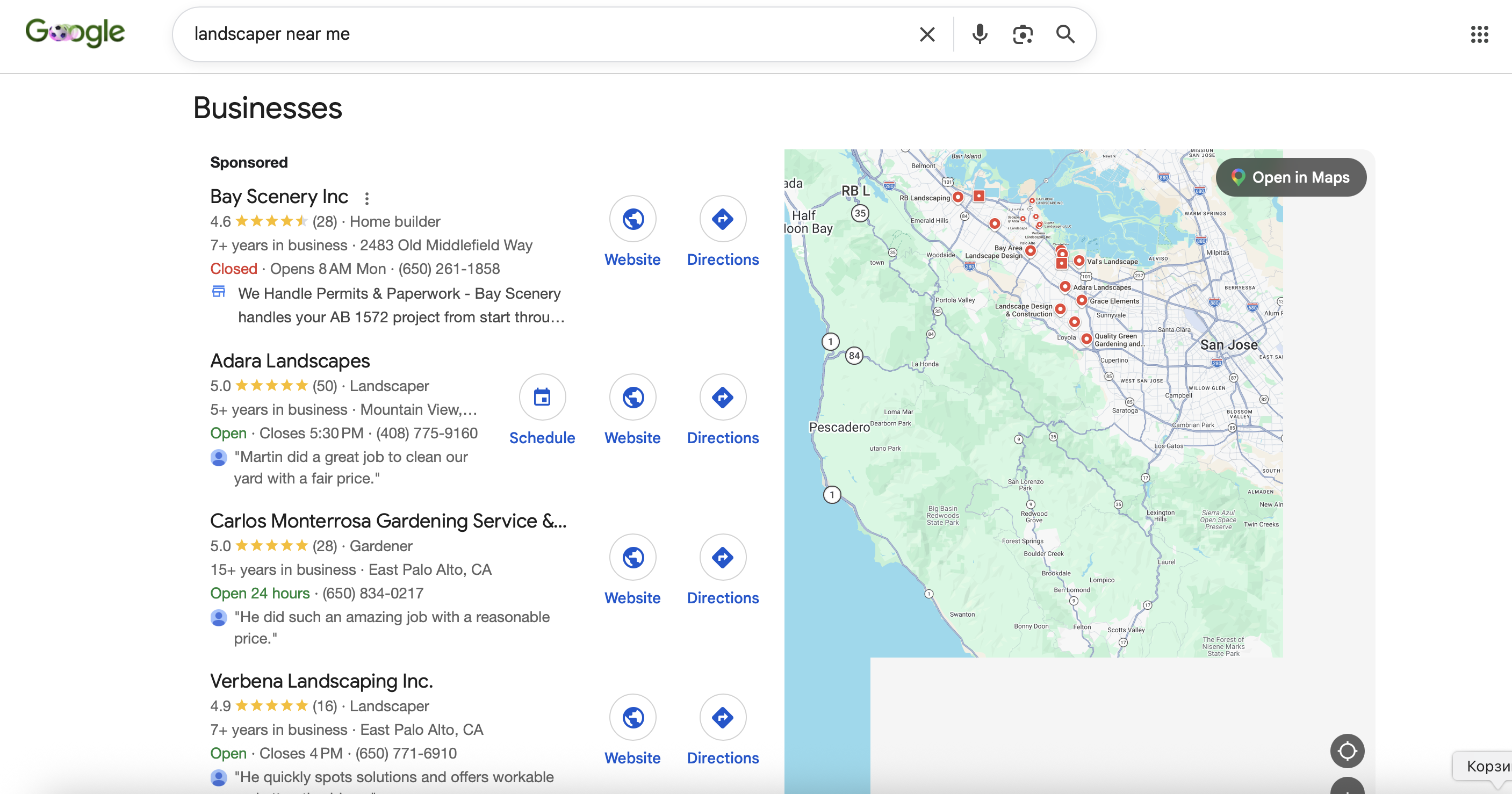
When someone searches "landscaper near me" or "lawn care [your city]," the businesses in the local map pack are Google Business Profiles. It is the most visible real estate in local search, and it costs nothing.
What a fully optimized profile looks like:
- Every field complete: name, address, phone, hours, website, service areas.
- A detailed service list: "lawn mowing," "mulch installation," "paver patios," "retaining walls," "irrigation," "landscape design," not just "landscaping."
- Ten or more real photos: your crew, your equipment, completed jobs, your branded truck. Before-and-after shots are the highest-performing post type.
- Weekly posts: seasonal offers, finished projects, quick tips.
- Every review answered within 24 hours, good and bad.
- Messaging enabled.
Tip. Weekly posts are a strong signal to Google that your business is active, and they keep your profile looking fresh to anyone who lands on it. A single weekly before-and-after photo does more than most paid posts.
Local SEO: show up when someone searches "landscaper near me"
SEO stands for search engine optimization. In plain English, it is what makes your website show up when someone Googles "lawn care near me" or "landscapers in [city]." You are not paying for that click. You are earning it by having a site Google trusts enough to recommend.
It is slow to build (six to twelve months) but it compounds. Once it works, it keeps bringing leads long after you stop actively working on it. Focus on three things:
- Create location and service pages. One page per service ("paver patios in [city]," "lawn care in [city]," "irrigation in [city]"), 300 to 500 words each, with your phone number, a map, and local reviews. Link them from your homepage.
- Answer the questions homeowners actually ask. Blog posts like "how much does landscaping cost in [city]," "sod vs seed," and "when should I aerate my lawn" rank for years and pull in steady traffic. Aim for one to two posts a month.
- Make the site fast on phones. Under three seconds to load, click-to-call at the top, simple navigation.
Google Ads and Local Services Ads: when you need leads now
Local Services Ads (LSA)
These show up at the very top of Google with a "Google Guaranteed" badge, and you only pay when someone actually contacts you. For most crews on a tight budget, this is the best starting point because of the pay-per-lead model.
Google Search Ads
Standard text ads. You pay per click whether the person calls or not. Here are the real 2026 numbers landscapers see:
- Average cost per lead for landscaping: about $85, with average cost per click around $2.55.
- Close rate on those leads typically runs 30% to 50%, which puts customer acquisition cost somewhere between $170 and $280.
- Landscape design leads run cheaper per lead, roughly $35 to $85.
- Seasonality is huge: lawn care cost per lead drops to $40 to $50 in late April and early May, then settles into the mid $80s. Year-round services cost more per lead than seasonal ones.
One tactic that pays off: separate your campaigns by service type, but run them on a shared account budget so Google can chase demand when one service is hotter than another.
Tip. Start at $500 to $1,000 a month and send traffic to a dedicated landing page, not your homepage. Track calls and form fills, not clicks. In many local markets that budget yields 10 to 30 qualified leads a month.
Route density: the marketing tactic only trades like this have
Here is something an HVAC company never has to think about, but it sits at the center of your profit: the geography of your customers is your margin. Every mile between jobs is fuel, drive time, and a crew that is driving instead of mowing. So the goal of your local marketing is not just more leads, it is more leads clustered on the streets you already serve.
Route optimization alone cuts fuel and time costs by about 15% to 20%. That is before you sell a single new job. So the smart play is to market tight:
- The "5-arounds" door hanger. Every time you finish a job, leave a door hanger on the five nearest houses: "We just transformed your neighbor's yard at [address]. Here is $X off if you book this month." Those homes have the same lot size, the same problems, and they can see your work from the curb. This is the single cheapest way to grow a route.
- Yard signs at every install. A neighbor watching a backyard get rebuilt is a warmer prospect than any ad will ever produce. Put a sign up at every job, with the homeowner's permission.
- Targeted direct mail, not blanket mail. Pick the specific streets where you already have density or have closed before, and mail only there. Most landscapers gave up on direct mail, which is exactly why a well-designed postcard to the right block stands out.
From mowing to money: turning low-margin jobs into high-margin ones
Not all landscaping work pays the same, and your marketing should be built to win the profitable work, not just any work. Here is the rough margin spread by service:
| Service | Typical gross margin | Ticket size |
|---|---|---|
| Lawn maintenance / mowing | 55% to 65% | Low ($50 to $150/job) |
| Mulch & material installs | 45% to 55% | Medium |
| Hardscaping (patios, walls) | 40% to 50% | Large |
| Design-build & irrigation | Premium pricing | Largest per project |
Margin ranges vary by source and region; treat these as typical bands, not exact figures.
The marketing takeaways:
- Use mowing as the front door, then upsell. The easiest sale is to a customer you already have. Selling a $350 aeration to an existing mowing client costs you almost nothing in acquisition, so it is nearly pure margin. Keep the prompts soft and helpful: "We noticed your mulch is looking thin. Want us to top it off while we mow next week?" Bundling maintenance with seasonal services can lift a client's lifetime value by around 30%.
- Point your paid ads at high-margin intent. Bid on "retaining wall installation [city]" and "paver patio [city]," not generic "landscaping tips." A design-build lead is worth many times a one-off mow. Use short lead forms with a service qualifier (mowing / design / hardscape / cleanup) so you can route and price by margin.
- Track profit by service line. Plenty of landscapers find mowing is quietly profitable while installs lose money on bad estimates. Pour your marketing budget into the service lines that actually net out, not the ones that just keep the crew busy.
Reviews: your highest-leverage free marketing
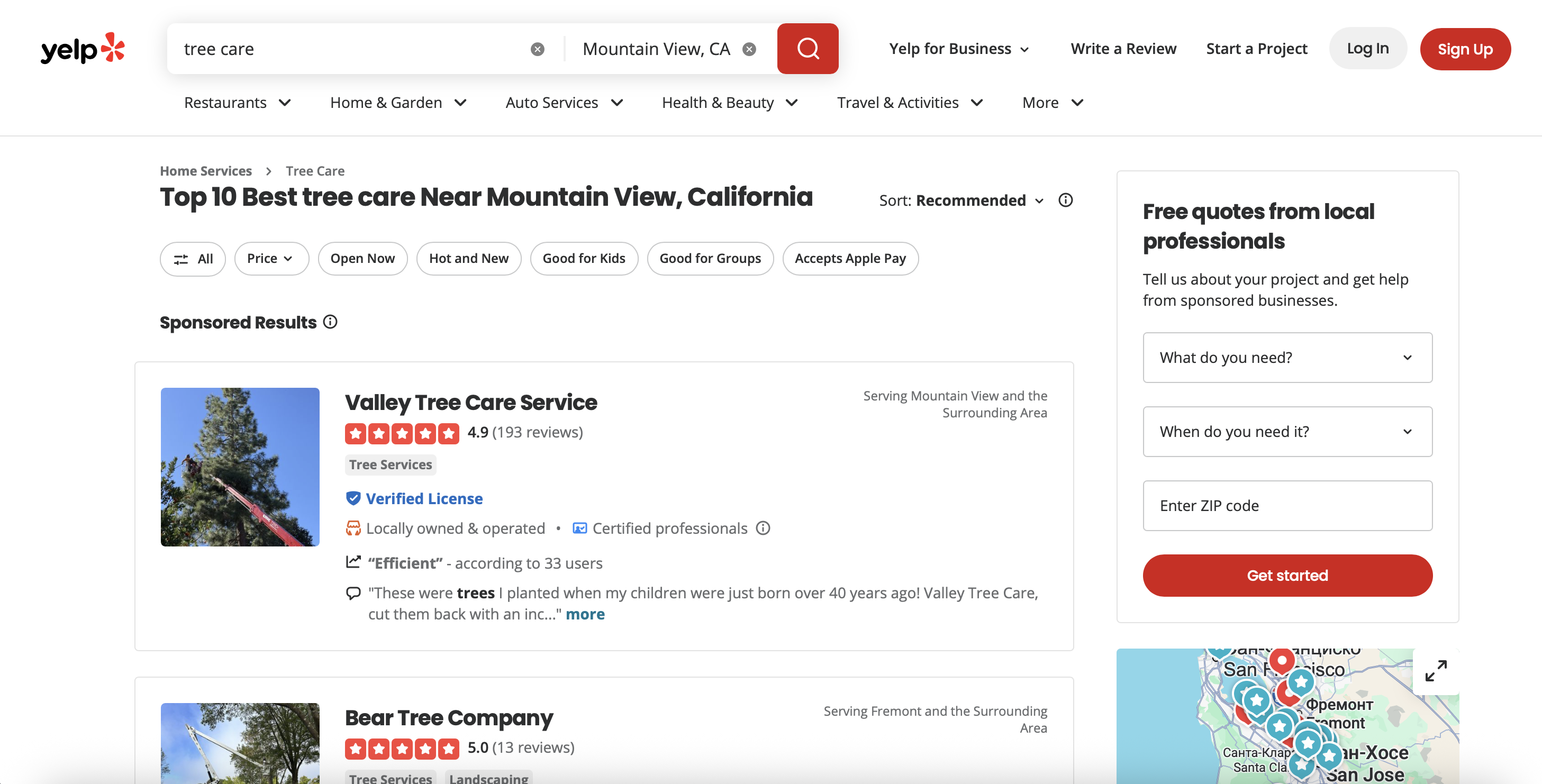
Your review count and rating directly affect whether you show up in local search and whether people call you. Build a system:
- Ask every customer at the end of every job, in person, while the conversation is warm.
- Follow up the same day with a text containing a one-tap link to your Google review page.
- Respond to every review within 24 hours.
- Never fake reviews or pay for them.
For negative reviews, do not get defensive. Acknowledge it, apologize if it is warranted, and offer to make it right offline. A well-handled bad review often builds more trust than a five-star one.
Speed to lead: the tactic most crews ignore
Most leads go to the first business that responds, and most landscapers take hours to reply to a web form. By then the homeowner has messaged two other crews. The fix is simple: every web form submission triggers an automated text and email within 60 seconds. "Hi [Name], thanks for reaching out. We have openings this week, tap here to book a time." No human needed for the first reply. If you are paying for ads but answering slowly, you are burning that budget.
Email and SMS: your cheapest repeat-revenue channel
You already own the most valuable list there is: every customer who has ever paid you. Segment it by who is due for service, who has not booked in 12+ months, plan holders, and residential versus commercial.
The timing is what makes it work. Send spring cleanup and aeration promos in February and March, not May, so you fill the schedule before the rush. A simple spring text blast to last year's customers ("Spring is here, reply YES to get back on the mowing schedule") refills a route fast. Six message types that work: seasonal reminders, service follow-ups, helpful tips, past-customer offers, referral asks, and review requests.
The Facebook Groups and Nextdoor play
In most metros there are 10 to 30 active local Facebook groups: neighborhood groups, HOA groups, "Moms of [City]" groups. Homeowners ask for landscaper recommendations in them daily. Post genuinely helpful content weekly, do not spam, and your name comes up when someone asks.
Nextdoor is worth claiming too. Members are verified by name and address, and recommendations there carry more weight than Google or Yelp. Around a third of Nextdoor posts are requests for local recommendations. Claim your business page and join the conversation.
Referral programs: warm leads at near-zero cost
Referred customers convert far higher than cold leads, cost less, and stay longer. Structures that work: account credit ("give $25, get $25"), gift cards to a local restaurant, a charitable donation in the customer's name, or a free add-on service.
The mistake most crews make is assuming customers know the program exists. Mention it at the end of every job, put it in your follow-up email, and print it on the invoice.
Insider tip: the referral card. Hand happy customers a physical branded card or coin they can pass to a neighbor. It is tangible, it stands out from digital noise, and the friend brings it in for a discount. Simple, memorable, and it gets passed along.
Before-and-after content and short-form video
Landscaping is the most visually transformational trade there is, which makes before-and-after your single best content format. Short-form video (Reels, TikTok, Shorts) gets several times the organic reach of static photos right now.
Five videos you can shoot on your phone today: full yard transformations, time-lapse installs, a day in the life of the crew, quick lawn-care tips, and common questions answered. You do not need fancy gear: a phone, decent light, and a $20 lapel mic. The dirty-to-clean contrast is what gets shared.
Houzz, Pinterest, and Instagram: the visual-portfolio channels
Because landscaping sells a visual outcome, platforms built around images and inspiration convert differently for you than they do for an emergency trade like HVAC. These are worth real effort, especially if you do design and hardscape work.
- Houzz skews toward homeowners with real renovation budgets, which makes it strong for high-end design and hardscaping leads. A claimed Pro profile with a keyword-tagged project portfolio works like a search engine for design work. Worth it for design-build, lower priority for pure mow-and-go.
- Pinterest is where homeowners plan outdoor projects months ahead. Pin your before-and-afters and project boards with location and service keywords. It is a top-of-funnel inspiration source that feeds design inquiries.
- Instagram is the portfolio prospects check before they call. Track the metrics that matter (profile visits, DMs, quote-request clicks), not follower count, and point every post toward a "Request a quote" page.
Reality check. For a solo mow-and-go crew, Facebook and your Google Business Profile still come first. Houzz and Pinterest earn their place once you are actively chasing design and hardscape work.
Social media: pick one platform and actually use it
- Facebook: best for local reach and community groups.
- Instagram: before-and-after photos and short video.
- YouTube: longer how-to content.
- LinkedIn: commercial and property-manager work only.
Content mix: about 40% job photos, 25% educational tips, 20% behind-the-scenes, 15% seasonal promos. Post at least three times a week. Consistency beats polish. A crew that posts a clean backyard makeover video can wake up to new inquiries the next morning. Treat paid social as an amplifier, not your main channel.
Recurring revenue: maintenance plans and seasonal contracts
This is the landscaping equivalent of an HVAC maintenance agreement, and it is arguably more important here, because about 66% of the market already runs on subscriptions. Established landscaping businesses routinely pull the majority of their revenue from recurring contracts with high renewal rates.
Structure it as a flat annual or monthly fee for scheduled mowing, seasonal cleanups, and fertilization rounds, and bundle snow removal or holiday lighting where your region allows. Why it matters: it smooths the 20% to 30% winter revenue drop, locks in repeat customers, and means plan holders call you first.
Service visits are also your prime upsell window, since you are already on the property and the customer trusts you. Common add-ons: edging, aeration, seeding, fertilizing, mulch top-offs, lighting, and irrigation tune-ups. A tool like Tofu Field Service lets you track service history per client and send invoices right from the job site, so nothing slips between the visit and the follow-up.
Don't let a good job turn into a forgotten invoice.
Tofu tracks your service history, sends estimates, and takes payment from the job site – before you drive away.
Strategic partnerships: free warm referrals
The fastest way to grow without ad spend is to get other people sending you customers. A referral from someone the homeowner already trusts closes faster and costs you nothing. Build relationships with:
- Realtors: curb appeal before a listing, and new owners who want the yard redone after moving in.
- Property managers: multi-unit, year-round recurring work. One good relationship is steady income.
- Home builders and general contractors: new construction almost always needs landscaping.
- Pool, fence, and deck installers: same customer, no service overlap. You refer them, they refer you.
- Arborists and tree services: hand off the work you do not do, and take the work they do not.
- Nurseries and garden centers: their customers are already buying plants and need someone to install them.
Pick three or four partners in your area and reach out directly. Offer to send them business first, before asking for anything back, then follow up every month or two so you stay top of mind.
Traditional marketing that still works for landscaping
Digital gets the attention, but offline still pulls its weight for a trade that works in visible neighborhoods. Most of these cost little and keep working long after you pay for them.
- Yard signs at every job site, with permission. The neighbor sees it while you are working.
- Truck and trailer wraps: tens of thousands of impressions a day for well under $100 a month over the wrap's life.
- Door hangers on the same block after a job (see the "5-arounds" tactic above).
- Direct mail postcards to targeted neighborhoods, especially for older homeowners who do not respond to digital.
- Local sponsorships: youth sports, school fundraisers, community beautification, tree-planting events.
Track results with a unique phone number or offer code on each piece so you know what is actually working.
How much should your landscaping business spend on marketing?
Every article says "spend 8 to 12% of revenue." Nobody shows what that looks like in dollars, broken down by channel, with estimated leads. Use our landscaping marketing costs calculator to identify what spend would bring you the right amount of leads.
Agency vs DIY: when to hire help
Do it yourself if you are under about $500k in revenue or just starting out. Handle your Google Business Profile, social media, email, and review requests yourself.
Hire an agency for the technical work (SEO, PPC) once you have budget, typically $1,500 to $5,000 a month. Questions to ask: Do you work with my competitors? Can I see landscaping client results? What do the first 90 days look like? How do you report? What happens to my accounts if I leave?
Red flags: guaranteed top rankings, long lock-in contracts, and an inability to explain what they are doing in plain language. Always own your own accounts.
Using software to keep it all running
The biggest gap most small landscaping businesses have is not marketing ideas. It is follow-up. A customer hires you, you do the job, and nobody reaches out again for 18 months. That is money left on the table, and it costs roughly five times more to win a new customer than to keep an existing one.
A simple system that tracks customer history, automates follow-up reminders, handles invoicing, and sends review requests will do more for your bottom line than any single ad campaign. Tofu is built for exactly this kind of field work, from scheduling jobs by area to invoicing from the truck.
Where to start based on where you are
Starting from zero. Google Business Profile, reviews, and a truck wrap. Do these three well before anything else.
Have the basics but want more leads. Add email and SMS to your past customers, a referral program, local Facebook groups, the "5-arounds" door-hanger habit, and one social platform you will actually keep up.
Ready to invest in growth. Local SEO (service and location pages), Google LSA or Search Ads pointed at high-margin work, maintenance plans, and speed-to-lead automation. If you do design-build, add Houzz and Pinterest.
The lead came in. Don't lose it to paperwork.
Schedule, invoice, and get paid from your phone.
Bottom line
You do not need all 30+ tactics. Pick three to five that match where your business is right now, run them for 90 days, and track what actually drives calls.
The crews that win this market are not the ones with the biggest budgets. They are the ones doing the basics consistently: showing up on Google, answering fast, doing great work, building a tight route, and asking for the review. Then doing it again next week. That is the whole playbook.