How to start a lawn care business: 7-step guide for 2026
Start a lawn care business in under a month for as little as $300 – here's the 7-step playbook, from licenses and equipment to your first paying customers.



TL;DR: You can start a lawn care business in 3 to 4 weeks for as little as $300 to $1,360 in equipment. The seven steps: write a simple business plan, register your business and get the right licenses, get insured, buy your starter equipment, choose your services and set pricing, land your first customers, then run and grow with the right tools. Most states do not require a special license to mow, trim, and edge, but applying fertilizer or weed control does. Solo operators commonly earn $5,000 to $10,000 per month at margins of 18 to 35%.
Starting a lawn care business is one of the lowest-barrier ways to build a real income with your own two hands. The startup costs are small, the demand is steady, and you can be cutting your first lawn within a month. This guide walks you through all seven steps, from the paperwork to your first paying customer to running the whole operation like a pro.
Is starting a lawn care business right for you?
Before you buy a mower, be honest about the fit. A lawn care business rewards people who like working outdoors, enjoy steady physical work, and take pride in a clean, finished yard. It is not a desk job, and the income follows the seasons.
The landscaping services market continues to grow steadily, driven by homeowner demand and outdoor-living upgrades. The U.S. landscaping services market was worth roughly $116 billion in 2022 and is projected to grow at about 7.3% per year through 2030, according to Grand View Research. That tailwind is real, but it does not erase the day-to-day realities of the trade.

Pros:
- Low barrier to entry. You can start with used equipment and a personal vehicle.
- Freedom of working outdoors and setting your own schedule.
- Recurring revenue. Lawn maintenance is needed every week, so one good customer can mean months of income.
- Clear path to scale, from solo operator to a small crew.
Cons:
- Seasonal income. Most regions have only 7 to 9 active months, so you need an off-season plan such as snow removal or leaf cleanup.
- Physically demanding work in heat, sun, and dust.
- Weather can wipe out a workday with no notice.
- Early mornings and route logistics take discipline.
If the pros sound like freedom and the cons sound like a fair trade, you are a good fit. The U.S. Census Bureau and the SBA both treat lawn and landscaping services as a stable small-business category with consistent household demand.
Your lawn care business starts here.
Tofu helps solo operators schedule jobs, send estimates, and get paid from the field — no office needed.
How much does it cost to start a lawn care business?
You can start a lawn care business for $755 to $1,360 in basic equipment, or as little as $300 with used gear and a vehicle you already own. That low floor is exactly why the trade attracts so many first-time business owners.
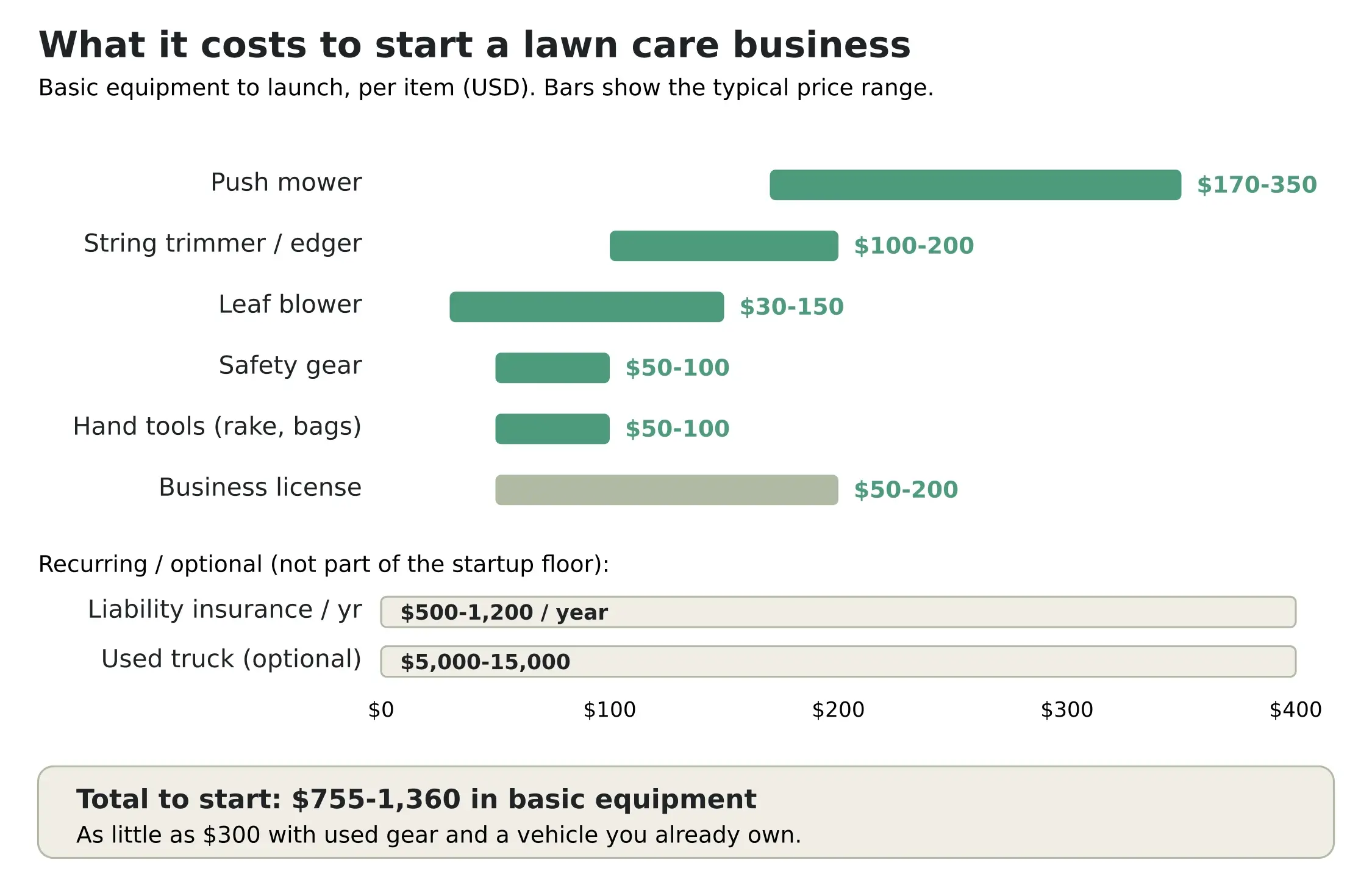
Here is a realistic startup-cost breakdown:
| Item | Cost range |
|---|---|
| Push mower | $170 to $350 |
| String trimmer / edger | $100 to $200 |
| Leaf blower | $30 to $150 |
| Safety gear (gloves, glasses, ear protection) | $50 to $100 |
| Hand tools (rake, shears, bags) | $50 to $100 |
| Business license | $50 to $200 |
| General liability insurance | $500 to $1,200 / year |
| Optional truck / transport | Used $5,000 to $15,000 |
The SBA offers a free startup-cost calculator that helps you map these expenses against your first few months of expected revenue, so you know how fast the gear pays for itself.
How to start a lawn care business with no money
No cash for new equipment? You can still launch on a shoestring with a focused "$300 start" plan:
- Buy used. A solid second-hand push mower, trimmer, and blower on Facebook Marketplace or Craigslist often run a third of retail.
- Borrow or rent. Home Depot rents equipment by the hour or day, which covers you for your first jobs before you own anything.
- Use what you have. Your own car or a friend's truck handles transport at the start.
- Reinvest first-job revenue. Take the cash from your first three or four lawns and put it straight into better gear. Most operators upgrade within weeks once the work starts flowing.
The point is simple: customers pay you to cut grass, not to admire your equipment. Start small, get paid, then reinvest.
How profitable is a lawn care business?
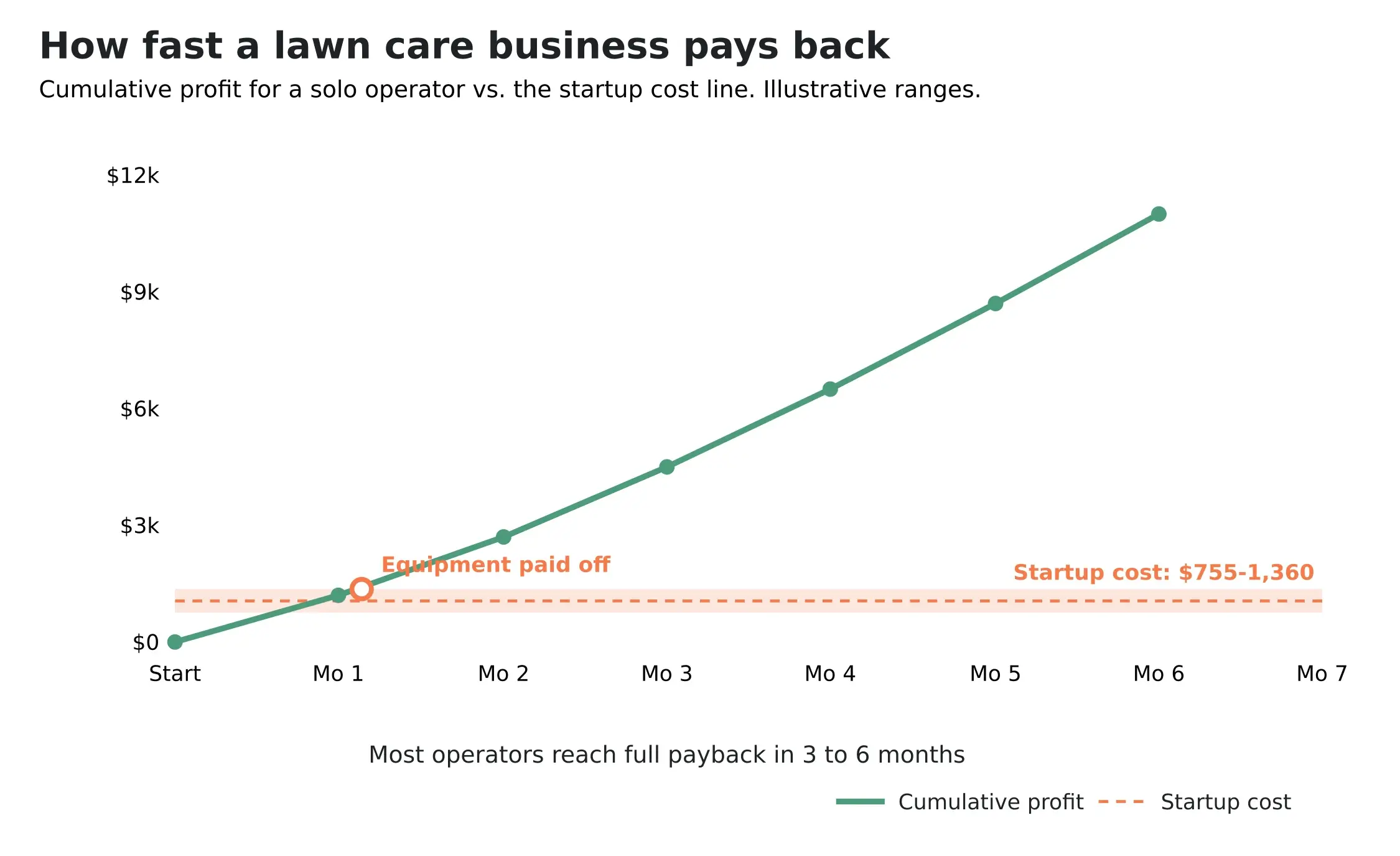
A solo operator who keeps a tight route commonly earns $5,000 to $10,000 per month during the active season. Small teams and established businesses scale well beyond that. Profit margins typically land between 18 and 35%, and because startup costs are low, many operators reach payback within 3 to 6 months.
What actually drives profitability:
- Correct pricing. Underpricing is the number-one killer of margin.
- Route density. Servicing ten lawns on one street beats ten lawns across town.
- Retention. Recurring customers cost nothing to re-acquire.
- Upselling. Fertilization, aeration, and seasonal cleanup add high-margin revenue to existing accounts.
Step 1 - Write a simple lawn care business plan
You do not need a 30-page document. You need a lightweight, practical lawn care business plan that forces you to answer four questions before you spend a dollar.
Pick a niche. Residential lawns are the easiest entry point: smaller jobs, faster payment, and a deep customer base. Commercial accounts (offices, HOAs, retail) pay more per contract but demand insurance, reliability, and often a bid process. Start residential, add commercial later.
Define your target market. Estimate the serviceable homes in your area, then pick a realistic starting segment, such as one or two neighborhoods you can service efficiently. Market segmentation keeps your route tight and your fuel costs down.
Research competitors and pricing. Call three local lawn care businesses for quotes on a standard yard. That tells you the going rate and where you can position yourself.
Sketch basic financial projections. How many lawns per week to cover costs? What is your target monthly income? A single page is plenty. The SBA publishes free business-plan templates if you want a starting frame.
Step 2 - Register your business and get the right licenses
Getting legal is faster and cheaper than most people expect.
Choose a structure. Start as a sole proprietorship for simplicity and minimal paperwork. Once revenue grows and liability matters more, form an LLC to separate your personal assets from the business. (If you are weighing the options, Tofu Field Service's guide to business structure types breaks down the trade-offs.)
Register a DBA ("doing business as") if you want to operate under a brand name rather than your own.
Get an EIN. An Employer Identification Number is free directly from the IRS and lets you open a business bank account and hire later. Beware of third-party sites that charge for this; the EIN application is always free.
Get your general business license. This typically costs $50 to $200 from your city or county.
Here is the part that confuses most new owners: most states do not require a special license or permit for basic mowing, trimming, and edging. However, applying pesticides, herbicides, or fertilizer requires a separate license from your state Department of Agriculture. Some states also set a contractor-license threshold for larger landscaping work; in California, for example, work over $500 may require a contractor's license. Check your state's rules before you offer chemical treatments, and you will start your own lawn care business fully legally.
Step 3 - Get insured
Insurance is what separates a hobby from a business. One thrown rock through a customer's window can cost more than a season's profit if you are uninsured.
- General liability insurance covers property damage and injury, such as a mower flinging a rock through a window or a client tripping over your equipment. Expect $500 to $1,200 per year.
- Commercial vehicle insurance covers your truck or trailer if you use one for the business. Personal auto policies usually exclude commercial use.
- Workers' compensation becomes necessary the moment you hire your first employee, and is legally required in most states.
- Tools and equipment coverage replaces stolen or damaged gear, which is common when equipment lives in an open truck bed.
Treat insurance as the cost of sleeping well at night, not an optional extra.
Step 4 - Buy the lawn care equipment you need to start
Buy in tiers. Get only what you need to service your first lawns, then upgrade as revenue justifies it.
Tier 1 (minimum to start, ~$755 to $1,000):
- Push mower
- String trimmer / edger
- Leaf blower
- Safety gear (gloves, glasses, ear protection)
- Hand tools, including a sturdy rake and bags for grass clippings
Tier 2 (upgrade when revenue justifies it):
- Riding mower for larger properties and faster routes
- Backpack blower for serious leaf removal
- Professional-grade trimmer for all-day reliability
Transport:
- Start with your personal vehicle or a small trailer.
- Rent a Home Depot truck for large hauls before you own one.
- Buy a commercial vehicle once you are consistently past roughly $5,000 per month in revenue.
Equipment references from manufacturers like Husqvarna can help you compare push mower and riding mower options, but resist over-buying. A reliable push mower and trimmer will carry you through dozens of yards.
Step 5 - Choose your lawn care services and set your pricing
Starter services (offer these from day one):
- Mowing and basic lawn mowing services
- Trimming and edging
- Basic cleanup and grass-clipping removal
Growth services (add these to raise revenue per customer):
- Fertilization
- Weed control
- Aeration and overseeding
- Seasonal leaf removal
- Snow removal for the off-season
Once you know your services, pick a pricing model. Here is a neutral, side-by-side comparison of the four common approaches:
| Pricing model | Typical range | Pros | Cons | Best for |
|---|---|---|---|---|
| Per job | $50 to $150 / lawn | Simple to quote, predictable for the customer | Penalizes you on slow or oversized lawns | Standard residential yards |
| Per hour | $45 to $75 / hour | Protects you on tough jobs | Harder to quote upfront, can feel open-ended | Cleanups, overgrown or irregular properties |
| Per square foot | $0.05 to $0.10 / sq ft | Scales fairly with property size | Requires measuring; awkward for small lawns | Large or commercial properties |
| Per season / contract | Flat recurring fee | Recurring revenue, locked-in route | Requires accurate season estimate | Loyal residential and commercial accounts |
How to set your rates: calculate your costs (fuel, maintenance, time, insurance), research what local competitors charge, then add an 18 to 35% margin. A smart launch tactic is to start slightly below market to win your first reviews, then raise prices once testimonials accumulate and your schedule fills. Once you are quoting regularly, working from lawn care estimate templates keeps your pricing consistent and your quotes looking professional.
To put numbers on it, the lawn mowing cost calculator prices a job from your own hourly rate – lawn size, mower, terrain, and the add-ons you sell – and shows what the account is worth per month.
Step 6 - Get your first lawn care customers
Your first ten customers are the hardest. After that, word-of-mouth does much of the work of bringing in new customers.
Build a brand and online presence:
- Pick a memorable, easy-to-spell business name.
- Set up a free Google Business Profile so you appear in local "lawn care near me" searches.
- Print simple business cards to leave after every quote.
First-customer tactics:
- Go door-to-door in your target neighborhoods. Expect roughly 1 to 2 yeses per 100 doors, so volume matters.
- Tap your social circle. Friends, family, and neighbors are your easiest first wins.
- Post in local Facebook groups and Nextdoor. These are where homeowners actively ask for recommendations.
- List on Craigslist for low-effort local reach.
Build recurring revenue:
- Offer seasonal contracts so customers lock in weekly service.
- Run a referral program ("refer a friend, get $25 off"). Word-of-mouth is the cheapest and highest-trust marketing in this trade.
- Collect testimonials and reviews after every job. A handful of five-star Google reviews turns cold door-knocks into warm inbound calls and steadily grows your customer base.
Step 7 - Run and grow your lawn care business like a pro
The difference between a busy operator and a profitable one is how well the back office runs.
The solo-vs-hire decision. Hire your first helper when you are consistently booked 4+ weeks out and turning down work. When you do hire, prioritize reliability over raw skill, because you can teach someone to edge a lawn but you cannot teach them to show up.
The software layer. Once you are juggling more than a handful of recurring lawns, paper and texts stop scaling. Modern field-service software like Tofu's lawn care business software is built to run the day-to-day of a small crew:
- Schedule jobs with dates, times, and addresses so your route plans itself.
- Attach photos to jobs (before-and-after shots double as marketing).
- Add team notes so everyone knows the gate code and the dog's name.
- Track job activity from the customer's location so you know who is where.
- Send estimates and invoices and get paid straight from the field.
This is the layer that lets you stop working in the business every minute and start working on it. If you are comparing options, this guide to the best field service management software breaks down what to look for.
Stop tracking jobs in your head.
Tofu keeps your schedule, invoices, and client notes in one app built for lawn care operators.
Set money aside for taxes from day one
As a self-employed lawn care operator, no one withholds taxes for you, so this is the mistake that sinks more first-year businesses than any equipment failure. Plan for it from your first invoice.
The essentials, current for the 2026 tax year:
- Self-employment tax is 15.3% of your net earnings (12.4% Social Security plus 2.9% Medicare), applied to 92.35% of your net profit. That is on top of regular federal income tax.
- Pay quarterly. If you expect to owe $1,000 or more for the year, the IRS requires estimated quarterly payments using Form 1040-ES. A safe habit is to set aside 25 to 30% of every payment in a separate account.
- Track your miles. The 2026 IRS standard mileage rate is 72.5 cents per business mile. At 10,000 business miles that is a $7,250 deduction, so a simple mileage log is real money back.
- Deduct your expenses. Equipment, fuel, insurance, repairs, phone, and software are all deductible business expenses that lower your taxable income. Keep every receipt.
When in doubt, a one-time session with a CPA in your first year pays for itself. This is general information, not tax advice; confirm your situation with a tax professional.
How do you handle the off-season?
Lawn care income is seasonal. In most of the US you have only 7 to 9 active months, so the operators who survive year after year plan for the quiet months before they arrive.
Ways to keep revenue (and your crew) through the off-season:
- Snow removal and ice management. The most natural pivot: same trucks, same customers, opposite problem. Many lawn care businesses sign winter snow contracts with their existing summer accounts.
- Fall leaf removal and cleanup. Bridges the gap between mowing season and winter, and it is high-margin work homeowners gladly pay for.
- Gutter cleaning and light landscaping. Off-season is the time for one-off jobs that do not fit a weekly mowing route.
- Sell prepaid seasonal contracts. Offer a small discount for customers who pay for next season upfront in winter. This smooths your cash flow through the lean months and locks in your route before spring.
- Service your equipment. Use downtime to sharpen blades, change oil, and repair gear so you start spring at full speed.
A realistic plan is to bank a portion of peak-season profit to cover fixed costs (insurance, vehicle payments, your own pay) through the slow months, then layer winter services on top.
How long does it take to start a lawn care business?
You can realistically launch in 3 to 4 weeks. Here is the timeline mapped to the seven steps: