A practical guide for solo contractors and small crews who want predictable income without chasing new leads every season.



If your income swings every month and every season, you know the grind: you clean the same houses, service the same pools, mow the same lawns, and tune up the same systems, but you renegotiate every one of those jobs from scratch, every time. Every job is a decision the customer gets to make again, which means they can put it off, shop around, or just forget to call.
It doesn't have to work that way. A recurring service plan turns that repeat work into income you can count on: put 10 clients on a plan at $200 a month and you have $2,000 booked before the month even starts. The work is already there. What's missing is a system to lock it in.
This guide covers why recurring plans work (with real retention data by trade), how to price, package, sell, and contract them, and what a plan looks like across different trades.
Key takeaways
A service plan is a simple arrangement where a customer pays you on a fixed schedule to do a defined set of work on a fixed schedule. Instead of booking each job one at a time, the client signs up once, and the service, the visits, and the billing repeat automatically.
You will hear the same thing called by several names. A "maintenance plan" or "maintenance agreement" sounds friendly to a homeowner. A "service agreement" or "maintenance contract" sounds more formal and is the term most contractors use on paper. "Recurring revenue" is what it adds up to on your side. They all describe the same model: predictable work, billed on a predictable cadence.
The defining feature is the schedule. A handful of regulars who call you whenever they happen to think of it is not a service plan, even if you see them often. A plan means the next visit and the next payment are already on the calendar before anyone picks up the phone.
Service agreements turn the work you already do into income you can count on, and the businesses that run them keep their customers far longer than the ones that don't.
Look at the repeat-customer numbers from Tofu users. The trades built on standing schedules see most of their business come back month after month: pool routes run a median 76% repeat-customer rate, lawn routes hold around 64%, and cleaning runs from about 67% for residential work to 75% for commercial office accounts. These aren't one-time customers who might come back. They're paying again next month, and the month after.
.webp)
There's a profitability angle too. A repeat customer costs almost nothing to win again, since you already did the work of earning their trust. Every repeat visit skips the marketing, the quoting, and the chasing that a brand-new job demands, so the same hour of work leaves you with more to keep.
It's tempting to blame the season or the market. But the actual reason is simpler: every job you do is a one-time decision for the customer.
Each time work comes up, the client gets to choose again. They can put it off. They can shop around for someone cheaper. They can forget to call you entirely. You are stuck waiting for a decision that already went your way once, and now has to go your way again.
A recurring plan removes that friction point. Instead of the client deciding to hire you every time, they decide once. After that, the work, the schedule, and the payment all happen automatically. You stop selling the same customer over and over, and start collecting from a decision they already made.
The retention figures above tell you customers stay. The check sizes tell you what each one is worth per visit. Drawn from the same Tofu user data, here is the typical per-visit invoice (median) by trade:
Put retention and check size together and the math doesn't need to be fancy. 10 clients at $200 a month is $2,000 in guaranteed income. 20 clients is $4,000. That is money you can count on before you turn the key in your truck on the first of the month, and because those clients keep coming back, it's money that shows up again next month without you selling anything.
Yes. Especially then.
A small recurring base is the easiest possible place to start. With five or ten regulars, you can launch a plan in an afternoon, manage it in your head if you have to, and see proof of concept inside the first month. You are not betting the business. You are running a small test with customers who already trust you.
Every high-retention business started somewhere. Nobody opens with 200 plan members. They convert the regulars they already have, then add the next one, then the next. The businesses pulling in steady recurring revenue didn't get there with scale first. They got there with a system first, and the scale followed.
You don't need to be big to start. You need a repeatable way to schedule, deliver, and bill the same work on a fixed cadence.
This is the section most guides skip, and it's the one that matters most if your income swings with the calendar. And the swings are real. One flooring contractor runs 3–5 jobs a week in season but drops to about 2 in January; a gutter pro goes from 5–6 jobs a week in summer down to 1–3 in winter. Recurring work is what fills those gaps.
Moreover, it doesn't just stabilize a busy month. It carries you through the slow ones by booking work before the rush and keeping clients on the schedule through the gaps.
The pattern across all four: the work that survives a slow season is the work that was already on the schedule before the season started.
Set up a recurring plan once and let the visits, schedule, and payments repeat on their own.
There are two basic ways to structure a recurring plan. Pick the one that matches how your trade actually works.
Task-based plans define a specific list of work done at set intervals. "We service your pool every week" or "we tune your HVAC system twice a year." The client knows exactly what they get, and you know exactly what you owe. This is the model behind nearly every high-retention account in Tofu's data.
Hours-based plans sell a pool of labor hours the client can spend on whatever comes up. This fits trades where the work is unpredictable but ongoing, like a handyman or a multi-trade operator.
One rule above all: keep it simple to start. Launch with one plan, not three tiers. Tiers sound impressive and create three times the confusion, three times the scheduling complexity, and three times the chances a client picks "none of these." Get one plan working, then expand if you have a real reason to.
Most contractors who underprice do it for the same reason: they only count the time they're standing on the job. Here is a formula that counts everything.
Worked example (illustrative only, not a market benchmark): Say a weekly pool service visit takes you 45 minutes of work at a $60 hourly rate ($45), plus $20 in chemicals, plus 20 minutes of round-trip drive time ($20), plus a few minutes of admin ($5). That's $90 per visit before buffer. Add 20% and you're at roughly $108. Across four visits, that's about $432 a month.
Use the calculator below to count price for specifically your case.
Monthly vs annual billing: Offer both. Monthly billing lowers the barrier to sign up, since the client commits to a small number. Annual billing improves your cash flow and cuts your payment risk. A small discount of 5–10% on the annual option is usually enough to nudge the clients who can pay upfront.
The most common pricing mistake, by far, is leaving drive time and materials out of the calculation. Put them in.
This is the single biggest source of client conflict and the fastest way to lose a plan member. Settle it before anyone signs.
The clean distinction: a recurring plan covers scheduled maintenance. Repairs are separate, charged at your regular rate. The plan is what keeps things running. When something breaks, that's a different job.
Say this out loud, in plain language, before the client signs, not after the water heater fails. "Your plan covers the regular service visits. If something breaks and needs a repair, that's a separate charge, but plan members get priority and a discount on the labor." Now there's no surprise, no argument, and no feeling that you moved the goalposts.
That member discount on repairs is worth offering. It raises the perceived value of the plan without raising your labor cost, and it gives the client a reason to call you first instead of shopping the repair around.
You do need something in writing, but not a scary legal document. A service agreement is just a written version of what you already agreed to out loud, and it protects both sides when memory gets fuzzy six months in.
At minimum, a maintenance contract should spell out:
This is the document that protects both of you. Whether you call it a maintenance agreement, a maintenance plan, or a service agreement, it does the same job: it writes down the deal so nobody has to remember it.
You don't need a lawyer to get started. Write a simple version covering the six points above, use it with a few clients, then have a local attorney review it once. After that, you reuse the same document indefinitely. One review, used forever.
To skip the blank page, download the free service agreement template. It already includes all six elements above as fillable fields. Open it, type in your business details, services, schedule, and pricing, then send the finished PDF to your customer to sign.
Fillable PDF with all six elements ready to go. Add your details, send it to your customer, and get it signed.
What a plan includes, how often you visit, and what you can realistically charge varies by trade. Here is what each one tends to look like, with repeat-rate and check-size data from Tofu users where available.
HVAC service agreement
Plumbing service agreement
Pool service plan
Lawn care service plan
Cleaning service plan
The reason a recurring plan feels easy to sell is that it isn't really a pitch. It's a natural follow-up to work you already do for the customer. As one cleaning business owner described their setup:
"I usually have my jobs reoccurring… I set it and forget it."
That's the whole appeal – for them and for the client.
The simplest version happens right on the job site, when you've just finished and the client is happy:
That's it. You're not adding a service. You're removing a chore from their to-do list.
If you'd rather follow up after the job, a short text works well:
Or an email, for clients who prefer it:
Notice what none of these do: pressure, discount-stack, or oversell. They frame the plan as convenience, because that's what it is.
Here's the part that makes recurring revenue easy to start: you don't have to learn a new way to market. The customer most likely to say yes to a plan is someone who already hired you and was happy with the work. You don't need to find them, run ads, or build a funnel. You need to ask them, which is exactly what the scripts above are for.
That reframes where your effort goes. With one-time work, growth means a steady stream of new leads, because every job ends and you start over. With plans, a single conversion keeps paying for months, so the highest-return move isn't always more traffic, it's converting the regulars already in your phone. Go through your last six months of repeat customers and offer each one a plan. That list is your fastest path to recurring revenue, and it costs nothing.
When you do want more customers to convert into plans, the marketing is the same work you already do to win any job. Our trade guides cover it by industry if you want to go deeper:
A spreadsheet gets you started, and that's genuinely fine. But here's the operational reality every growing plan hits: as the number of agreements climbs, manual tracking quietly fails. You miss a visit. You forget a renewal. You invoice late, or not at all. Each miss is revenue walking out the door.
We built Tofu for exactly this kind of contractor: the person who's the tech, the scheduler, and the bookkeeper all at once. The goal was simple, to take the busywork off your plate so the recurring side runs itself. Recurring job scheduling, invoicing, payments, and your client list and notes all in one place, available right from the jobsite. The work you do stays the same. The tracking stops being your problem.
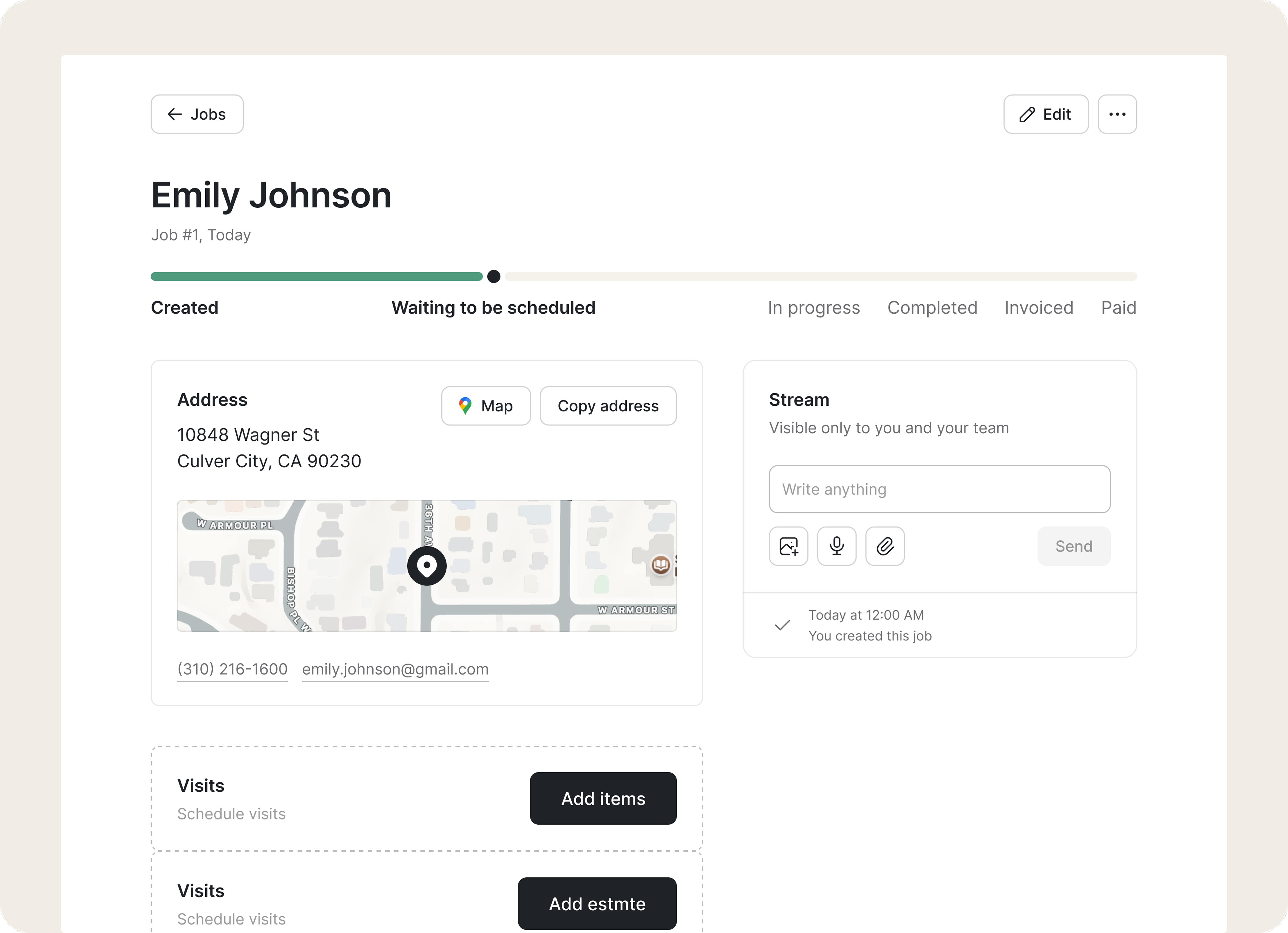
See how Tofu schedules recurring visits, tracks jobs, and collects payments for you.
Recurring revenue isn't a different business. It's the business you already run, with the renegotiation taken out. You're taking the regulars you already serve and giving them a reason to stay on the schedule, so the work and the income repeat without you selling them again each time.
Here's the whole strategy in five steps:
That's it. The pricing formula, the contract, the software, everything else in this guide just helps you run this loop without the tracking taking over your life. Start with one client this week, and you'll have proof the model works before the month is out.