How to grow a pool service business: 7 Things that actually move the needle
What actually grows a pool service business: pricing from real costs, dense routes, and recurring contracts – backed by real invoice data.



If you want to grow a pool service business past the first dozen accounts, the problem is rarely a lack of customers. It's pricing that doesn't cover real costs, routes that eat hours in windshield time, and no system for turning satisfied clients into referrals.
This guide is for operators already running routes who want to stop trading time for money. If you're still in the starting phase, read how to start a pool service business first, then come back here.
There are more than 78,000 pool cleaning businesses in the US. The ones that grow get a few fundamentals right and stay consistent. Here's what those fundamentals are.
Key takeaways
- Price from your costs up, not from competitor rates down. Build in both a profit margin and a reinvestment buffer so you have room to grow.
- Dense routes beat big routes. Drive time is unbillable. Clustering accounts in the same neighborhoods earns more per hour than spreading thin.
- Recurring contracts are the foundation. Move one-off clients to weekly maintenance agreements for predictable income you can plan around.
- Plan for the season. Demand swings nearly two to one across the year. Sign contracts in peak season; sell closings and repairs in winter.
- Commercial accounts and route acquisition scale faster than residential one at a time. One HOA or hotel contract can equal eight to ten residential stops.
- Referrals, yard signs, and a complete Google Business Profile fill a route for almost nothing. Spend on ads only after these are maxed out.
- Hire slightly before you're overwhelmed, and document your operation so a new tech can run a route without you.
- Software removes the admin tax that quietly caps how many accounts you can handle.
How to price pool service jobs so every stop makes money
Pricing is where most pool service businesses quietly bleed out. The logic seems reasonable: look at what competitors charge, go slightly under to win the client, figure out the margins later. The problem is that "later" often reveals the job was barely breaking even once you factor in drive time, chemicals, and equipment wear.
The fix is to price from your costs up, not from the market down.
Start by calculating your actual cost per service stop:
- Labor: your time, or a tech's time, at a real hourly rate
- Chemicals: what you use per pool on average (chlorine, pH adjusters, shock)
- Drive time: time and fuel cost between stops
- Equipment depreciation: poles, vacuums, testing kits, truck maintenance
- Overhead: insurance, licensing, phone plan, software subscriptions
Add those up and you get your break-even cost. From there, add a margin that covers two things: your profit and your reinvestment buffer. A lot of owners build in a profit margin but forget to leave room for a second truck, a new hire, or a slow month. Build both into your price from day one.
A simple starting point: if your break-even cost per visit is $40, your minimum price isn't $50. It's closer to $60 to $65, depending on the growth margin you need.
For reference, real invoicing data from Tofu Field Service across pool service businesses shows a median maintenance invoice of roughly $410, while repair jobs run closer to $770 and installations land in the thousands. On a per-service basis, the typical maintenance line item is around $125. Those are medians, not targets: where you land depends on your market and your costs. But if your maintenance invoices are consistently well below the $400 range, it's worth checking whether you're actually pricing to grow or just pricing to stay busy.
On pricing structure, flat-rate monthly contracts work better than per-visit billing for most residential accounts. Customers prefer predictability. You get recurring revenue you can plan around. And you stop having awkward conversations about "this month had five Fridays."
For guidance on running the numbers for your specific costs, see how to figure out what to charge.
On raising prices: if you've held rates steady for two or more years, you're almost certainly undercharging. Give 30 days' notice, keep the message brief ("rates are increasing from X to Y on [date]"), and don't apologize. Most clients who value the service will stay. The ones who cancel over a $5 increase were your least profitable accounts.
Know what every stop actually earns
Tofu tracks every invoice, so you can see which accounts make money and which just keep you busy.
Route optimization: The pool service growth lever nobody talks about
This is the section missing from most pool business advice, and it may be the highest-leverage one.
The assumption most owners make is that more customers equals more revenue. That's only true if the new customers are in the right place. A route with 25 accounts spread across 30 miles earns significantly less per hour than a route with 20 accounts clustered in three adjacent neighborhoods.
Here's the math: if you're spending 3 hours a day driving between stops instead of 1.5 hours, you're losing 1.5 hours of billable time every day. Over a week, that's 7.5 hours. At your service rate, calculate what that costs you annually. For most solo operators it runs into the thousands.
The principle: fill a geographic cluster before you expand to a new area.
When a new client inquiry comes in from a neighborhood you're not currently in, think twice before saying yes. If you already have 8 accounts within a mile of that location, adding a ninth is efficient. If it's an isolated stop 12 miles from your nearest existing client, you'll spend more time driving to it than servicing it.
Practical steps:
- Plot your current accounts on a map. Group them by neighborhood or zip code.
- Identify your densest cluster. That's where your marketing energy goes first: door hangers, yard signs at current clients, word-of-mouth push in that area.
- For inquiries from outside your zones, add a travel fee or refer them out and stay focused on building density where you already are.
- Schedule stops in a geographic loop, not based on when clients happen to call.
Route efficiency is not a logistics detail. It's how you turn the same working hours into more billable stops.
One operator who scaled from a single route to seven locations described the math in three words: the profit killers are shop time, drive time, and overtime. Every hour your tech spends loading the truck, driving between distant stops, or working past schedule is an hour that doesn't show up on an invoice. Cut all three and the same crew services more pools for the same pay.
Pool service agreements: How to lock in recurring revenue
One-off jobs feel like wins. Recurring maintenance contracts are what actually build a pool cleaning business.
A client on a weekly maintenance agreement is fundamentally different from a client who calls you when their pool turns green. One is predictable income. The other is income you can't plan around. And unpredictable income is hard to grow on.
The numbers back this up in a way that surprises a lot of operators. In our data, one-off pool jobs carry a much higher median invoice (well over $1,300) than recurring maintenance invoices (around $380). At first glance that makes one-off work look more attractive. But the recurring accounts are the ones generating invoice after invoice, week after week, all year. A single $1,366 repair is one transaction. A $381 maintenance account billed weekly is a relationship that compounds into far more revenue over a season, with none of the cost of constantly finding the next customer. Volume and predictability beat the occasional big ticket.
Weekly clients also churn less. If someone is used to seeing you every Friday, they have to actively decide to cancel. Occasional callers just stop calling.
Converting one-off clients to recurring agreements:
The right moment to make the pitch is right after you fix something. You've just handled a green pool, an algae problem, or a failing pump. The client is relieved. That's when you say: "I can keep it looking like this with a weekly maintenance plan. Here's what it includes and what it costs." You're not selling in the abstract. You're selling the thing they just watched you fix.
What a basic pool service agreement should cover:
- Frequency and what each visit includes
- Chemicals policy (included, client-supplied, or billed separately)
- What's not included (equipment repairs, one-off treatments)
- Cancellation terms (30 days' notice is standard)
Keep it to one page. Clarity is the goal, not a legal document.
For a template, see the service agreement guide.
Upselling within existing accounts:
Your current clients are your lowest-cost sales opportunity. Services that layer naturally on top of weekly maintenance:
- Seasonal pool opening and closing
- Filter cleaning (usually quarterly)
- Equipment inspections
- Chemical deliveries for clients who manage their own chemistry
- Salt cell cleaning for saltwater pools
One mention per visit, when it's relevant. No hard pitch needed.
Move into commercial accounts once your residential route is solid:
Residential pools come one at a time. Commercial accounts come in bulk. A single HOA, apartment complex, hotel, or property management company can be worth eight to ten residential stops, all at one address or within one cluster. The work is steadier, the contracts are longer, and the client is less likely to cancel over a price increase.
Commercial accounts have higher standards: more documentation, sometimes specific certifications, stricter scheduling. But once your residential route is dense and reliable, going after one or two commercial contracts is often the fastest way to add meaningful revenue without adding 10 separate clients.
Stay in front of clients between visits with email:
A short monthly email keeps you top of mind and creates natural upsell moments. Seasonal care tips, a reminder before opening or closing season, a heads-up about a service you offer that they're not using yet. You don't need a marketing platform to start. One email a month with one useful tip and one offer is enough. Clients who hear from you between visits are the ones who say yes to add-ons and refer you to neighbors.
Plan for seasonality so winter doesn't sink you
Pool service demand is seasonal, and the swing is bigger than most operators plan for. In real invoicing data, the slowest months (January and February) run roughly a third below an average month, while the back half of the year (August through November) peaks at nearly 30% above average. Peak-to-trough, invoice volume swings close to two to one across the year.
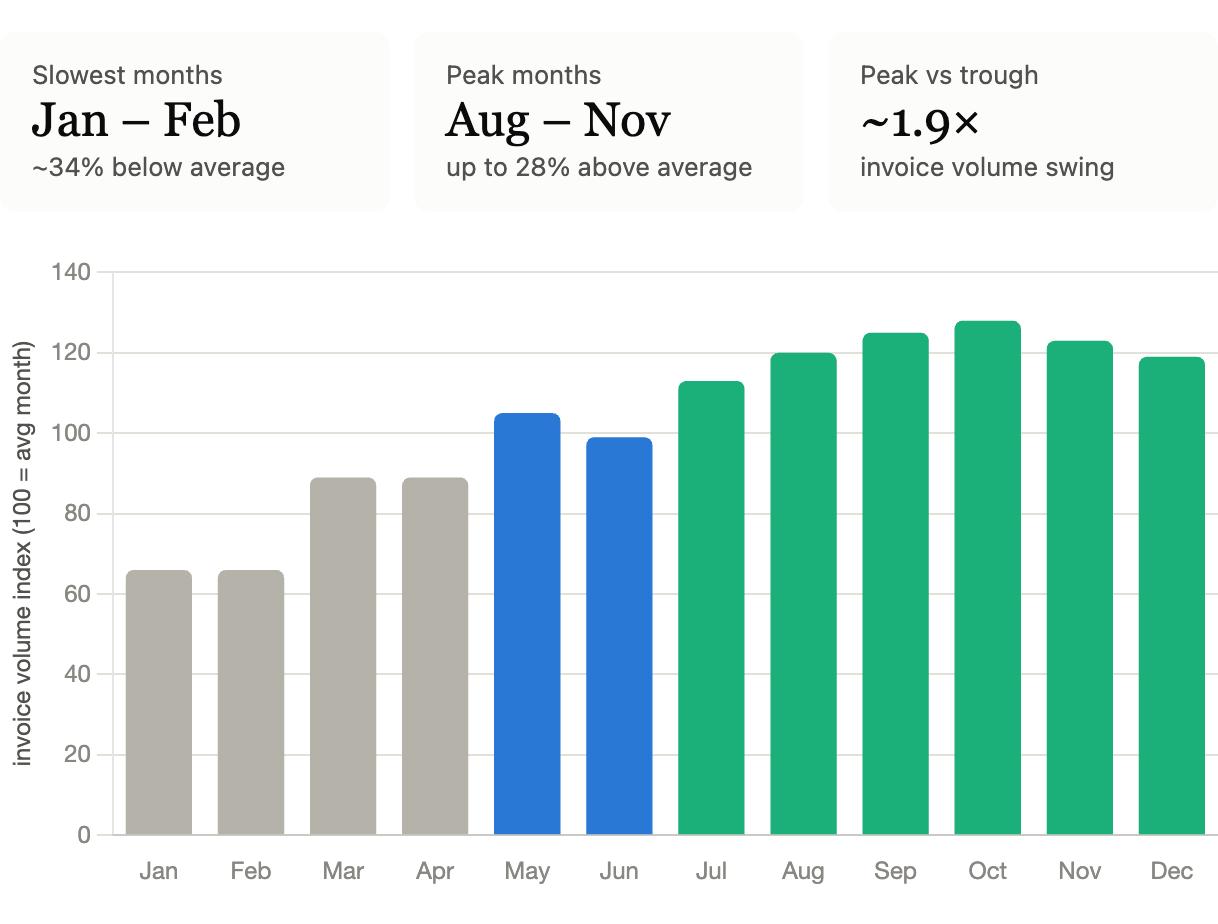
That pattern has two implications for growth. First, the busy season is when you should be locking in next year's recurring contracts, not just clearing the backlog. The clients you sign in peak season are the ones who carry you through the slow months. Second, the slow season is not dead time. It's when you offer pool closings, equipment repairs, off-season maintenance, and cover sales to keep revenue flowing and keep your techs working. Operators who treat winter as a planning and upsell window, rather than a write-off, are the ones who come into spring with a full route instead of scrambling to rebuild it.
If you're billing through software, your own invoice history will show you exactly when your local season peaks and dips. Use it to plan hiring, marketing pushes, and cash flow rather than guessing.
How to get more pool cleaning customers through referrals
New customers are expensive. A referral costs almost nothing and closes faster because it arrives with built-in trust.
The referral source most operators aren't using: yard signs. A sign at a house you service is passive advertising to every neighbor who walks or drives past. The message is implicit: this homeowner trusts this company. That credibility is worth more than a Google ad to someone who's never heard of you.
Ask current clients for permission to place a sign. Most will say yes if you're doing good work. Keep it simple: company name, phone number, one line about what you do.
Asking for referrals directly:
The right moment is right after a compliment. If a client says "the pool looks great" or "I really appreciate how reliable you've been," that's your cue: "If you know anyone else with a pool, I'd really appreciate the referral. I'm building my route in this area." Short, specific, not pushy.
A simple incentive: one free service visit for every new client who signs up and mentions the referrer. Not cash, not a points system. One free visit is enough to make the gesture feel valued.
Google reviews:
A pool service with 80 recent Google reviews will win a local search over a competitor with 12, even if that competitor is cheaper. After a good service visit or a moment when a client expresses satisfaction, send them a direct link to your Google review page by text. Not "leave a review if you have time." Specifically: "Would you mind leaving a quick review? It really helps." Then give them the link.
One review per week is 50 by end of year. That changes your local search visibility.
Partner with businesses that share your customers but don't compete:
Some of your best referral sources aren't customers at all. Pool builders, pool supply stores, landscapers, and property managers all deal with the same homeowners you want, and none of them service pools the way you do. A pool builder who finishes an installation needs someone to recommend for ongoing maintenance. A landscaper whose client mentions a green pool can hand over your card. Set up a few of these relationships, ideally with reciprocal referrals, and you get a steady trickle of pre-qualified leads with zero ad spend.
For a fuller breakdown of what actually generates leads in this business, the pool service marketing guide goes deeper on channels worth your time.
Pool service marketing: Get found online before you spend on ads
Most pool service searches are local and immediate. People type "pool cleaning near me," "pool maintenance [city]," or "pool service [neighborhood]." They want to hire someone now.
The highest-leverage thing you can do to show up in those searches costs nothing: set up your Google Business Profile properly.
Most solo operators claimed their profile, added a phone number, and stopped. A complete profile includes:
- Primary category: Swimming Pool Cleaning Service (not a generic home services category)
- Service areas: every city, neighborhood, and zip code you actually cover
- Business hours: accurate, including whether you take weekend calls
- Photos: real photos of your truck, equipment, and team. At least 10. No stock images.
- Services listed: weekly maintenance, pool opening, pool closing, equipment repair, whatever you offer
- Booking link or direct contact: make it easy to reach you from the profile itself
Reviews feed directly into local pack ranking. The three businesses that appear at the top of map results have more reviews, more recent reviews, and more complete profiles than their competitors.
What your website needs at minimum:
- Your phone number visible above the fold on mobile
- A page for each major service area you cover
- A clear description of what you do and who you serve
- Real testimonials or review quotes
On Google Ads: they can work, but they stop the moment you stop paying. Referrals, route density, and organic local search compound over time. Run ads once you've maxed out the free channels.
Hiring your first pool service employee: When and how
The signal that it's time to hire is usually one of two things: you're regularly turning away new clients, or you're running behind on existing routes and service quality is starting to slip.
Both matter. Turning away clients leaves money on the table. Slipping on service quality puts your recurring contracts at risk.
What most advice on this topic skips: hiring doesn't just add capacity. It changes your job. The day you bring on your first tech, you shift from being a pool service operator to being a pool service business owner who manages someone else. That's worth thinking through before you do it.
Solo vs. employee vs. subcontractor:
A subcontractor arrangement is simpler to start. They handle their own taxes, you pay per job or per route day, and you're not responsible for workers' comp if they're genuinely independent. The tradeoff is less consistency and less stake in your reputation.
A W-2 employee gives you more control over quality and schedule. The tradeoff is payroll taxes, insurance, and more administrative overhead. But if you want to build a company rather than just a bigger solo operation, employees are the path.
Setting a new tech up to work independently:
Before they go out solo, they need:
- A checklist for each service type you offer
- Training on your chemical standards and testing methods, following CDC water chemistry guidance (free chlorine at or above 1 ppm, pH 7.0 to 7.8) so every tech tests and balances consistently
- Access to client addresses, pool notes, and special instructions
- A way to reach you in the field when something unexpected comes up
If that information lives in your head or across scattered text messages, the hire will struggle. Documenting your operation isn't busywork. It's what makes your second employee as easy to onboard as the first.
Certifications are worth considering as you build a team. The Pool & Hot Tub Alliance Certified Pool Operator (CPO) program is the most widely recognized credential in the industry, and some states and municipalities require it for commercial work. Beyond compliance, a certified team is a selling point: it signals to homeowners and commercial clients that your crew knows water chemistry and safety, which makes it easier to win higher-value accounts.
The most common mistake: waiting until you're completely overwhelmed before hiring. By that point you've already lost clients and taken a reputation hit. The right time to hire is slightly before you need it, not well after.
Pool service business software: Cut admin so you can actually grow
At a certain point, the thing holding a pool service business back isn't pool company marketing or pricing. It's the hours per week that disappear into admin: writing invoices at night, texting clients about appointments, trying to remember which account had the pump issue last month, chasing payments.
Two hours of admin per day is 40 hours a month you're not spending on billable work.
What a solid scheduling and invoicing setup handles:
- Jobs with addresses, photos, notes, and service history in one place, so any tech can walk in knowing what to expect
- Invoices created and sent before you leave the driveway, not at 10pm from memory
- Payment collected on-site via card, Apple Pay, or Google Pay
- A record of every client, every visit, and every transaction without spreadsheets
Tofu is built for this kind of operation: mobile-first, with an offline mode for when you're poolside with no signal. You create the job, attach the notes, send the invoice when you're done, and get paid on-site. The billing cycle takes minutes instead of an hour. It's simple enough that a new hire can use it on day one, which matters when you start to scale.
What to look for in any pool service business software:
- Mobile-first. You are never at a desk.
- Offline mode. Signal is unreliable at a lot of service locations.
- Simple enough for a new employee to use without a week of training
- Invoicing built in, not bolted on. One system, not three.
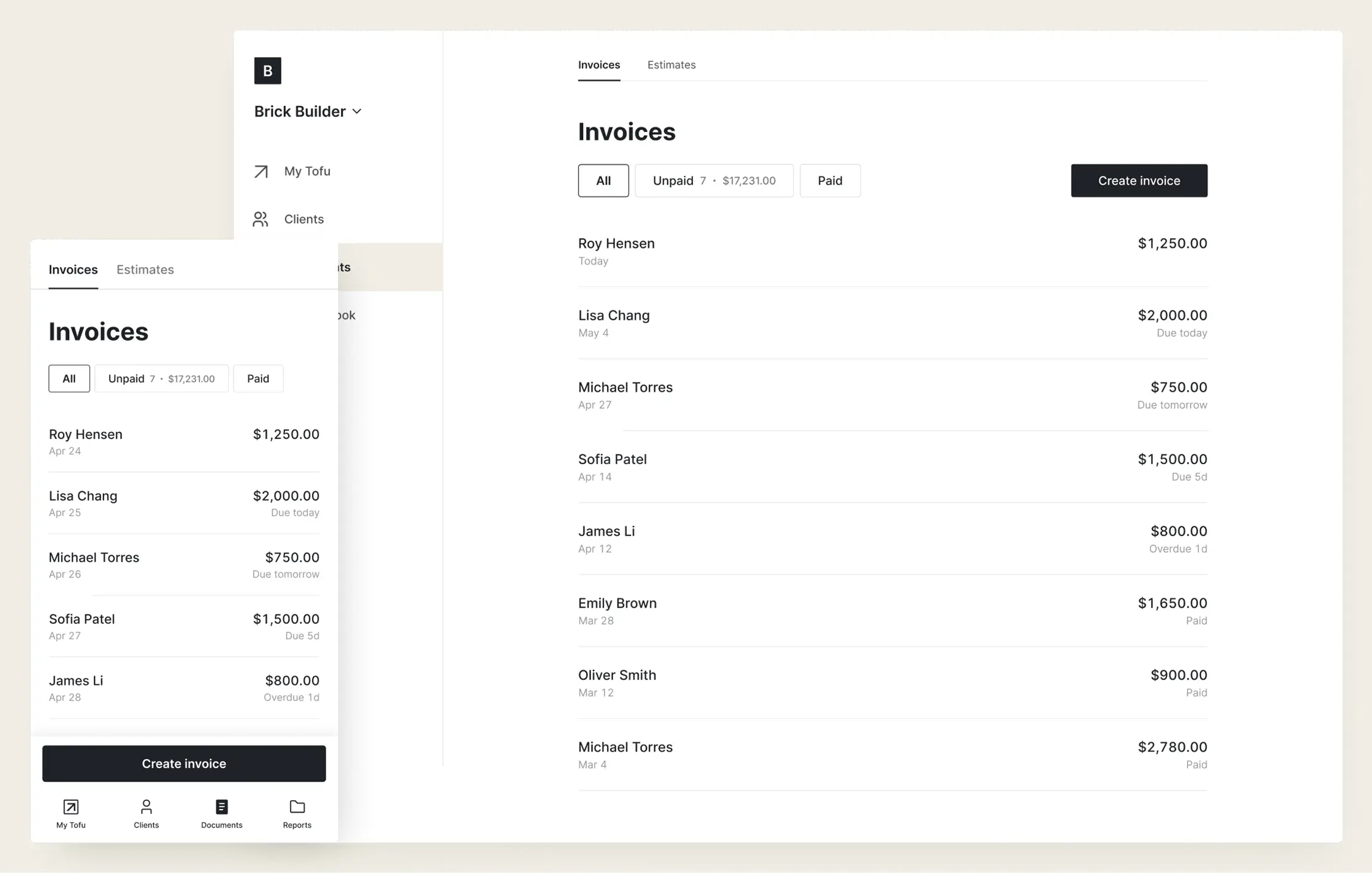
Run your whole route from your phone
Schedule jobs, send invoices, and get paid poolside – even with no signal.
What growing a pool service business looks like year over year
Growth in a pool cleaning business isn't linear and it's not fast. Here's what to focus on at each stage.
Year 1: Get the fundamentals right
Nail your pricing so every stop makes money. Build a geographically dense route. Get to 20 to 30 recurring weekly accounts. Set up your Google Business Profile and start collecting reviews. Spend nothing on ads yet.
Year 2: Lock in recurring revenue and build systems
Move one-off clients to maintenance agreements. Put a referral loop in place: yard signs, direct asks, a simple incentive. Get your operation documented so you're not the only person who knows how anything works. By end of year two, monthly revenue should be predictable enough to plan around.
Year 3: Hire and scale
Bring on your first tech. Double capacity without doubling your own hours. The documentation you built in year two is what makes this work. With a second operator on the road, you shift into managing routes, quality, and client relationships rather than doing every service yourself.
This is also the stage to consider buying a route. Pool service routes change hands regularly: operators retire, relocate, or exit the business and sell their book of accounts directly or through a broker. Buying an established route in or near your existing service area can add 20 or 30 recurring accounts overnight, far faster than acquiring them one referral at a time. Vet the accounts carefully (how long they've been clients, their payment history, how dense they are relative to your current route) but for the right cluster, acquisition is the fastest growth lever there is.
None of this is complicated. The challenge is execution, not strategy.