How to start a pool service business: Step-by-step guide
Starting a pool service business is easy to enter but easy to underprice. This guide covers the essentials – licensing, gear, pricing, and landing your first weekly accounts.



You can start a pool service for a couple thousand dollars. Here's the step-by-step guide to licensing, insurance, equipment, pricing for profit, and landing your first weekly accounts.
Key takeaways
- You can start lean. A solo operator with basic gear, the right insurance, and an existing vehicle can open for far less than the $20,000-plus figures quoted for a fully equipped company or a bought route.
- The cleaning is the easy part. Pricing your routes, getting licensed where it's required, and getting paid on time are what decide whether you're still in business in year two.
- Licensing is local, and it splits on one line: no state requires certification to clean residential pools, but most require a certified operator for public and commercial work.
- Recurring revenue is the whole appeal. A weekly route is predictable monthly income with high retention, but the real margin lives in repairs and equipment, not the weekly clean.
- Price for profit, not for the lowest bid. The fastest way for a new pool business to stay busy and still go broke is undercutting the going rate to win accounts.
Starting a pool service business is one of the more approachable trades to break into, and one of the easier ones to underestimate. The barrier to entry is low, the income is recurring, and a single operator can build a profitable route without ever hiring. The catch is that the money is made or lost on pricing and route density, not on how well you brush a wall. Whether you're a working pool tech going independent or someone drawn to a hands-on local business with steady monthly revenue, this guide walks the full path: choosing your services, getting set up legally and insured, buying the right gear, pricing routes so they actually pay, and landing your first customers.
Is a pool service business worth starting? For the right person, yes. Pools need year-round care in warm states and reliable open/close work in cold ones, customers stay for years, and the work is hard to offshore or automate. The trade-offs are seasonality, chemical handling, and a market that's getting more crowded every year. If you're comfortable with physical work outdoors and willing to run the business side with the same care you bring to water chemistry, it's a solid trade to build.
The 10 steps at a glance
| # | Step | The one thing to get right |
|---|---|---|
| 1 | Learn the trade and get experience | Master water chemistry before you charge for it |
| 2 | Get certified and check your state's rules | Residential rarely needs a license; commercial usually does |
| 3 | Write a one-page business plan | Keep it short enough that you actually use it |
| 4 | Choose a structure and register | An LLC shields your personal assets from job-site risk |
| 5 | Get insured | General liability is the floor, not the ceiling |
| 6 | Buy your equipment | Start with a starter kit, open a wholesale chem account |
| 7 | Price your routes for profit | Charge by pool size and complexity, never by gut feel |
| 8 | Build your brand and get found | Google Business Profile plus referrals beats a fancy site |
| 9 | Book your first customers | Build route density; a tight route is the whole game |
| 10 | Set up software and grow | A small crew needs scheduling, invoices, and payments |
Each step is covered in full below.
What a pool service business actually does
Before you launch, get clear on which services you'll offer. Most pool businesses build from this core list:
- Weekly and bi-weekly maintenance. Brushing, skimming, vacuuming, emptying baskets, and balancing water chemistry. This is your recurring base, the steady monthly income that everything else builds on.
- Chemical balancing and treatment. Testing and dosing for sanitizer, pH, alkalinity, and stabilizer. The skilled core of the work, and what keeps a pool safe and clear.
- Filter cleaning and equipment service. Cleaning or swapping filter media, checking pumps and heaters. A natural step up from cleaning into higher-value work.
- Repairs and installs. Pumps, heaters, filters, automation, plumbing. Higher value, higher skill, and where the best margins in the business live.
- Seasonal open and close. Opening pools in spring and winterizing them in fall, a strong seasonal revenue spike in cold-winter states.
A practical way to start: lead with weekly maintenance to build recurring revenue, add filter and equipment service to raise the value of each account, and subcontract or partner out major repairs until you've learned them well enough to bring in-house.
Is it worth it? Demand, earnings, and the honest downsides
The market is large and overwhelmingly small-business, which is good news for a newcomer. IBISWorld puts US swimming pool cleaning services at roughly $8.8 billion in 2025 across nearly 79,000 businesses, and the Pool & Hot Tub Alliance counts close to 11 million pools nationwide. Most companies serving them are tiny: two to five people, and the large majority under $500,000 a year. Demand is seasonal, but how much depends on where you work, close to year-round in the Sun Belt, summer-peaked elsewhere with spring opens and fall closes filling the gaps.
On earnings, separate two numbers. As an employee, a pool maintenance worker earns a median around $16 an hour, with total pay roughly $26,000 to $57,000 a year by experience and region (PayScale, BLS). Owner take-home is different: industry margins commonly run 40–60%, and a tight solo route of 50–60 pools can support a comfortable full-time living once established, with repairs and installs on top. That predictable monthly billing is the real draw, and it's worth seeing how recurring revenue compounds over time. Build your plan from your own costs, not a single rosy figure.
The downsides deserve a straight answer: the work is physical and weather-dependent, you're handling chemicals that demand respect, winter demand drops across much of the country, and competition has intensified, with several operators now working the same streets in pool-heavy neighborhoods. That's exactly why pricing discipline and route density matter, and the rest of this guide is about getting them right.
Spend your time on pools, not paperwork.
Tofu runs the business side so you can focus on the route.
Step 1: Learn the trade and get experience
Before you service a single paying pool, you need to actually know what you're doing: water chemistry, filtration, common repairs, and the rhythm of a weekly route. Skip this and you'll learn on customers' pools, which is how you lose customers.
The chemistry and cleaning are the part most people can learn quickly. Filtration, troubleshooting, and equipment repair are where it gets genuinely complex, and where a season of hands-on experience pays off. The safest on-ramp is to work for an established pool company first. You get paid while you learn the trade, customer handling, and what a realistic day on a route actually looks like. (Heads up: some employers will ask you to sign a non-compete, so read before you sign.)
If a job isn't an option, there are solid free resources to build the fundamentals, from manufacturer guides to dedicated pool-chemistry communities online. Once you've got the basics, practice on friends' and family pools, at a discount or free, until your readings and dosing are second nature. Many new operators also sub-contract their first repairs to a more experienced pro, learning on the job before bringing that work in-house.
Step 2: Get certified and check your state's licensing
This is the step most guides wave past with "check your local laws." Here's the actual picture.
The certification. The industry-standard credential is the Certified Pool/Spa Operator (CPO), issued by the Pool & Hot Tub Alliance. It's roughly a 14–16 hour course plus an exam, covering water chemistry, filtration, safety, and maintenance. Even where it isn't legally required, it builds credibility with customers and is usually expected for commercial work.
The key distinction is residential versus commercial. No US state requires CPO certification to clean residential, private, single-family pools. Certification and licensing rules kick in for public, commercial, and semi-public pools, the hotels, apartments, clubs, and community pools regulated by health authorities. So if you're starting with backyard pools, you likely don't need CPO to operate legally, though getting it is still smart. If you want hotel and HOA contracts, you'll almost certainly need it.
Keep two terms separate, because they're easy to confuse:
- A certification (like the CPO) proves skill and builds reputation.
- A license is legal permission to operate, which varies by state and by the type of work.
A few licensing patterns worth knowing:
- Entity vs. individual licensing. Florida, California, and South Carolina license the business entity and require a "qualifying individual," a licensed person of record responsible for the work. Texas and Arizona license the individual and register the business separately.
- Maintenance vs. repair. Routine maintenance (vacuuming, brushing, dosing, filter cleaning) is generally exempt from contractor licensing. The moment you repair or replace equipment, heaters, pumps, piping, you typically need a contractor's license with a pool/spa classification.
- Chemical handling. A few states regulate pool chemicals directly. Pennsylvania, for example, requires a pesticide applicator license to add chlorine or algaecide to public pools. Everywhere, OSHA and EPA rules govern how you store and handle chemicals.
Pool operator certification requirements by state
Use the lookup below to check your state. It covers public, commercial, and semi-public pools; no state requires certification for residential pools. Across the country, 27 states and Washington, D.C. require a certified operator statewide, 7 leave it to local counties and cities, and 16 have no requirement at all. Treat this as a starting point, not legal advice: rules change and local requirements can be stricter than the state, so always confirm with your state health department and county before taking on commercial work.
The takeaway isn't "memorize every state." It's "look up yours, then call your county health department and state board before your first commercial job, and get it in writing." Getting this wrong can mean fines or voided insurance claims.
Step 3: Write a simple one-page business plan
A business plan is just a clear answer to "what am I doing and how will it make money." Even self-funding, write one, it forces you to think through pricing, costs, and how many accounts you actually need to make a living. If you're borrowing to buy a route or a vehicle, the lender will require it.
Start with one page and expand over time. Cover:
- The services you'll offer and your service area.
- Who your customers are (homeowners, HOAs, commercial accounts) and what they'll pay.
- Your startup budget and where the money is coming from.
- A basic first-year forecast: accounts per month, average monthly ticket, and your costs.
A short, honest plan you actually use beats a long one that sits in a drawer. For a fuller walkthrough, our guide on how to start and structure a business covers formation, planning, and growth in one place. Tie the numbers to a goal: if a solo route of 60 pools at a healthy monthly rate is the target, work backward to how many accounts you need to add each month and what it'll cost to get them. If you need financing, this is also the document a lender or the Small Business Administration will want to see.
Step 4: Choose your business structure and register
How you structure the business affects your taxes, your paperwork, and how much personal risk you carry. Most small pool services choose from one of a few common business structures:
- Sole proprietorship. Simplest to set up for a one-person operation, but no personal liability protection.
- Partnership. Similar simplicity, with ownership shared between two or more people.
- Limited liability company (LLC). A popular choice because it separates your personal assets from business risk while staying manageable to run.
Because pool work involves property access, chemical handling, and equipment liability, many owners choose an LLC for the added protection. Once you pick a structure, register your business name and get an Employer Identification Number (EIN) from the IRS so you can open a business bank account and keep personal and business money apart. If you're weighing the cost and mechanics, see our guides on how much it costs to start an LLC and whether you can run more than one business under a single LLC.
Two practical habits from day one: fund your business account with a reserve covering at least 90 days of expenses for slow winter stretches or unpaid invoices, and set aside roughly 25% of what you earn in a separate tax account so quarterly taxes never catch you short.
Step 5: Insurance you shouldn't skip
You're working on other people's property, handling chemicals, and servicing expensive equipment, exactly the kind of risk that needs coverage. At a minimum, plan for these:
Many operators carry a $1,000,000 general liability policy, and some commercial clients require proof of it before they'll hire you. Premiums vary by state, crew size, and the services you offer, especially once you add repairs. Get a few quotes early, because insurance cost is a real input into how you price your accounts.
Step 6: Equipment and chemicals
You can start with a surprisingly short list. Buy what your starting services require, and add gear as the work justifies it.
Starter kit (solo):
- Telescopic pole with skimmer net, algae brush, and corner brush
- A quality vacuum head with roughly 50 feet of hose
- Skimmer socks
- A reliable water test kit
- Core chemicals: chlorine (tabs and/or liquid), acid, pH and alkalinity adjusters, algaecide, and shock
Step-up gear (as you grow):
- A robotic or pressure cleaner to speed up service
- Repair and diagnostic tools for pumps, filters, and heaters
- A dedicated work vehicle or trailer setup
Two ways to save money from the start: open a wholesale distributor account instead of buying chemicals retail, you'll get a price list and far better rates, and wait to buy filter media (sand, cartridges, DE) until a specific job calls for it so you're not sitting on inventory. Pass chemical and filter costs through in your estimates so materials don't eat your margin, and start from a pool service estimate template so every quote is consistent.
How much does it cost to start a pool service business? Less than you'd think if you start lean. The table below shows typical ranges for a lean solo start versus a fully equipped company. Treat these as ballpark only: prices vary widely by region and the condition of used gear, so always get real quotes.
The takeaway: you can open the doors for around $2,000 with a starter kit and your existing vehicle, then reinvest profits into better equipment as the route grows. The big jump in cost comes from buying an established route, which is a different strategy covered in Step 9.
Step 7: How to price pool service so you actually make money
This is the step most new owners get wrong. Pricing by gut feel, or simply undercutting the company down the street, is how small pool businesses stay busy while going broke.
Price by pool size and service frequency, then add for complexity. Offer weekly, bi-weekly, and monthly plans, plus seasonal open and close packages where winters are cold. A sound monthly price covers:
- Labor. Your time per visit across the month, including drive time between stops.
- Chemicals and materials. Sanitizer, balancers, and filter media, marked up appropriately.
- Equipment and vehicle. Fuel, wear, and the cost of your tools and any cleaners.
- Overhead. Insurance, licensing, software, and your share of fixed costs.
- Complexity premium. Bigger pools, heavy debris, pets, or difficult access all add time and should cost more.
- Profit. A real margin on top, not whatever is left over by accident.
A practical way to structure it is a base monthly rate set by pool size (gallons), plus surcharges for anything that adds time or mess: an unscreened pool that collects more debris, heavy plant cover around the deck, pets that swim, or a high-maintenance property. On a tight route you want to average a tight, predictable time per pool, so price problem pools accordingly or pass on them.
The one rule that protects the whole business: don't undercharge. Lowballing to win accounts drags down the local market and traps you in unprofitable work that's hard to raise later. Know your value and price for it. Write every quote the same disciplined way: our guide on how to write a job estimate walks through the format, and once a customer approves it you can convert the estimate to an invoice in a step. And remember where the margin really is: weekly cleaning is your recurring base, but repairs, equipment swaps, and installs are where a pool business actually makes money.
A worked example. Say you build a 60-pool residential route at an average of $150 a month. That's $9,000 a month in recurring revenue, or $108,000 a year, before any repair or equipment work. At industry-standard 40–60% margins, that's a solid solo living, and repairs layered on top push it higher. The lesson: route density and disciplined pricing, not the number of pools alone, are what make the math work.
Keep every account on schedule.
Map your weekly stops, send estimates, and get paid from one app built for pool pros.
Step 8: Build your brand and get found
Customers hand you their backyard and a gate code, so look like someone they can trust.
- Pick a clear, memorable name that says what you do, and put it on consistent branding across your vehicle, uniform, invoices, and cards.
- Build a simple website with your services, service area, before-and-after photos, and online booking.
- Set up a Google Business Profile. For "pool service near me" searches, this is often more valuable than a website at the start. Add photos and collect reviews.
- Get on local service directories and ask early customers for reviews. Retention in this business is high, so each good account compounds. Marketing a pool business well is a deep topic on its own, from local search to referrals, and our pool service marketing guide lays out the playbook.
Step 9: Book your first customers (and decide whether to buy a route)
Finding clients is consistently harder than cleaning pools, and it's where most new operators underestimate the effort. There are two paths to a full route, and they suit different budgets.
Building from scratch. Cheaper, but slower. The local-trade playbook works because it's well worn:
- Lean on referrals and word of mouth. Start a referral program and ask every happy customer for a review.
- Use Google Business Profile and Local Services Ads to capture "near me" searches.
- Door-knock pool-heavy neighborhoods. Use satellite view first so you only target homes that actually have pools, then build route density street by street, the tighter your route, the more profitable each day.
- Partner with landscapers and home-service pros who run into pool work they don't do.
- Be cautious with paid lead services. They have a mixed reputation in this trade, with many operators reporting low-quality leads, so test cheap, trackable channels before committing budget.
Buying a route. The big strategic alternative is to buy an established book of accounts, which means recurring income from week one instead of grinding for months to fill a schedule. Many buyers finance the purchase, choosing a route whose monthly revenue comfortably covers the loan payment plus chemicals and overhead so it's cash-flow positive from the start.
What's a route worth? A common rule of thumb is around 10 months of revenue, so a route billing $20,000 a month might sell for roughly $200,000. Brokers and listing sites specialize in these sales, and many include after-sale training, which helps if you're newer to the trade. Verify the accounts and their history before you buy. A route is only worth what its customers actually retain.
Whichever path you choose, route density is the real game. A clustered route cuts drive time, fuel, and wasted hours, which is what turns a busy schedule into a profitable one.
Step 10: Get paid, stay organized, and grow
Once you've got more than a handful of accounts, spreadsheets and paper invoices stop scaling. A one-to-ten-person pool operation needs a short list: a way to schedule routes, send professional estimates, invoice, get paid, and keep track of clients. The enterprise features (fleet GPS, heavy route-optimization suites) can wait until you're much bigger, if you ever need them at all.
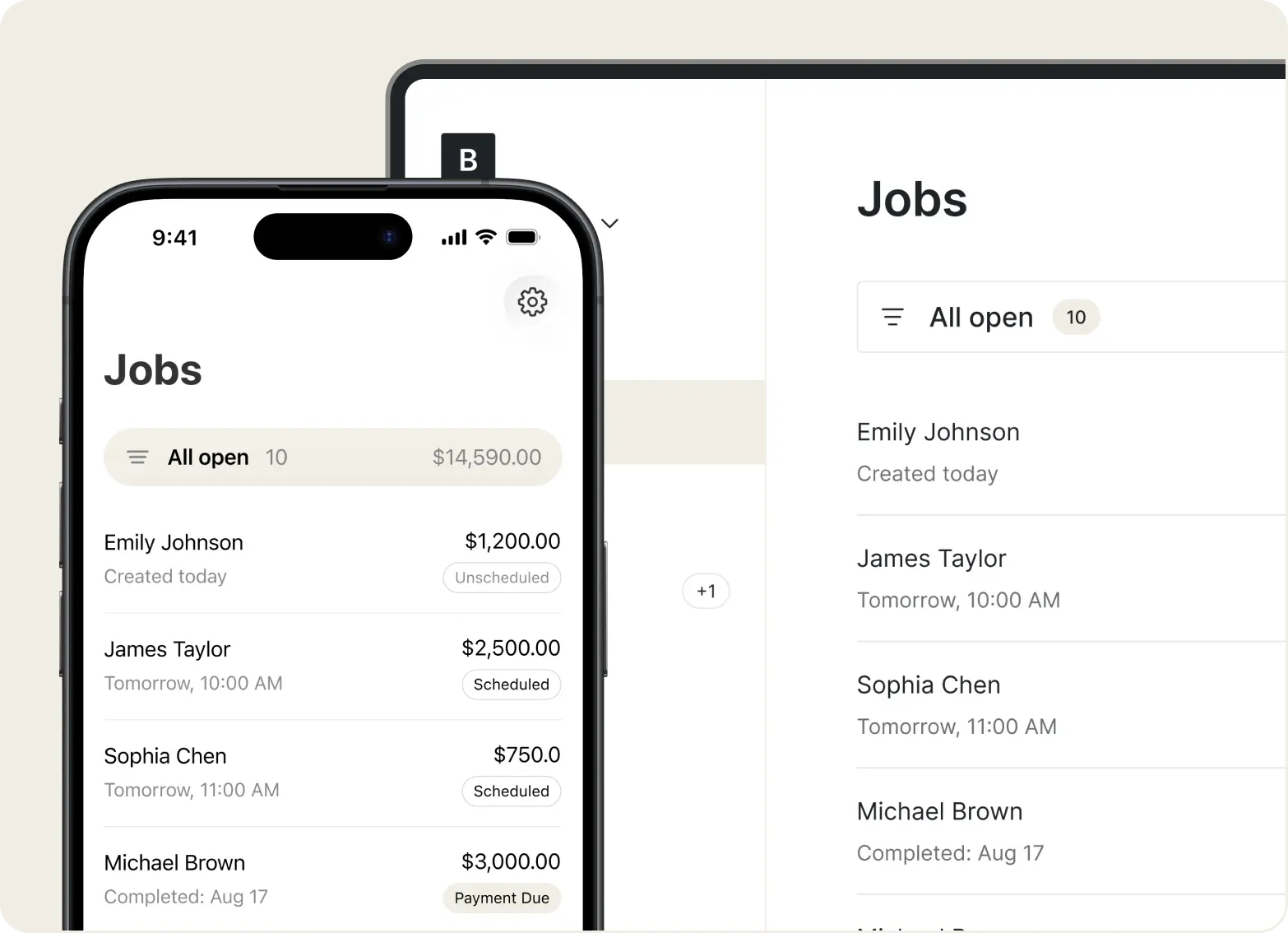
Tofu Field Service is built for exactly this stage: solo operators and small crews in the trades, not enterprise fleets. With Tofu you can schedule jobs with dates, addresses, and photos; send estimates that look professional and convert into jobs; invoice and take payment so you get paid faster and stop chasing checks; keep client and property history in a simple CRM; and reuse a price book of your standard services and rates instead of rebuilding numbers on every quote. It runs on the web and as mobile apps for managers and techs in the field, and it works offline, which matters on a property with no signal. If you want to see how it compares with the broader category first, our roundup of field service management software lays out the options, and you can grab a free pool service invoice template to send your first bill today.
The bottom line
Starting a pool service business doesn't take a loaded truck or a big loan. It takes a clear head about the parts that are easy to skip and expensive to get wrong. Start lean: a starter kit, your existing vehicle, and a wholesale chemical account will get your first accounts serviced for around $2,000. Get licensed where your state requires it, insured before the first paid job, and disciplined about chemistry from day one.
Then treat pricing and route density like the skills they are. The operators who last aren't the ones with the lowest bid. They're the ones who price every account for labor, chemicals, overhead, complexity, and a real margin, and who build tight routes that cut wasted drive time. Get that right and a one-person operation can grow into a booked route, and eventually a crew, without ever losing money on a pool it stayed busy servicing.
When you're ready to run the business side without the paperwork piling up, that's where Tofu comes in: schedule routes, send estimates, invoice, and get paid from one app built for small crews.
Don't let a quote sit in the truck.
Estimate on site, invoice same day, get paid faster.