How to price tree service jobs (So every job makes money)
A cost-based guide to pricing tree service jobs, with the cost-plus formula, five pricing models, a free calculator, real invoice benchmarks, and what every winning estimate needs.


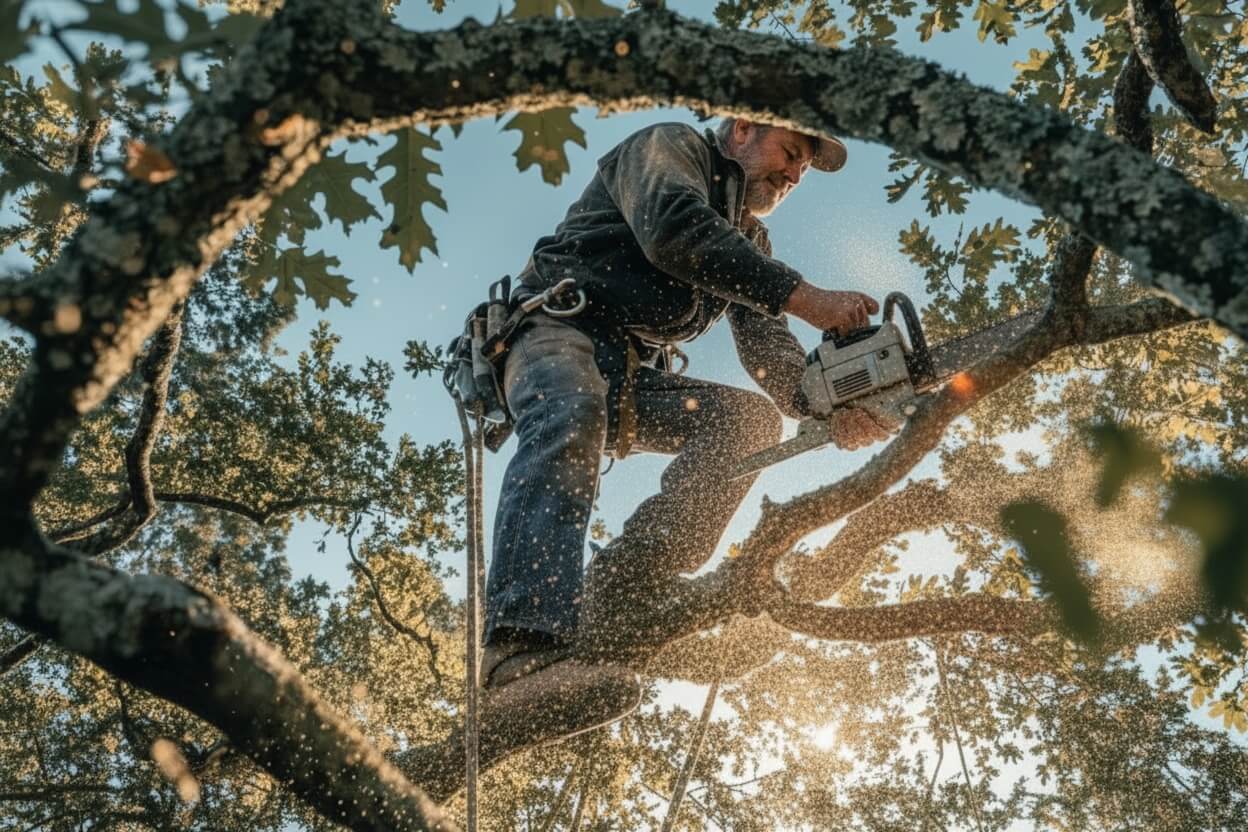
Most tree work gets priced by feel. The crew lead walks the yard, looks up at the oak, and says, "That's a twelve hundred dollar job." Sometimes that number is right. Often it is short by a few hundred dollars once you count the dump fee, the saw chains, the fuel, and the hour the chipper sat idle waiting in traffic.
Pricing by feel works until it doesn't. The fix is not a fancier gut. It is a simple, repeatable way to build a number from your actual costs, plus a clear estimate the customer can say yes to fast.
This guide covers the pricing models tree services use, the formula that keeps you from losing money, the factors that move every quote, and what to put in an estimate that wins the job.
Key takeaways
- Price from cost, not feel. Build every quote with one formula: (crew labor + equipment + disposal) × (1 + overhead %) × (1 + profit %) = job price.
- Tree service is several services. Removal, trimming and pruning, stump grinding, general tree care, and storm cleanup each price differently. Put them on the estimate as separate line items.
- What jobs actually run. Based on real invoices from tree service businesses on Tofu Field Service, a typical tree job invoices a median of about $2,355. A full tree removal runs a median around $2,360, the median price per tree removed is about $1,000, and stump grinding and trimming each run a median around $700.
- Choose a pricing model on purpose. Flat rate, per tree by size, unit based (per foot or per inch of trunk diameter), tiered packages, or market based. Most crews mix them by job.
- Adjust for the job in front of you. Access, proximity to structures and power lines, species, and emergency timing all move the price up from your base.
- The estimate wins or loses the job. Quote fast, use clear line items, attach photos, and make it easy to say yes.
Why guessing on tree service prices costs you money
A price that feels right and a price that pays the bills are two different numbers. The gap is everything you forget to count: crew time on setup and cleanup, equipment wear, disposal, insurance, your truck, and the profit that lets you replace a chipper when it dies.
Underpricing does more than a thin job. It trains customers to expect that number, and it trains your competition to match it. Win enough jobs at the wrong price and you stay busy while going broke. The goal is not the lowest bid. It is the right bid, explained well enough that the customer stops shopping.
Types of tree service (and why each one prices differently)
Tree services fall into five main types: tree removal, trimming and pruning, stump grinding, general tree care, and storm or emergency cleanup. Customers lump it all together as "tree work," but the jobs underneath price very differently. Sorting the work into clear services is the first step to pricing it right, and it is also what lets you build line items the customer actually understands.
The common ones:
- Tree removal. Taking the whole tree down. Usually the most expensive and highest risk service, because of the climbing, rigging, and equipment involved.
- Trimming and pruning. Cutting back branches to improve health, shape, clearance, or safety. Less intensive than removal, so it usually costs less, but it spans everything from a few dead limbs to a full canopy thinning.
- Stump grinding. Almost always a separate line, priced by stump diameter and how easily the grinder reaches it. It needs its own machine, so it is rarely folded into the removal price by default.
- General tree care and health. Inspection, disease and pest treatment, fertilization, and cabling or bracing to support weak limbs. Unlike a one-time removal, this is recurring work that builds an ongoing relationship with the customer.
- Storm and emergency cleanup. Urgent, after hours, higher risk response to fallen or hanging limbs. It carries a premium, and in our data it prices highest of all.
Some crews also take on bigger work like lot clearing or crane assisted removals. Whatever the mix, the point holds: name each service, price each on its own, and put them on the estimate as separate line items. A customer who sees "removal, stump grinding, haul away" as three lines argues less than one who sees a single lump sum.
The 5 tree service pricing models
Most companies use a mix of these, picking the model that fits the job in front of them.
| Pricing model | How it works | Best for |
|---|---|---|
| Flat rate | One total price for the whole job, based on your calculated costs and margin | Straightforward jobs with good access |
| Per tree by size tier | Set price bands for small, medium, large, extra large | Fast quoting and marketing, backed by cost math |
| Unit based | Price per foot of height or per inch of trunk diameter at breast height (DBH) | A structured system that scales to any tree size |
| Tiered packages | Basic, standard, full service levels (cut only vs cut plus haul vs cut plus stump plus cleanup) | Giving customers options and raising average job value |
| Market based | Set the number against local rates and demand | Starting out, before you know your true costs |
A note on market based pricing: use it as a sanity check, not a foundation. Your own costs set the floor, and the market tells you how much room you have above it. Whichever model you lean on, a saved price list keeps your size tiers and unit rates consistent from one quote to the next.
How to calculate a tree service price (cost-plus formula)
Tree service pricing means setting a job price from your real costs, labor, equipment, and disposal, then adding overhead and profit. Every pricing model above traces back to one build up. Start with cost, add overhead, add profit:
(crew labor + equipment + disposal) × (1 + overhead %) × (1 + profit %) = job price
Price a tree job from your real costs
Enter what the job actually costs you, then set your overhead and profit. The price builds itself.
This is an estimate to sanity-check your pricing, not a quote. Your costs and local market set the final number.
Crew labor. Estimate the crew hours the job takes, start to finish. Count setup, climbing or rigging, cutting, lowering sections, chipping, and cleanup, not just the time the saw is running. Multiply crew hours by your blended labor rate (what each crew member actually costs you per hour, loaded with payroll taxes and workers comp).
Equipment. Assign a per job cost for the gear the job uses: bucket truck, crane if rented, chipper, stump grinder, dump trailer. The simplest method is a daily rate per machine, allocated to the job by how long you use it.
Disposal. Dump fees, wood recycling, or the time to process logs into firewood. This line gets skipped more than any other, and it is rarely free.
Overhead. Everything that keeps the business running whether or not you are on a job: insurance (tree work insurance is not cheap), vehicle costs, fuel, marketing, phone, office. Roll it into a percentage and add it on top of direct cost.
Profit. This is not what is left over by accident. It is a number you set on purpose. Pick a target margin and build it in. Many tree care businesses aim somewhere in the range of 15 to 25 percent, but the right number is yours to choose based on your market and risk.
Run this once for a few common job types and you stop doing math in the driveway. You start recognizing the shape of a profitable job on sight, with the formula backing you up.
Stop doing math in the driveway
Build every quote from real costs with a saved price list and send it on the spot.
Tree service pricing factors
No two tree prices are the same. These are the variables that move the number, up or down, from your base calculation:
- Size and species. Taller trees and dense hardwoods take more crew hours than the same height in a soft, fast cutting species.
- Access. A tree you can reach with a bucket truck is a different job than one where the crew hand carries every piece around the back of the house. Limited access adds hours.
- Proximity to structures and power lines. Anything near a roof, fence, or line means rigging and lowering instead of dropping. Many crews add a meaningful premium here because the risk and the time both climb. Work near power lines belongs to the utility or a qualified line clearance crew, never an untrained ground crew.
- Emergency and storm work. After hours and storm response carries a premium. The urgency, the risk, and the disrupted schedule all justify it.
- Season. Demand swings hard through the year. On Tofu, tree work volume climbs through spring and peaks in summer, then drops off in winter. The median job price stays fairly steady across the year, so season is mostly a lever on how busy you are, not on the per job number. Slow winter months can still pull prices down as crews compete to stay working.
- Local competition. Saturation and competitor rates set the ceiling on how aggressively you can price while staying healthy.
Build your base from cost, then adjust for the job in front of you. The factors are modifiers, not the starting point.
How much tree service jobs cost (real pricing data)
Tree service jobs on Tofu invoice a median of about $2,355, with most landing between roughly $1,670 and $3,440. A full tree removal, which usually includes the stump and cleanup, runs a median of about $2,360. These figures are not national hearsay: they come from real invoices run through Tofu by tree service businesses, aggregated across hundreds of accounts. Use them to check that your calculated number lands in a believable neighborhood. They are still not your prices: your costs and your local market set those.
One thing to keep straight: a whole job (an invoice) often bundles several services, so it runs higher than any single line on it. That is why the per service numbers below come in lower than the whole-job medians above.
Broken down by individual service, here is what one line of work typically costs. The mid range below covers the 25th to 75th percentile, so half of all jobs fall inside it:
The median price per tree removed runs around $1,000. Storm and emergency cleanup sits highest of all in the data, on too few jobs to publish a firm range, which fits the pattern: urgent work commands a premium.
Treat any range, including this one, as a reference, not a quote. The fastest way to lose money is to price off someone else's averages instead of your own costs.
What every tree service estimate should include
A clean estimate is your best salesperson. Customers cannot judge how well you rig a removal or plan an anchor point. What they can judge is the quote, and they use it as a read on how the whole job will go. A vague estimate creates doubt, and doubt delays the decision.
Every estimate should include:
- Your business name, contact details, and credentials (ISA certification or TCIA accreditation, insurance, license)
- The customer's name and the property address
- A unique estimate number and a valid until date
- Each tree identified by species, size, and location
- The specific work for each tree (remove, prune, stump grind), as line items
- Cleanup and debris disposal terms (does the price include hauling every last branch)
- The total, broken into line items so the number does not feel like one big guess
- Payment terms
- Notes on access, utility lines, and any limitations
Line items do real work here. They let you explain a total without defending a single scary number, and they make optional add ons (stump grinding, log splitting, extra hauling) easy to present as upgrades rather than upsells. Lead with the core service price to anchor the value, then let the options ride alongside it.
Photos help too. A few site photos attached to the estimate show the customer you actually looked at the job, and they protect you later if anyone questions the scope.
If you are building your estimate format from scratch, here is a walkthrough on how to build a job estimate. Or start from Tofu's free tree service estimate template and adjust the line items to your services.
Send estimates that win the job
Build clean, line-itemed estimates and send them before you leave the yard.
How to get paid faster for tree work
A good price loses to a faster competitor. Tree work is often urgent, and the crew that gets a clear quote in front of the customer first usually wins it. Speed and follow through close jobs as much as the number does.
Here is the workflow that keeps a job moving from yes to paid:
- Quote fast, with photos. Send a clear, line itemed estimate while the job is still fresh in the customer's mind.
- Turn the accepted estimate into a scheduled job. Lock the date, time, and address so nothing falls through.
- Give the crew what they need on site. Job photos, team notes, and the scope, in their pocket, even where there is no signal.
- Invoice the moment the work is done. No waiting until the weekend to write it up.
- Get paid on the spot. Card, Apple Pay, or Google Pay before you leave the driveway beats chasing a check for two weeks.
This is the part most crews run on sticky notes and texts, and it is where jobs leak. Software built for field work pulls it into one thread. Tofu turns an accepted estimate into a scheduled job, lets the crew add photos and notes from the site (it works offline when there is no signal), and sends the invoice when the work is finished, so the customer can pay by card, Apple Pay, or Google Pay on site. Client history, a reusable price list, and separate apps for the manager and the crew keep the whole thing in one place instead of five.
The tool matters less than the habit. Whether you run it on an app or a clipboard, the crews that quote fast, schedule tight, and invoice on completion get paid sooner and argue about price less.
Methodology
Pricing figures in this article are aggregated from tree service invoices processed through Tofu between 2024 and 2026, across hundreds of accounts. All figures are in USD. Ranges show the 25th to 75th percentile (the middle half of jobs); medians are the midpoint. Trimming, pruning, and storm cleanup come from smaller samples and are labeled as such.