Flooring estimate templates
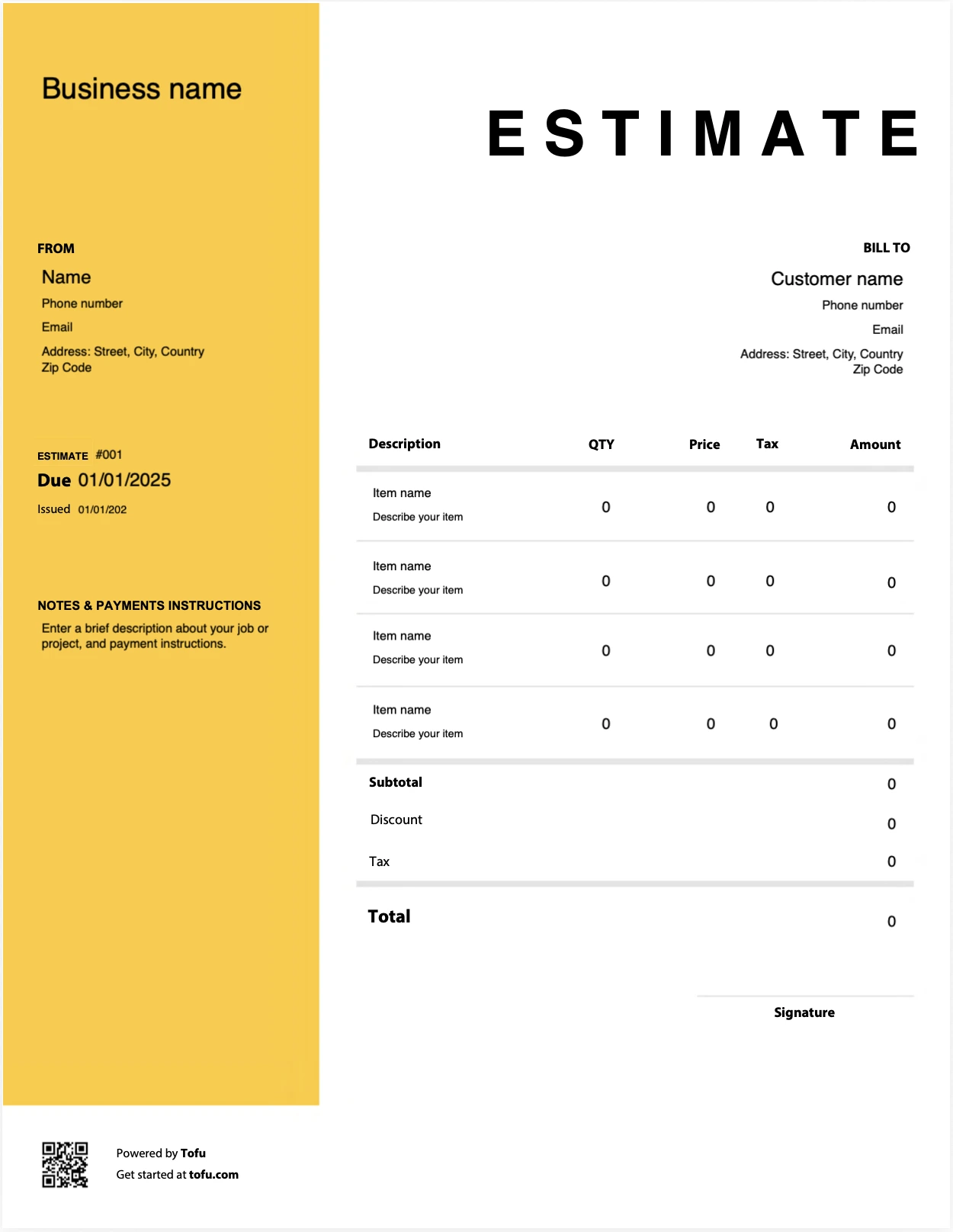
Estimate jobs for tile, hardwood, laminate, carpet, or any install that starts with a quote. Tofu's ready-to-use flooring estimate templates make it simple. Choose your format, add your branding, and download.
Estimate templates designed for flooring pros
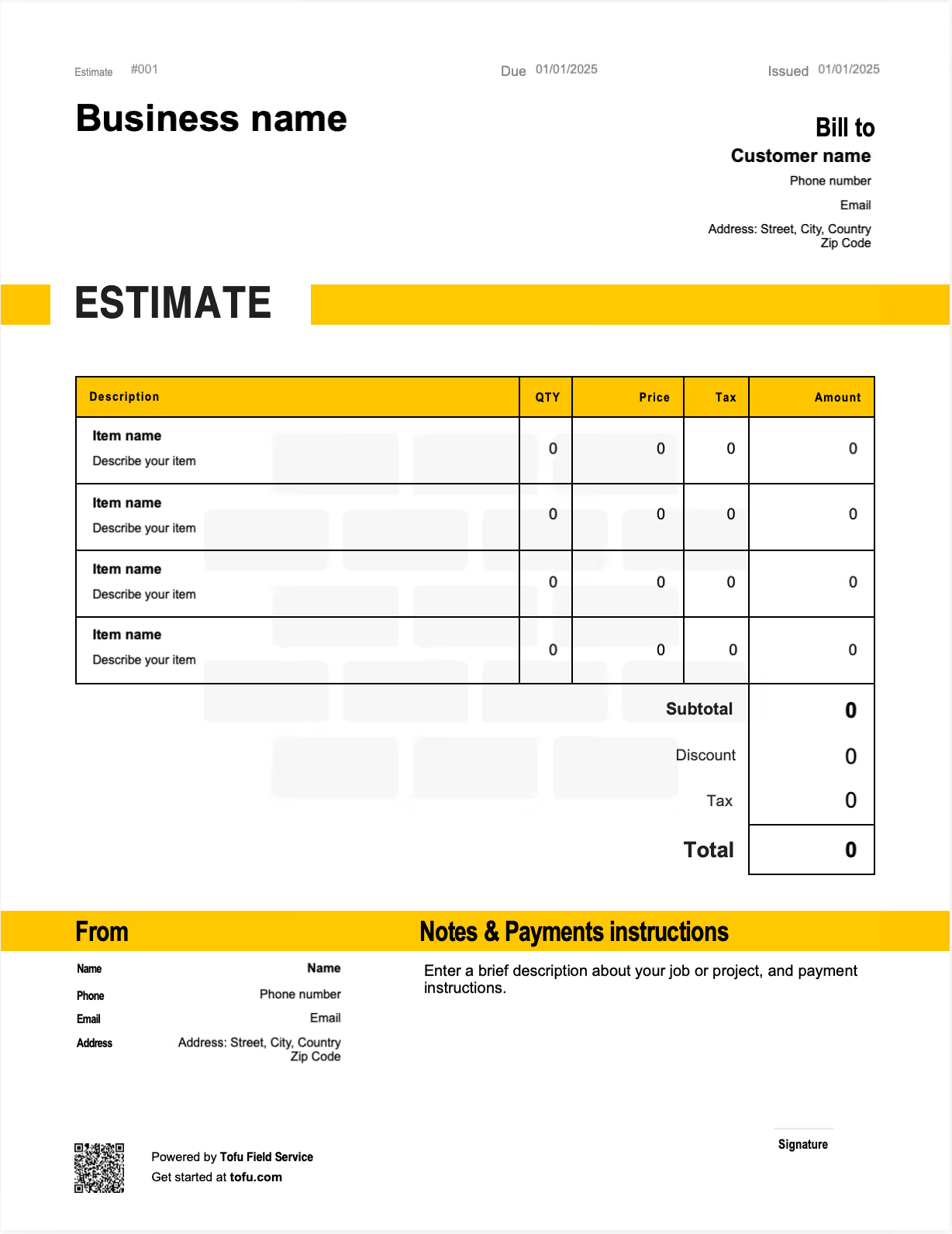
What to Include in a Flooring Estimate Template
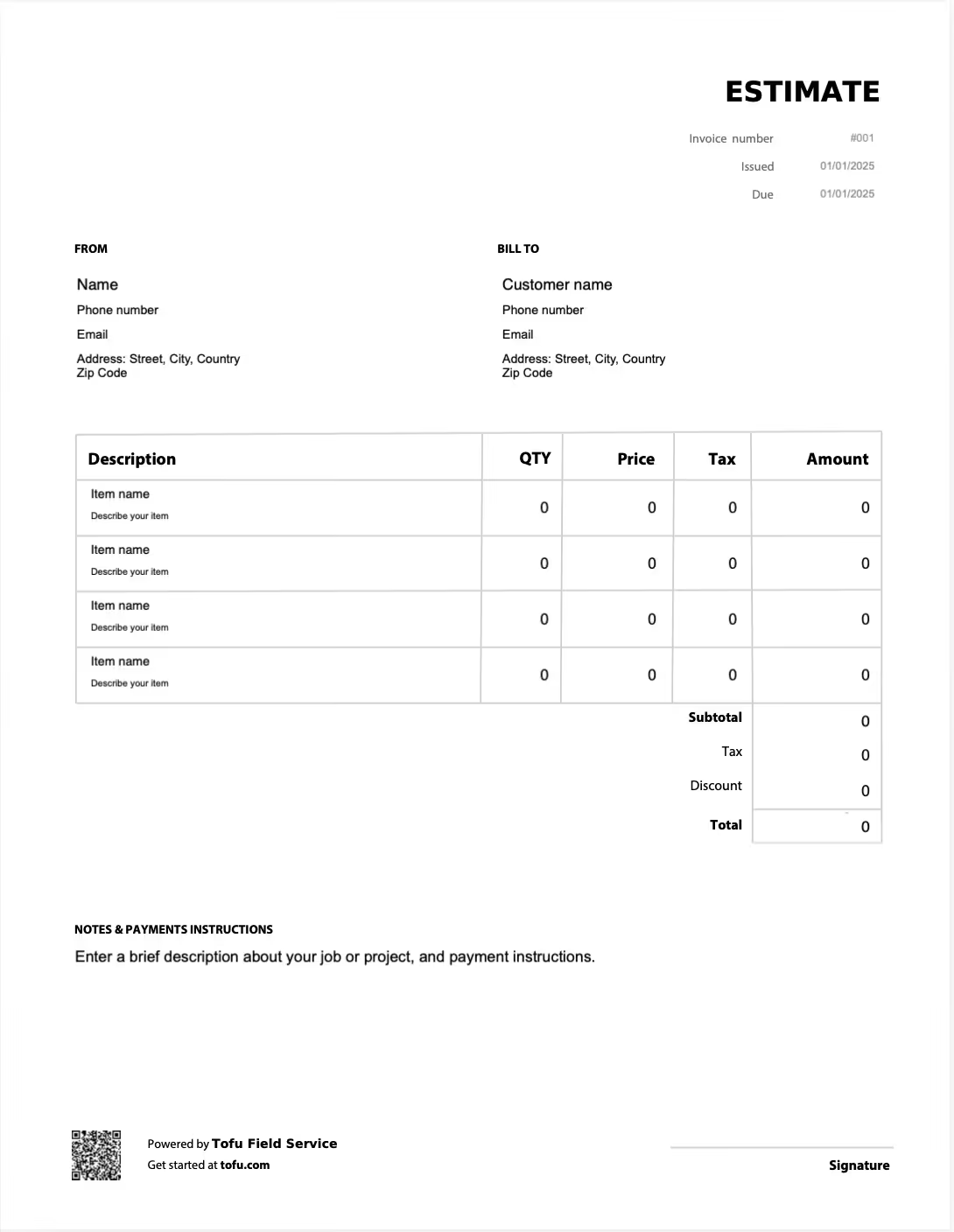
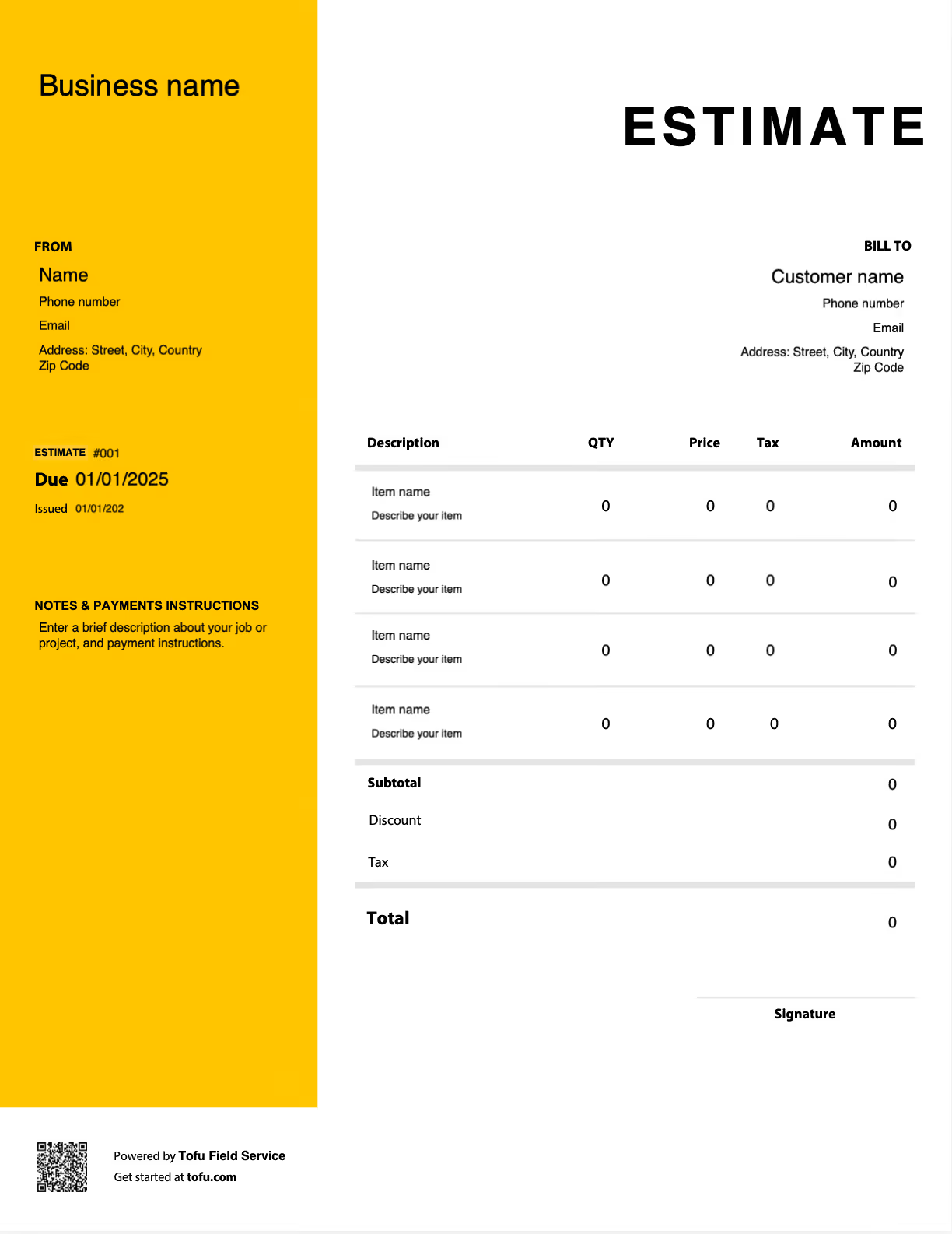
A complete flooring estimate has two layers: the standard business fields any document needs, and the flooring-specific fields that protect your margin. Leave out the second layer and you'll eat the cost of every surprise on site. A strong template should capture:
- Company Info & Logo — identifies your business and looks professional: company name, logo, license, contact details.
- Customer Information — ties the estimate to the billing party: name, address, phone, email.
- Estimate Number & Date — tracks the document and sets a timeline, including an issued date and a valid-until date.
- Scope of Work — defines exactly what's included, such as "remove carpet, install LVP across 320 sq ft."
- Flooring Type — sets the cost structure for the job: tile, hardwood, laminate, or carpet.
- Total Area (Square Footage) — the basis for all material and labor math.
- Cost Per Square Foot — makes pricing transparent and defensible: material plus labor rate per sq ft.
- Material Costs — itemizes flooring, underlayment, and adhesive, each priced separately.
- Labor Costs — separates installation labor from materials: install hours × labor rate.
- Subfloor Prep — captures repair and leveling before install, such as leveling and patching an existing concrete subfloor.
- Markup — protects your margin, applied as a percentage across direct costs.
- Total & Payment Terms — shows the final figure and how to pay: subtotal plus tax, with deposit and balance terms.
Separating material costs from labor is what keeps a dispute from turning into a loss. When a homeowner can see the floor itself priced apart from the install, the number stops feeling arbitrary. Pricing by square foot, documenting the subfloor, and showing markup all do the same quiet work: they make the estimate accurate enough to protect you if the scope shifts mid-job.
Line Items That Generic Templates Miss
A construction estimate template won't have a place for the costs that decide a flooring job's margin. These are the line items pros build in, whether they're working in a spreadsheet or a dedicated form:
- Subfloor inspection and repair — leveling, patching, or replacing damaged subfloor before anything goes down.
- Underlayment — required under most laminate and carpet, and often hardwood.
- Material waste factor — extra material for cuts, pattern matching, and breakage on tile and hardwood.
- Removal and disposal of existing flooring — tear-out labor and haul-away that's easy to forget.
- Transitions and trim — thresholds, reducers, and quarter round between rooms and surfaces.
- Adhesive or fasteners — mortar, glue, nails, or staples specific to the flooring type.
Skip these and you absorb the cost on every job, quietly eroding margin one line item at a time.
Your next flooring estimate is 60 seconds away
Open Tofu, add the job details, send it for approval. Your customer sees a clean, itemized estimate before the first plank goes down.
Rated excellent on review platforms

Absolutely amazing! It’s saves so much time and it gives you the professional touch needed to make you look good!
★ ★ ★ ★ ★
Tony W., TrustpilotTofu works with Stripe for on-site card payments, lets me turn estimates into invoices, and instantly syncs jobs, photos, and client notes offline.
★ ★ ★ ★ ★
Tofu user, G2
I use Tofu for my cleaning business, and it solves so many problems for me. I consider it a complete success for myself and my employees.
★ ★ ★ ★ ★
Marjorie N., G2Easy to use and straightforward! Been using it for over a year now!
★ ★ ★ ★ ★
Manuela M., TrustpilotI need some basic features like send estimate, invoice, track my jobs and get money. Tofu is good for that.
★ ★ ★ ★ ★
Tofu user, G2I love it 10 out of 10 would highly recommend to anyone
★ ★ ★ ★ ★
David M., CapterraHow to Create a Flooring Estimate Using a Template
The template gives you the structure; this is the order to fill it in. A flooring estimate is built before work begins, unlike the invoice you send after, so the goal is an accurate forecast the client can approve.
- Measure the total area and record square footage per room, including closets and offsets.
- Identify the flooring type so you can set the right material and labor rates.
- Inspect the subfloor and note any prep, leveling, or repair the job will need.
- Calculate material costs using cost per square foot plus a waste factor, underlayment, and fasteners.
- Add labor costs based on install hours and your rate for that flooring type.
- Apply markup consistently across materials and labor to protect your margin.
- Deliver the estimate to the client with a valid-until date before any work starts.
💡 Pro Tip: Send the finished estimate as a PDF. It presents as a clean, professional document and locks the layout so line items and pricing can't be accidentally edited before the client signs off.
Flooring Estimate Templates by Format: Excel, PDF, and Google Sheets
The right format depends on how you work and who's receiving the estimate.
- Excel template: Best for contractors who want built-in formulas that calculate square footage and costs automatically. A flooring estimate template for Excel is easy to customize and save per job, and it handles the math on multi-room work without manual re-entry.
- PDF: Best for sending a polished, non-editable estimate to a homeowner. The layout stays fixed and nothing gets changed between you and the signature.
- Google Sheets: Best for teams or contractors quoting from mobile on-site. Cloud access means you can build the estimate in the driveway and share it before you leave the job.
Most pros build in Excel or Google Sheets and export flooring invoice templates to PDF. As your volume grows, flooring business software offers automation, takeoff, and tracking beyond what a static template can do, and many tools offer a free trial when you're ready to scale.
Flooring Estimate Templates for Different Flooring Types
Flooring choice changes the estimate's structure, not just its price. A fully customizable template lets you adapt one base document for any job rather than maintaining separate files.
Tile and stone flooring need grout and mortar as line items, plus a higher waste factor for cuts and pattern matching. Diagonal or herringbone layouts increase both material waste and labor.
Hardwood flooring involves a moisture barrier, acclimation time before install, and finish type (prefinished versus site-finished), each of which affects cost and timeline.
Laminate and carpet require underlayment, and carpet adds stretch and seam allowances that change how much material you order.
Keeping a sample estimate for each major flooring type helps newer contractors avoid the most common mistake in the trade: underbidding because a type-specific line item got left out.
Benefits of Using Flooring Estimate Templates
A template does more than save a blank-page start:
- Saves time by reusing one structure instead of rebuilding every quote from scratch.
- Consistent professional estimates across every job, so your tile quote and your hardwood quote look and read the same.
- Fewer scope disputes because clear line items document exactly what was priced and what wasn't.
- More jobs won, since a polished presentation builds client trust and gets faster approvals.
- Better job costing, by comparing estimated against actual costs after each project to sharpen the next bid.
- Cleaner payment terms, which set deposit and balance expectations up front and reduce collection friction.
Templates streamline operations in the short term. As a flooring business grows, dedicated estimating software with takeoff and estimate features becomes the better long-term investment for managing volume.
Common Flooring Estimating Mistakes to Avoid
Most margin leaks trace back to a few avoidable errors:
- Ignoring material waste percentage → Add a waste factor (often 10% or more for tile and patterned installs) to every material line.
- Combining labor and materials in one line → Itemize them separately so costs are transparent and defensible.
- Failing to document subfloor conditions → Inspect and note prep needs before quoting, not after demo.
- Omitting underlayment → Include it as its own line item wherever the flooring type requires it.
- Guessing square footage with round numbers → Measure every room and record actual square footage.
- Skipping markup → Apply consistent markup so materials and labor both carry margin.
- Sending estimates with no expiration → Add a valid-until date so old pricing can't be held against you.
Estimates are just the start
Every client, job, estimate, and payment lives in Tofu, ready to pull up in seconds, right from the job site.
FAQs
Everything you need to know about the product and billing

Still have questions?



Create the perfect estimate for your business
Get started for free