How to start a cleaning business: The complete step-by-step guide for 2026
Low startup costs, steady demand, and real recurring revenue – here's the complete step-by-step guide to launching a cleaning business in 2026.


Starting a cleaning business is one of the lowest-risk ways to become your own boss. The startup costs are small, the demand never really goes away, and you can launch with little more than supplies you may already own. The global cleaning services market was worth an estimated $415 billion in 2024 and is projected to keep growing at around 6.9% a year through 2030, which means there is plenty of room for new operators who do good, reliable work.
This guide walks you through how to start a cleaning business step by step, from choosing your niche and getting licensed to pricing your services and landing your first clients. Whether you want a solo house cleaning side hustle or a commercial cleaning company with a crew, the path is the same. You just scale the decisions to your goals.
Key takeaways
- Choose your niche first. Decide between residential (house) cleaning and commercial cleaning, study your local market, and look for a service gap you can fill.
- Keep startup costs low. A solo residential cleaner can start for roughly $300 to $2,000. Buy only what your first jobs need and reinvest your early profits.
- Get legal before you clean. Register your business, get an EIN, secure a business license, and carry general liability insurance. Many clients also want you bonded.
- Price for profit, not just to win the job. Research local rates, pick a pricing model that fits your service, and build in a real margin.
- Win your first clients through people you know, then systematize. Start with friends, neighbors, and referrals, then use software to schedule jobs, track them, and get paid on time so you can grow.
Not sure where to start? Grab the checklist.
Download our free "How to Start a Cleaning Business" checklist and work through every step at your own pace.
Why start a cleaning business?
A cleaning business has one of the lowest barriers to entry of any service trade. You do not need a degree, a license to mop a floor, or expensive machinery. You need supplies, a way to get to the job, and the discipline to do consistent work.
The demand behind it is enormous and stable. According to the U.S. Bureau of Labor Statistics, janitors and building cleaners alone held about 2.4 million jobs in 2024, and the wider building and grounds cleaning field employs more than 4.5 million people. Even though the occupation is only projected to grow about 2% through 2034, the BLS expects roughly 351,300 openings every year over the decade, driven mostly by people leaving the field. In plain terms, there is a constant, churning need for cleaning that does not disappear when the economy slows. The BLS also confirms the low barrier directly: the work typically requires no formal education to enter, and most cleaners learn on the job.
A few reasons it is such a popular first business:
- Constant demand. Homes and offices always get dirty. Demand holds up even when the economy slows, and many clients want recurring service rather than one-off jobs.
- Recurring revenue. A single client who books weekly or biweekly cleaning becomes a predictable income stream. A handful of steady commercial contracts can cover your costs on their own.
- Low overhead. Compared with most trades, your supply and equipment costs are minimal, and you can run the whole operation from home and your vehicle.
- It scales on your terms. You can stay solo for the higher margins, or hire a crew and take on more work. Both models work.
Is a cleaning business right for you? Residential vs commercial
Before anything else, decide what kind of cleaning company you want to run. This single choice shapes your pricing, your equipment, your marketing, and how big you can grow.
Residential (house) cleaning is the easiest place to start. You can work alone, the spaces are smaller, and clients usually pay right after each visit. You will typically build up to a dozen or more homes that you clean weekly or every other week. This is the right fit if you want to start solo and keep things simple.
What a typical residential job looks like: You arrive at a client's home in the morning with your own supplies and a caddy, often working solo. A standard recurring clean of a two or three bedroom house takes roughly 1.5 to 3 hours: you work room by room, dusting surfaces, wiping kitchen counters and appliances, scrubbing bathrooms (toilet, sink, tub, mirrors), and vacuuming and mopping floors. You let yourself in with a key or lockbox code, since many clients are at work. You might clean two to four homes in a day, drive between them, and get paid by card or app right after each visit. The work is physical, repetitive, and detail-driven, and the relationship is personal because you are in someone's private space every week.
Commercial cleaning means offices, retail spaces, medical facilities, and other businesses. It usually requires a small team, a vehicle to move people and supplies, and the ability to clean after hours. The upside is that a few regular commercial contracts can keep you profitable, since the jobs are larger and recurring.
What a typical commercial job looks like: You and one or two crew members arrive at an office or retail space after closing, often in the evening or early morning when the building is empty. The work is faster and more systematized than residential: emptying trash and recycling across the whole floor, vacuuming open areas, wiping and disinfecting desks and high-touch surfaces, restocking and sanitizing restrooms, and cleaning break rooms and kitchens. You follow a fixed checklist and route to hit the same standard every visit, and you bring larger equipment like commercial vacuums, floor buffers, and bulk supplies in a vehicle. Because the contract is recurring (nightly, several nights a week, or weekly), the income is predictable, but you are managing a schedule, a team, and a client's facility manager rather than working alone.
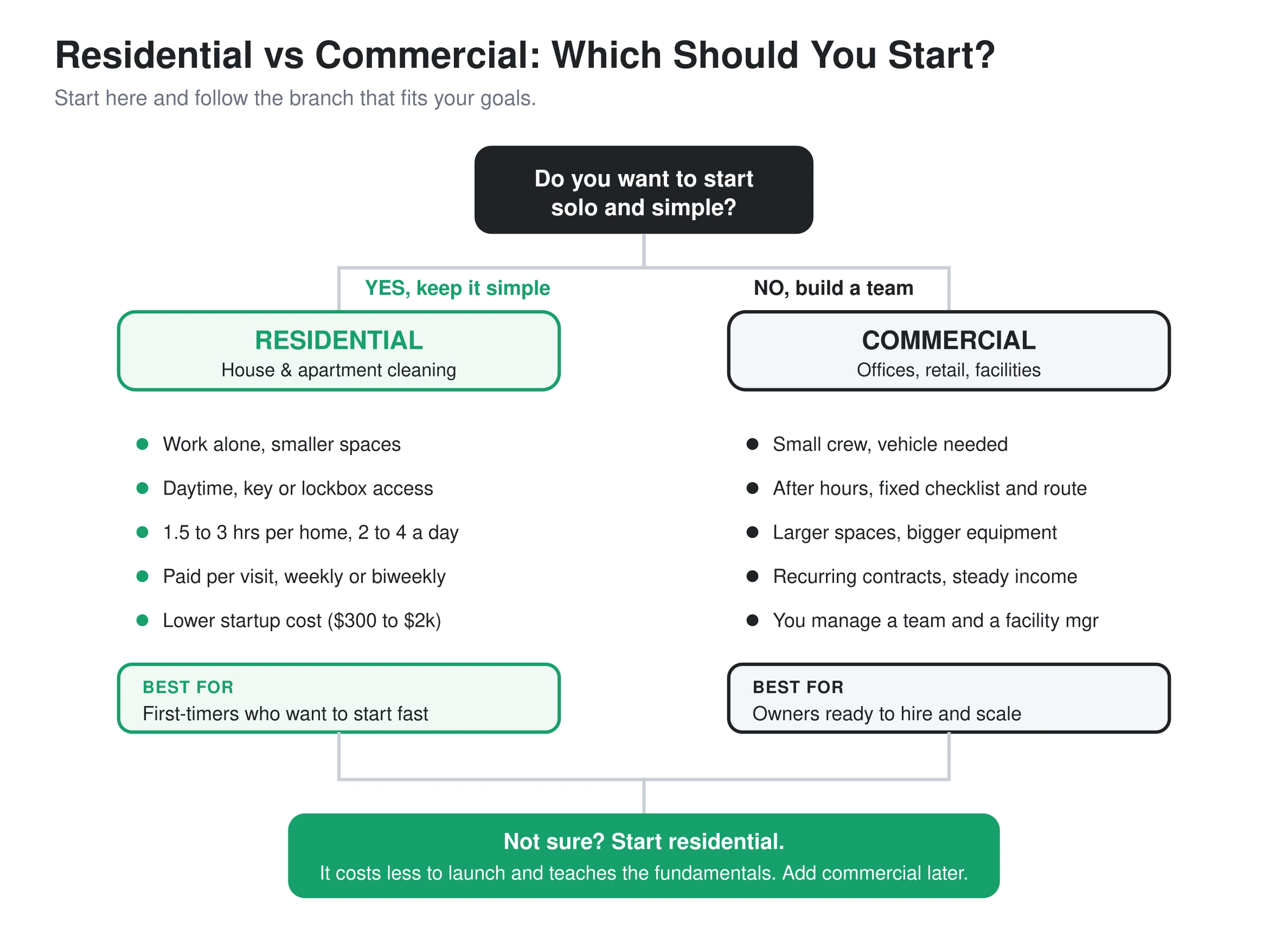
Many owners start residential and add commercial later. Let your local demand and your own goals guide the call. If you are not sure, start with house cleaning, because it costs less to launch and teaches you the fundamentals fast.
How much does it cost to start a cleaning business?
You can start a cleaning business for as little as $300 if you go solo and residential, or expect $1,000 to $2,000 for a more complete setup. Commercial cleaning costs more because of larger equipment, a vehicle, and bigger insurance and bonding requirements.
Here is a realistic breakdown for a new residential cleaner:
| Startup item | Typical cost |
|---|---|
| Cleaning supplies and chemicals | $100 to $300 |
| Equipment (vacuum, mop, microfiber, caddy or cart) | $200 to $600 |
| Business registration / LLC | $0 to $200 |
| Business license or permit | $50 to $200 |
| General liability insurance | $500 to $1,200 per year |
| Bonding (often required for commercial) | $100 to $300 per year |
| Marketing (website, cards, Google Business Profile) | $0 to $500 |
| Estimated total to launch | ~$300 to $2,000 |
How to start a cleaning business with no money
If your budget is close to zero, you can still get going:
- Start solo and residential so you avoid payroll and a second vehicle.
- Use cleaning supplies you already own and buy only what the first job actually requires.
- Ask friends and family for your first few jobs to build experience and reviews.
- Reinvest every dollar from your first jobs into better supplies and a basic website.
- Look into small-business grants and low-cost local resources for new entrepreneurs.
The goal early on is to keep expenses low while you prove the business works, then upgrade as paying clients come in.
How much money can a cleaning business make?
This is the question that actually matters, and most guides dodge it. Here are realistic 2026 numbers, not best-case fantasies.
| Stage | Typical annual revenue | Net profit margin | What it looks like |
|---|---|---|---|
| Part-time solo | $15,000 to $30,000 | 20% to 40% | A few clients, evenings and weekends, supplemental income |
| Full-time solo | $45,000 to $56,000 net | 10% to 28% (cost-controllers hit 20%+) | 5 to 20 recurring residential clients, you do the cleaning |
| Small commercial team | $70,000 to $120,000 | 10% to 22% | 5 to 10 commercial contracts, 1 to 3 staff |
| Established company | $250,000 to $585,000+ | 10% to 35% | Multiple crews, owner manages, ~12 jobs/day at the top end |
A few honest points behind those numbers:
- Solo residential is a real living, not just a side hustle. A full-time solo cleaner nets around $45,000 to $56,000, which beats the typical employed-cleaner wage by a wide margin and comes with the freedom of being your own boss.
- Margins are thinner than people expect. Residential cleaning runs roughly 10% to 28% net margin; commercial is steadier but often 10% to 22% because contracts get competed on price. Solo owners who keep supply and travel costs tight land at the high end.
- Location moves the needle hard. The same visit that bills $130 to $160 in a mid-size city can bill $200 to $300 in New York, LA, or San Francisco. Your costs are higher there too, so check local rates before you set yours.
- What separates six figures from breaking even is not how hard you scrub. It is correct pricing, client retention through recurring contracts, route efficiency, and adding higher-margin specialty services. The owners who struggle almost always underprice early and never recover.
Step 1: Research your local market and choose your niche
It does not matter how good you are if nobody nearby needs your service. Start by sizing up demand and the competition.
- Search "house cleaning near me" and "commercial cleaning near me" on Google and study the top competitors. Look at their services, pricing pages, and reviews.
- Check Google Maps, Yelp, and your local chamber of commerce to see who is already operating.
- Talk to neighbors and local business owners about what they like and dislike about their current cleaners.
- Look for a gap. If nobody local offers move-out cleaning, eco-friendly cleaning, or vacation rental turnovers, that gap is your opening.
Pick a niche you can own. A focused positioning (for example, "eco-friendly home cleaning" or "office cleaning for small clinics") lets you charge more and market with a sharper message than a generic "we clean everything" company.
Step 2: Decide which cleaning services you will offer
Start with a small list of core services you can deliver well, then expand. Core options include standard residential cleaning, deep cleaning, move-in and move-out cleaning, office and commercial cleaning, and sanitization.
Once you are established, you can add higher-margin specialty services:
- Carpet and upholstery cleaning
- Window cleaning
- Pressure washing
- Gutter cleaning
- Pool cleaning
- Vacation rental and Airbnb turnover cleaning
- Eco-friendly or "green" cleaning, which uses non-toxic products and often commands premium rates
You do not need formal certification to clean in most areas, but learning to clean professionally matters. Educate yourself on technique and on avoiding cross-contamination between homes. Optional certifications from industry associations can build client trust, though they are rarely a day-one priority.
Step 3: Write a cleaning business plan
A business plan is your roadmap, not a stack of paperwork. Even a one-page version forces you to think through how the business makes money. Cover:
- Executive summary: what you do and who you serve.
- Market analysis: local demand, competitors, and your niche.
- Services and pricing: what you offer and what you charge.
- Marketing strategy: how you will get and keep clients.
- Operations: scheduling, supplies, and how the day runs.
- Financial projections: startup costs and realistic monthly revenue.
Keep it practical. The point is clarity, not length.
Step 4: Register your business and choose a structure
Make your business official:
- Pick a name that is clear, memorable, and available in your state.
- Choose a structure. Many owners start as a sole proprietor for simplicity, then form an LLC for liability protection as they grow. An LLC helps separate your personal assets from the business. If you are weighing the options, this breakdown of business structure types and a guide to how much it costs to start an LLC are worth a read.
- Register with your state and file a DBA if you are operating under a name other than your own.
- Get an EIN from the IRS. It is free, takes a few minutes online, and you will need it to hire and to open a business bank account.
- Open a separate business bank account so your business and personal finances never mix.
Step 5: Get the licenses, permits, and insurance you need
This is the step new owners most often ask about, so handle it carefully.
Business license. Most cities and counties require a general business license to operate legally, but there is usually no special "cleaning" license for basic residential or commercial work. The catch is that the details vary by state and even by city, so requirements and fees differ depending on where you operate. Here is how it breaks down in some of the highest-demand states:
| State | State cleaning license? | What you actually need | Where to register |
|---|---|---|---|
| Texas | No state license for basic cleaning | Business registration (LLC recommended), sales/use tax permit (cleaning is taxable in TX), local city license in some areas | Texas Secretary of State + Texas Comptroller |
| Florida | No special cleaning license | Register with the Division of Corporations (Sunbiz), local business tax receipt, sales tax registration, possible permits if handling chemicals | Florida Dept. of State (Sunbiz) |
| California | No license for sole proprietors doing general cleaning, but janitorial services have a special registration | General business license (22+ cities require one), DBA if using a trade name, register with the Franchise Tax Board; janitorial firms must register and pay a $500 application fee (and $500 renewal) | CalGold portal + CA Franchise Tax Board |
| New York | No statewide cleaning license | Register with the Dept. of State, local city permits, and special permits in some cities for janitorial work involving hazardous waste | NY Dept. of State |
| Illinois | No special cleaning license | Business registration and local city/county license; check professional regulation for any specialty work | IDFPR + local clerk |
Two things to watch everywhere: general cleaning rarely needs a special license, but specialty work like mold remediation or lead/asbestos abatement is separately regulated in most states and is illegal without the right contractor license. And industry certifications (ISSA, ARCSI) build credibility but never replace a government license. When in doubt, check your state Secretary of State office and your city or county clerk before you take on clients.
Insurance. General liability insurance is essential because you work inside clients' homes and offices. If you break a vase or cause water damage, this coverage protects you from a claim that could otherwise sink the business. Most cleaning companies carry $500,000 to $2 million in coverage, with premiums starting around $400 to $1,200 per year for a small operation. Many commercial contracts and vendor platforms will not let you bid without proof of insurance.
Bonding. A janitorial or surety bond reassures clients that they are protected against theft or damage. It is frequently required to win commercial contracts.
Workers' compensation. Once you hire employees, most states require workers' comp coverage.
Get a few quotes, bundle policies where you can, and keep proof of insurance handy because clients will ask for it.
Step 6: Buy your cleaning supplies and equipment
You can start with a modest kit and upgrade as revenue grows. A solid starter list:
- Vacuum cleaner
- Mop and bucket, plus a stack of microfiber cloths
- All-purpose cleaner, disinfectant, glass cleaner, and bathroom cleaner
- Scrub brushes and sponges
- Gloves and basic protective gear, plus masks for heavy-duty jobs
- A caddy or cart to carry everything
Buy only what your first jobs require, then reinvest. Consider stocking eco-friendly products if your market wants them, since they support premium pricing. Think about where you will store supplies and how you will transport them between jobs.
Step 7: Set your prices and learn to estimate jobs
Pricing is where new cleaners most often leave money on the table. Pick a model that fits your service, then build in a real margin.
| Pricing model | How it works | Best for |
|---|---|---|
| Hourly | Charge per hour, often $25 to $50+ depending on market | New cleaners, unpredictable jobs |
| Per square foot | A set rate per square foot of space | Large or commercial properties |
| Flat per job / per visit | One price for a defined cleaning | Recurring residential clients who want price certainty |
| Monthly contract | A fixed monthly rate for scheduled service | Steady commercial and recurring residential work |
To set your rates, walk the space and factor in size, condition, how often you will clean it, and your supply and travel costs. Research what local competitors charge so you are in the right range. Then add your target profit margin. Many new owners underprice to win clients, then struggle to raise rates later, so charge what the work is worth from the start. A free cleaning estimate template helps you quote consistently and look professional from your first job.
Step 8: Set up accounting, banking, and getting paid
Good money habits keep the business healthy and make tax time painless:
- Use your separate business bank account for every transaction.
- Track income and expenses with simple accounting software, and keep receipts for deductible supplies and equipment.
- Send clear, professional invoices and make it easy for clients to pay you by card or online so you get paid faster. A free cleaning invoice template is an easy way to start, and online payments get you paid faster than checks or cash.
Getting paid on time is not a luxury. Late or messy invoicing is one of the fastest ways a small cleaning business runs into cash trouble.
Step 9: Market your cleaning business and get your first clients
You do not need a big budget to land your first clients. You need to be visible where local people look.
- Build a simple brand. Choose a clear name, get inexpensive business cards, and set up a basic website.
- Claim your free Google Business Profile. This is where most local clients will find and vet you. Add photos of your work and respond to reviews.
- Start with people you know. Tell friends, family, neighbors, and former coworkers that you are open for business and ask them to spread the word.
- Go local and free. Post in neighborhood Facebook groups and Nextdoor, hand out flyers or door hangers in target areas, and ask satisfied clients for referrals.
- Collect reviews relentlessly. Ask for a Google review after every job. Reviews are your reputation and your best marketing.
- Aim for recurring work. A weekly or biweekly contract is worth far more than a one-time clean, so make recurring service your default offer.
A simple referral program ("refer a friend, get your next clean discounted") turns happy clients into a sales force.
Step 10: Run and grow your cleaning business
Doing the cleaning is only half the job. Running the business well is what separates a hobby from a company that grows.
As soon as you have more than a couple of clients, the admin starts to pile up: scheduling visits, remembering addresses and gate codes, tracking what got done, and chasing invoices. This is where the right software pays for itself. With cleaning business software like Tofu Field Service, you can:
- Schedule cleaning jobs with dates, times, and addresses
- Attach before-and-after photos to each job
- Leave notes for your team
- Track job activity from the customer's location
- Keep a history for every client
- Send invoices and collect payment from the field
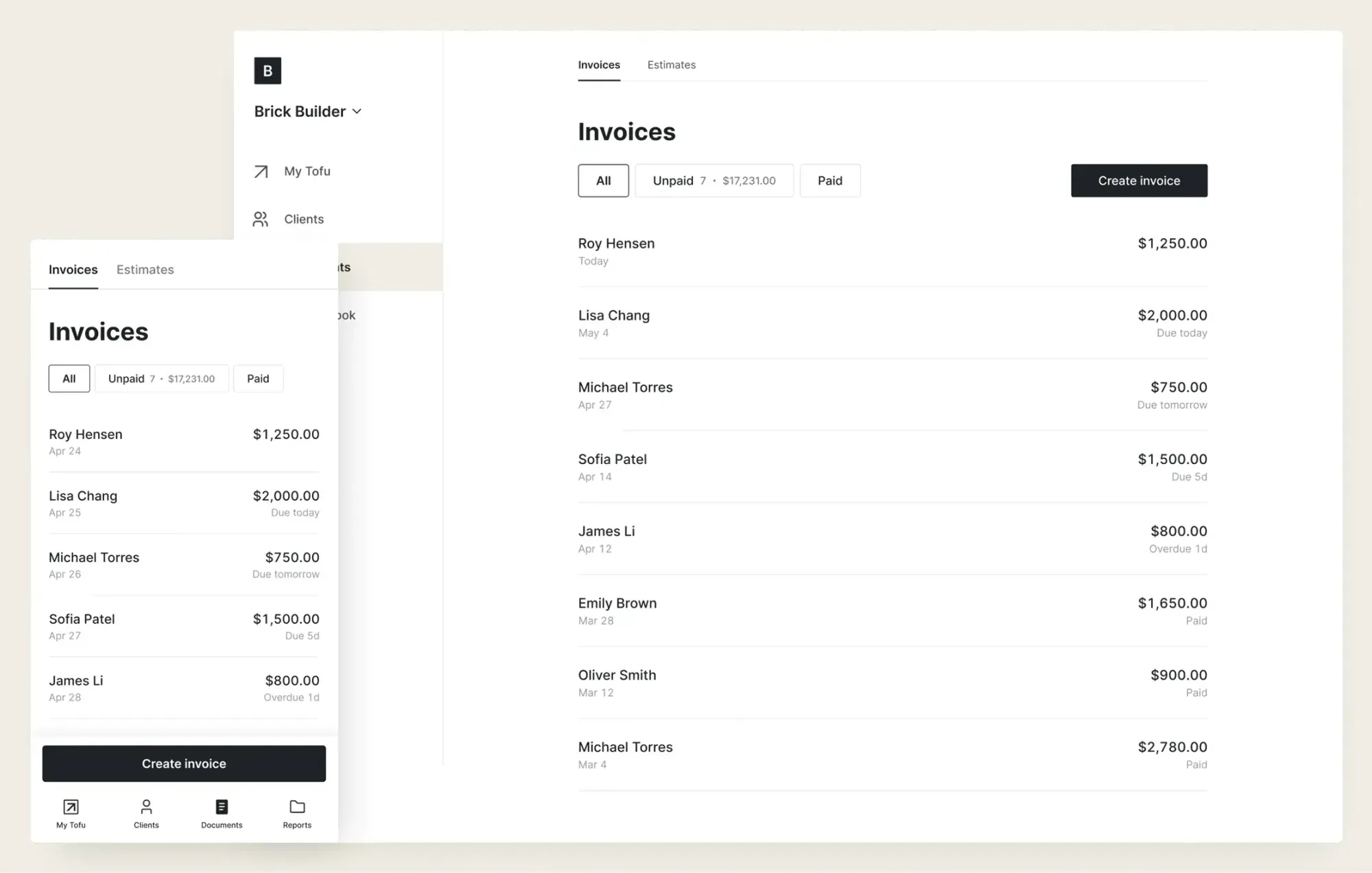
If you want to compare your options first, here is a guide to the best field service management software for cleaning services.
When to hire. Consider bringing on help once you are consistently booked several weeks out and turning down work. Hire for reliability and attitude first, because you can teach someone to clean but not to show up. Start with one trusted person, train them on your standards, and grow the crew as recurring revenue supports it.
Run your cleaning business from your phone.
Schedule jobs, send invoices, collect payment, and track every client — all in one app built for cleaning operators.
How long does it take to start a cleaning business?
Most people can go from idea to first paying client in about two to four weeks:
- Week 1: Research your market, choose your niche, and write a simple business plan.
- Week 2: Register your business, get your EIN and license, and buy insurance.
- Week 3: Buy your starter supplies and line up your first jobs through friends, family, and local posts.
- Week 4: Complete your first cleans, collect reviews and photos, and start booking recurring clients.
Move at the pace that fits your situation, but there is little reason to delay. The fastest way to learn this business is to do your first job.