7 proven ways to grow your HVAC business (Without burning out)
Running an HVAC business but not growing it? This guide covers marketing, pricing, hiring, and operations – so you scale without burning out.



Running an HVAC business is no joke. You know the drill: long days, emergency calls at 11 p.m., crawling in attics, working in the cold, and doing whatever it takes to keep customers’ systems running.
But growing the business? That’s a different fight.
Build a thriving HVAC business: A complete growth blueprint
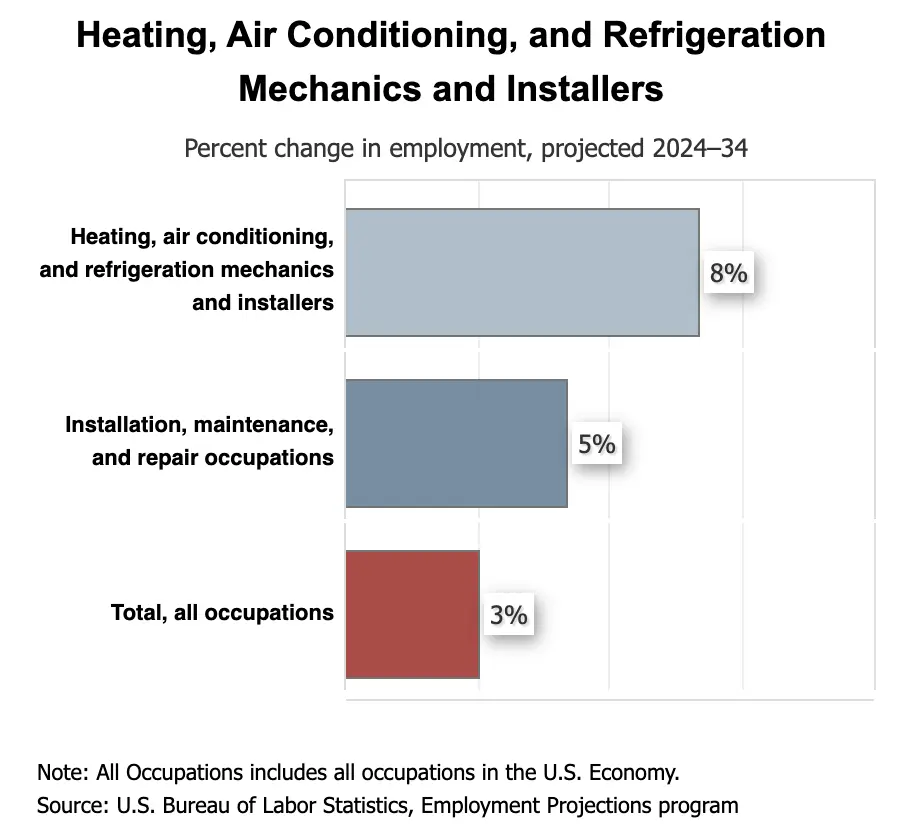
Here's the reality: by 2034, there's expected to be 34,500 more HVAC jobs than in 2024. The growth is ~8%, which is much faster than the average for all occupations. There's more work than anyone today can handle, whether you're in the heating, ventilation, and air conditioning business, plumbing, electrical, or any other trade. The opportunity is massive – but only if you stop running your business like it's still 1995.
What's holding most field service businesses back:
- Cash flow problems – customers pay whenever they feel like it
- No real marketing plan beyond hoping for referrals
- Buried in paperwork instead of out running jobs
- Can't find good techs, can't keep the ones you have
- Racing to the bottom on price instead of selling value
This guide provides actionable tactics for growing your business in 2026 and beyond – strategies you can implement this week.
Why most HVAC businesses struggle to scale
Let's cut to the chase. You know how to fix HVAC systems – that's not the problem. The problem is everything else that comes with running a business. And if you're in plumbing, electrical, or any other trade, you're dealing with the exact same challenges.
Cash flow kills more businesses than bad service ever will. Studies show 82% of small business failures come down to money management. One late payment can stall the whole week.
Poor management systems are the second bottleneck. 51% of small businesses struggle to grow due to operational inefficiencies, with the business owner being the only person who knows what’s going on. That caps growth immediately once you add trucks or techs.
No marketing strategy means you're dependent on whoever happens to call. Referrals are great, but you can't predict them. Relying on word-of-mouth isn't a strategy, it’s just hoping for the best.
Overhead creeps up while revenue stays flat. Prices for fuel, insurance, trucks, parts, and labor go up every year. If pricing doesn’t match real overhead, the business gets busier but the bank account doesn’t.
⚠️ Common mistake: Working harder isn’t equal to growth. You can take more calls, work longer hours, and skip weekends – but that's a job, not a business. Real growth comes from building systems that work without you babysitting every detail.
Create a strategic HVAC business plan for growth
Most contractors hear "business plan" and think it's corporate nonsense they don't need. Wrong. A business plan isn't bureaucratic paperwork – it's your roadmap for making decisions and spending money smart.
A good plan answers three simple questions:
- What type of work do you want more of?
- Who are you trying to serve?
- How will the business stay profitable year-round?
A real plan gives you clarity on pricing, services, staffing, and marketing. It also helps when dealing with banks, suppliers, and any support from the Small Business Administration. Whether you’re a startup company or a shop with several trucks, these components matter.
Here are the main things your business plan must include.
7 essential components of an HVAC business plan:
- Mission statement: What your company stands for and how you serve customers.
- Target market: Homeowners, light commercial, property managers, or all three.
- Service focus: Heating, air conditioning, refrigeration, or niche work like maintenance programs.
- Leadership and team roles: Who handles what; how decisions get made.
- Marketing strategy: How you attract the right potential customers and stay busy outside peak season.
- Operations and systems: Dispatching, job tracking, communication, invoicing.
- Revenue and financial projections: Real numbers, not guesses; the foundation of a sustainable business.
💡 Pro tip: Start with a one-page plan. Your mission, your target customers, your main services, and your 12-month goals. That's it. You can expand it later, but a simple plan you actually use beats a detailed plan that sits in a drawer.
Get Tofu and start sending professional invoices in minutes
Best HVAC marketing strategies that drive growth
Good marketing is consistent digital marketing, content marketing, and direct marketing working together so your business shows up everywhere customers look. When done right, it builds brand awareness and fills your schedule year-round.
Local SEO. The highest-intent leads come from searches like "AC repair near me." Showing up in the Google map pack beats any advertising slogan.
Reviews and reputation. Your online reputation is your new word-of-mouth. You need a simple process to request and manage reviews after every service call.
Paid ads (Google Ads + Local Service Ads). When you need calls fast, paid advertising works. Both put you in front of customers ready to book. A well-structured advertising campaign targets real intent, not random clicks.
Social media marketing. Posting job results, before/after photos, and seasonal reminders builds brand awareness and keeps you top-of-mind.
Email and SMS for retention. Pure direct marketing. Quick reminders for tune-ups, seasonal check-ins, and maintenance agreements turn one-time customers into repeat revenue.
Local SEO and Google Business Profile optimization
When someone’s heat dies at 6 a.m. or their AC quits during a heatwave, they don’t do long browsing – they grab their phone, search “HVAC repair near me” and tap the first result. If you’re not there, that job is probably gone. Local SEO isn’t marketing fluff but a straight-up digital marketing that gets your phone ringing when customers need help right now.
The core of this is Google Business Profile. It decides whether you show up in Google Maps, local search, and Google Local Service Ads.
This is also where content marketing helps. Google rewards businesses that publish real job photos, updates, and local info. It shows you're active, not a dead listing.
Here are 5 steps to optimize your Google Business Profile:
- Fill out everything (service areas, hours, phone, website, services).
- Pick the right categories: “HVAC Contractor” first, then specifics like “Air Conditioning Contractor.”
- Upload real job photos weekly (not stock pictures!).
- Get reviews and reply to every single one.
- Turn on messaging and connect Google Local Service Ads.
Leverage online reviews and reputation management
Homeowners don't guess which HVAC company to call – they check reviews first. According to BrightLocal research, 98% of consumers read online reviews for local businesses before making a decision. Reviews are today's version of word of mouth, so if you want steady customer flow, you need a simple system to collect them after every job.
Here are the best practices of what really works in the field:
- Ask for the review while you’re still on-site.
- Text the review link (don’t ask them to “find you on Google”).
- Train techs to request reviews after successful calls.
- Follow up once if the customer forgets.
- Respond to every review, good or bad (professional responses show you care).
A strong review profile builds trust, boosts ranking, and fills your schedule even in slow months.
Paid advertising: Google Ads and Local Service Ads
If you need calls already-this-week, paid advertising comes in. Done right, Google Ads and Google Local Service Ads bring in high-intent customers who are ready to book your service right now.
Local Service Ads (LSA) are the fastest wins for most HVAC companies. You only pay when a customer contacts you. It’s the closest thing to guaranteed demand in digital marketing.
Google Ads take a bit more work, but they give you control: specific keywords, locations, and job types. When you run a real advertising campaign – not random boosted posts – you show up exactly where customers are searching.
If you want the phone ringing consistently, both tools work. Start with LSA for quick wins, then use Google Ads to fill in the gaps.
Email and SMS marketing for customer retention
Keeping customers is cheaper than finding new ones. That’s why email and SMS should be part of every HVAC business marketing strategy. They keep you in front of customers long after the job is done and turn one-time calls into repeat revenue. Most shops only reach out when something breaks. The smart ones stay in touch year-round.
Email / SMS campaigns that actually work for HVAC businesses:
- Seasonal maintenance reminders: "Time for your spring AC tune-up" sent 6 weeks before summer
- Helpful tips: How to lower energy bills, when to replace filters, what weird noises mean
- Maintenance plan offers: Deals for joining your preventive maintenance program
- Post-job follow-ups: "How'd we do?" messages that get feedback and ask for reviews
- Weather alerts: Reminders to get service before extreme temperatures hit
Stop chasing payments, start getting paid
Join thousands of contractors who trust Tofu for fast, easy invoicing. Sign up today and simplify your billing.
How Tofu helps HVAC businesses grow
Paper invoices, late payments, and double entry slow HVAC shops down more than any technical problem. These operational bottlenecks directly limit your ability to scale: slow payments strangle cash flow, administrative work steals time from billable jobs, and delayed invoicing creates uncertainty that prevents you from confidently taking on more work.
Tofu Field Service eliminates these growth barriers. Built specifically for field service businesses, Tofu enables technicians to send estimates, create invoices, and collect payments right from the job site – no paperwork, no office delays, no cash flow gaps. The direct impact on business growth: you get paid in 1-2 days instead of weeks, reduce administrative overhead by up to 70%, and free up capacity to serve more customers. When operations run smoothly and money flows predictably, scaling becomes possible.
Here's how it removes the bottlenecks that usually stop growth:
Create professional invoices instantly from the field
Finishing a job is good. Getting paid for it is better. With Tofu, techs can create a clean, professional invoice on their phone before they even leave the driveway. No more paperwork, no more delays, no more “I’ll send it tonight.” This is real management: clear, fast, and accurate.
Tofu also auto-generates invoices from jobs, and it works even without service, so your team can bill from any location.
💡 Pro tip: Tofu automatically creates an invoice when you create a Job – no manual conversion needed.
Send professional estimates in minutes and close deals faster
A customer wants a quote for a new system. You tell them "I'll get you an estimate in a few days." Meanwhile, three other contractors are handing them quotes on the spot. Guess who gets the job?
Tofu lets techs build and send estimates on-site. Customers can approve with one tap, and you get notified the moment they view it. Once approved, the estimate converts to an invoice instantly.
💡 Pro tip: Tofu sends real-time notifications when customers view your estimates.
Get paid instantly with one-tap online payments
Slow payments crush cash flow. With Tofu’s Stripe integration, customers pay invoices the moment you send them – card, Apple Pay, Google Pay, or ACH. They tap “Pay Now,” and you’re done. Money hits your account in 1–2 days, not weeks. You get instant notifications, and invoice statuses update automatically so you always know who’s paid and who hasn’t.
💡 Pro tip: US users can use Tofu’s payment-fee pass-through option.
Work anywhere with true offline functionality
Most of HVAC work happens in basements, crawl spaces, or rural areas with terrible signal. Tofu keeps going even when your phone doesn’t. You can create invoices, estimates, and jobs offline, and everything syncs once you're back online. That’s real flexibility for any tech in the field and real efficiency for the business.
💡 Pro tip: Tofu’s mobile app has full offline capability and auto-syncs everything once you reconnect.
Build and manage a high-performing HVAC team
You can only run so many calls yourself. Real growth starts when you build a team that can handle jobs without you watching over every step.
The challenge? Finding HVAC technicians who are strong in the field and solid with customers. A tech who’s great at diagnostics but rude in someone’s home will cost you more than they earn. On the other hand, a friendly tech who can’t troubleshoot basic issues slows the whole shop down. This applies to HVAC professionals, electricians, plumbers – any contractor role that represents your brand.
Your job changes too. With a team, your role becomes management and leadership: building systems, setting expectations, and giving people the tools to perform. When something goes wrong, ask: “Is this a people problem or a systems problem?” Nine times out of ten, it’s unclear processes, weak training, or no accountability – an entrepreneurship problem, not a “bad employee.”
Hiring your first tech fundamentally changes the business. You move from doing the work to coordinating the work. It’s a tough shift, but it’s the only way to grow.
5 keys to building a strong HVAC team:
- Hire for attitude, train for skill.
Work ethic and communication matter more than a résumé full of brands and systems. - Train the way you want jobs done.
Technical skills, customer service, paperwork – everyone should follow the same playbook. - Show clear career paths.
Apprentices → junior techs → senior techs → lead roles. People stay when they see a future. - Pay competitively and reward results.
Quality work, low callbacks, and great reviews deserve recognition. - Build a culture people want to work in.
Respect, direct communication, and fairness keep good techs around.
Maximize profitability through strategic pricing
Trying to grow an HVAC business by competing on price is the fastest way to stay broke. You might win a few jobs, but you’ll lose the race where it matters: profitability. This is true for every contractor – HVAC, plumbing, electrical, whatever. When your prices don’t match your true costs, you end up busy, exhausted, and barely covering bills.
Most shops price based on “labor + parts.” That’s it. They ignore overhead, insurance, fuel, equipment depreciation, callbacks, administrative time, or their own salary. That’s not profit maximization. That’s survival. A business built on survival isn’t a sustainable business, and it never builds real business valuation.
Pricing isn’t guesswork. It’s math and sales strategy combined. You’re not charging for the part – you’re charging for the skill, the urgency, the liability, and the fact that you showed up when a customer needed help. Whether it’s AC in a heatwave or heat in a blizzard, that service has real value.
HVAC pricing components
| Component | What it covers |
|---|---|
| Labor | Tech wages, payroll taxes, benefits, training time |
| Materials | Parts, supplies, consumables |
| Overhead | Trucks, fuel, rent, insurance, phones, software |
| Margin | Profit, reinvestment, and long-term business valuation |
If your price doesn’t cover all four, you’re already losing money before the truck leaves the driveway.
Premium pricing isn’t “charging more just because.” It’s charging based on value. Fast response, better warranties, top-tier parts, trained techs, and reliable workmanship all justify higher rates. The customers who only want the cheapest option? They’re usually the slowest to pay and the quickest to complain.
Maintenance agreement plans are one of the strongest profit drivers in HVAC. Recurring revenue stabilizes slow seasons, boosts lifetime customer value, and delivers consistent 40–50% margins. They turn unpredictable business into steady, long-term income.
One more rule: don’t be afraid to walk away from unprofitable work. Your schedule has limited space. Filling it with break-even jobs blocks you from taking the jobs that actually grow your company.
Optimize operations for scalable growth
Many HVAC shops think “more jobs = more money,” but without solid management and tight systems, more jobs usually mean more mistakes, higher overhead, and a burnt-out team.
Real growth happens when your business becomes systems-dependent instead of owner-dependent. You shouldn’t have to babysit every job, every tech, and every customer call. Strong operations give you leverage – the ability to handle more work without everything falling apart. That’s real commerce: predictable inputs, predictable outputs, predictable profit.
Here are the systems every HVAC shop needs before adding more trucks or hiring more techs:
6 systems every growing HVAC business needs
- Customer intake and scheduling.
Calls get answered, details get captured, jobs get scheduled correctly, and assignments are clear. No more double-booking or missing information. - Service delivery standards.
How techs run calls from arrival to cleanup. Consistency builds reputation and reduces callbacks. - Inventory and truck stock management.
Know where parts are. Reduce “supplier runs” that kill schedules and profit. - Quality control and follow-up.
Before/after photos, review requests, and customer check-ins to prevent complaints. - Fast invoicing and payment systems.
Same-day billing, online payments, and auto-updates. - Lead tracking and marketing measurement.
Know which jobs come from where, follow up quickly, and stop wasting money on dead channels.
⚠️ Common mistake: trying to scale without documenting processes first. What works when you run every job collapses the moment you delegate. Write your processes before you hire – not after things break.
Strategic business expansion and scaling
Expansion is where many owners get ahead of themselves. Business is strong, phones are ringing, trucks are busy – so they add another truck or expand service areas. Six months later they're losing money and stretched thin.
Scaling requires systems, not hustle. Expansion demands documented processes, real leadership, and stable operations that don't depend on one person.
Before you expand, make sure the current operation runs without constant firefighting. Here's what must be in place before you scale:
- Real profitability for 6+ consecutive months
- Documented processes that new people can follow
- Management capacity to oversee new operations
- Financial reserves for upfront expansion spend
- Verified customer demand (not assumptions)
- Your current team operating smoothly without your constant involvement
- A clear entrepreneurship plan for what expansion will actually achieve
⚠️ Warning: don’t expand until you have consistent positive cash flow, documented processes that actually work, real management capacity to handle growth, and enough financial reserves to cover at least 6 months of expansion costs before new revenue kicks in.
Invest in mentorship and continuous learning
You may know the technical side cold, but running an hvac business requires different skills – leadership, hiring, pricing, and management. Most techs never get formal training on these. The smartest owners learn from people who've already built strong operations instead of paying for their own mistakes.
Mentorship, peer groups, and industry education shortcut years of trial and error. The ACCA and the PHCC Association provide training, certifications, business workshops, and best practices from across the hvac industry. They also track regulatory changes, codes, and workforce trends – keeping you ahead instead of scrambling to react.
Find mentors who've solved the challenges you're facing: hiring headaches, workflow problems, expansion decisions. Someone has already figured out what you're dealing with right now.
Strong owners schedule time for learning. It pays off in better decisions, fewer errors, and a stronger business.
Your next invoice could take less than 60 seconds
Start using Tofu and create invoices faster than ever. No setup, no stress — just clean, professional billing.
The HVAC growth formula: Putting it all together
Growth isn't random. It comes from a business where every major piece supports the others. When owners treat growth like a system, not a gamble, they build something stable.
The formula:
Consistent customer acquisition × Operational discipline × Team strength × Strong leadership = Sustainable business
If one part drops to zero, growth stops. Most business owners lean into what they're already good at – technical owners focus on craftsmanship, sales-driven owners chase leads, systems-driven owners obsess over processes. Real progress comes from balancing all four pillars and addressing weak spots.
Track your numbers closely. Revenue doesn't matter if profit disappears. Healthy HVAC shops know their gross margin, net margin, and profit per job. When margins slip, you've got pricing or operational leaks – not a "slow season."
The growth path is predictable: create steady demand → tighten operations → build a dependable team → step into real leadership. Skipping steps creates fragile growth that collapses under pressure.
✅ Quick win: Build a 90-day foundation
Pick one weak area and fix it fast:
- Need more leads? Optimize Google Business Profile + reviews.
- Operations messy? Move invoicing/payments to Tofu.
- Team inconsistent? Document service standards.
- Profit low? Rework pricing and cut bad jobs.
Key takeaways for growing your HVAC business
Building a thriving field service company comes down to implementing proven systems that create real leverage. In other words, working smarter, not harder.
The strongest HVAC companies follow the same core principles:
- Build a real plan. Know your market, services, and goals.
- Be visible when customers need help. Local SEO, reviews, and smart advertising drive calls.
- Run jobs on systems, not memory. Use digital tools for invoicing, payments, and daily operations.
- Hire and train the right people. Attitude first, skills second, growth paths for everyone.
- Price for real profit. Cover all costs plus a healthy margin.
- Keep learning. Mentorship and training prevent stagnation.
Get these fundamentals right, and growth becomes predictable.
Conclusion
Building a sustainable field service business takes more than technical skills – it requires strategic thinking, systematic operations, and consistent execution across marketing, team development, and financial management.
Growth comes from making dozens of small improvements consistently. Pick one thing and do it this week. Optimize your Google Business Profile. Set up streamlined invoicing with Tofu. Document your first standard procedure. Reach out to a mentor. Momentum comes from action, not planning.
Ready to stop chasing payments and get paid faster? Try Tofu free and see how mobile-first invoicing and instant payment collection can fix your cash flow and cut your administrative work.