Lawn care marketing: 6 channels that actually book jobs
A simple guide for lawn care business owners to the handful of marketing channels that actually book jobs – what each costs and how fast it works.


You cut grass all day. Then at 9pm, sitting in the truck or at the kitchen table, you try to figure out "marketing." Most guides don't help. They hand you a list of 25 tactics and wish you luck, as if a two-person crew has time to run 25 anything.
Marketing is one pillar of a successful lawn care business, just as important as doing great work and running the day-to-day on a lawn care business software you actually enjoy using. Get one right and neglect the other, and the business wobbles.
This guide is a complete, practical playbook for marketing a small lawn care business: every channel that actually books jobs, what each one costs, and how fast it brings a lead. You'll get the free foundation to set up first, the channels worth paying for, a season-by-season calendar, and simple lawn care marketing ideas you can run in an hour a week. By the end you'll know exactly how to get more lawn care customers without guessing which tactic works.

Key takeaways
- Lawn care marketing is a few channels run as one system, not 25 one-off tactics you try once and forget.
- Set up the free foundation first: a complete Google Business Profile, your first ten reviews, and one clear way to get a quote.
- The three channels that book the most jobs are local search, reviews plus referrals, and Local Services Ads, where you only pay when a customer contacts you.
- Once the foundation runs, layer on paid social, Nextdoor, and targeted offline (door hangers, yard signs, flyers).
- Keep every customer, estimate, and job in one lawn care business software like Tofu Field Service, so you can answer leads fast and see which channel actually books work.
- Track cost per booked job, not cost per lead, and put "How did you hear about us?" on every quote.
What lawn care marketing actually is
Lawn care marketing is how you get found by local homeowners and turn them into repeat customers. It's a mix of local search, reviews, referrals, and a couple of paid channels, run as one system instead of random tactics you try once and forget.
The word "system" matters. A single postcard drop or one Google ad can bring a lead. But the businesses that stay full aren't chasing one-off wins. They have a few channels working together all the time: they show up when someone searches, they have reviews that make the choice easy, and they make it simple for a happy customer to send a neighbor.
Word-of-mouth alone will carry you to a point. In our experience with field-service operators, referrals alone tend to stall somewhere around 40 to 50 accounts, especially if you want tighter routes in specific neighborhoods. That's when a real marketing setup starts to pay for itself.
Before you spend a dollar: the free foundation
The cheapest marketing you'll ever do is the stuff you set up once and leave running. Do these three things before you touch a paid ad.
Claim and fill out your Google Business Profile
This is the listing that shows up when someone searches "lawn care near me" or looks at the map. It's free, and it's the single highest-leverage thing on this list. Here's the surprising part: BrightLocal's 2025 SMB Marketing Report found that only 35% of small and mid-sized businesses have a Google Business Profile at all. Half your competitors are skipping the most valuable free spot in local search. Pick the right primary category ("Lawn Care Service"), set your service area, add real photos of your work, and keep your name, address, and phone number identical everywhere they appear.
Get your first ten reviews
Reviews are the modern version of a neighbor vouching for you, and homeowners lean on them hard. In BrightLocal's 2026 Local Consumer Review Survey, 41% of consumers said they "always" read reviews when choosing a business, and 68% said they'll only use a business rated four stars or higher. You don't need hundreds. You need a steady trickle of recent ones. The easiest way to start: after a job the customer is clearly happy with, ask in person, then send a follow-up text with the direct link. Ask right after they compliment the work, not in a mass email a week later.
Give people one clear way to reach you
You don't need a fancy website to start. You need a page that lists your services, shows a few before-and-after photos, and has an obvious way to get a quote or call you. If a homeowner has to hunt for your number, you've lost the job.
These three cost nothing but time, and they compound. Every review, every photo, every week your profile stays active makes the paid channels below work better and cheaper.
Stop chasing leads across sticky notes
See how Tofu captures every lead, keeps your quotes in one place, and helps you reply first.
3 channels that book the most jobs
If you only run three things, run these. They cover the full path: getting found, getting chosen, and getting the fast leads that fill gaps in your route. Together they're the core of any lawn care marketing strategy that holds up over a full season.
1. Local search and your Google Business Profile
This is the highest-intent free traffic there is. Someone typing "lawn mowing near me" wants to hire this week, not someday. Your job is to show up in that map pack of three businesses at the top.
What moves you up: a complete profile, a steady flow of recent reviews, photos added regularly, and consistent business info across the web. Post the occasional update (a seasonal offer, a finished job). It's slow to build and nearly free, which is exactly why it's worth starting today. The lead you get here costs you nothing per click and already wants what you sell.
2. Reviews and referrals, run as a system
These two are your cheapest customers, so treat them like a channel instead of an afterthought.
For referrals, attach real money to it. A simple offer works: "$25 off your next service for every neighbor who books with me." Cash-style credit tends to beat a vague discount because it feels concrete. Ask at the right moment, in person, right after good work. Field reports from lawn operators consistently show referred customers close at a much higher rate than cold paid leads and stick around longer, because a friend already vouched for you.
For reviews, make the ask a habit after every job, not a once-a-quarter scramble. Keep the flow recent, since homeowners trust fresh reviews more than old ones.
3. Local Services Ads (Google Guaranteed)
This is the channel most lawn care guides skip, and it's the fastest way to buy high-intent lawn care leads. Local Services Ads sit at the very top of Google, above the regular ads and the map, with a green "Google Guaranteed" badge. The key difference from normal Google Ads: you only pay when a customer actually contacts you, not every time someone clicks.
For a small operator, that pay-per-lead model is the whole point. You're not burning budget on clicks that go nowhere. According to SearchLight Digital's home services LSA benchmark (888 contractors, February 2026), blended Local Services Ads leads averaged about $53 each, cheaper than standard Google search ads, and lawn care tends to sit toward the lower end of the range because job values are lower than, say, roofing. Costs swing with your market and season, so start with a small budget in your strongest zip codes and expand what works.
Two things to know before you start. You need a verified Google Business Profile to run them (Google made that a requirement in late 2024), and response speed matters a lot. The faster you answer a lead, the more jobs you book and the more Google shows your ad.
More channels worth adding once the basics run
The three above are the engine. These next channels are how you add volume, fill quiet weeks, and stay visible in the neighborhoods you already serve. Add them once the free foundation is solid, not before.
Facebook and Instagram local ads
Paid social is where you buy attention, not intent. A homeowner scrolling Instagram isn't searching for a mower, so these leads are colder than search or Local Services Ads. But they're cheap and they build recognition across your service area. Run a simple lead ad with a before-and-after photo and a clear offer ("first mow $XX"), target only the zip codes you already serve, and start at $10 to $20 a day. Lawn care lead ads often land around $30 to $50 per lead, and those leads tend to close at roughly half the rate of a search lead. Use paid social for volume and to stay top of mind between seasons, not as your main source of booked jobs.
Nextdoor
Nextdoor is the digital version of a neighbor recommendation, which is the strongest referral there is in this business. Claim a free business page, keep it active, and make it easy for happy customers to recommend you in local threads. It's slow and you can't force it, but one "who mows your lawn?" thread where three neighbors name you is worth more than any ad. Treat it as a trust channel, not a volume one.
Email and text to past customers
Your cheapest future job is a customer you already have. A short list of past clients and their contact info is a marketing asset most crews ignore. Text them to rebook in spring, offer a seasonal add-on in summer, or sell cleanups in fall. A one-line message ("Ready to get back on the schedule? Reply YES") books work at almost no cost. This is exactly where keeping customer records in one place pays off, because a list scattered across a notebook and three apps is a list you'll never actually use.
Offline still works: door hangers, yard signs, and flyers
Print isn't dead in lawn care. It's just most powerful when you aim it at the right ten houses instead of the whole town. Here's how to run each piece so it earns its cost.
Door hangers: build route density
After you finish a job, drop a door hanger on the closest neighbors. They can literally see your work from their own yard, which does half the selling for you. This is also how you build route density, more jobs clustered together, so you spend less time driving and more time mowing. Aim at the ten houses around a job you already have, not the whole zip code.
Yard signs
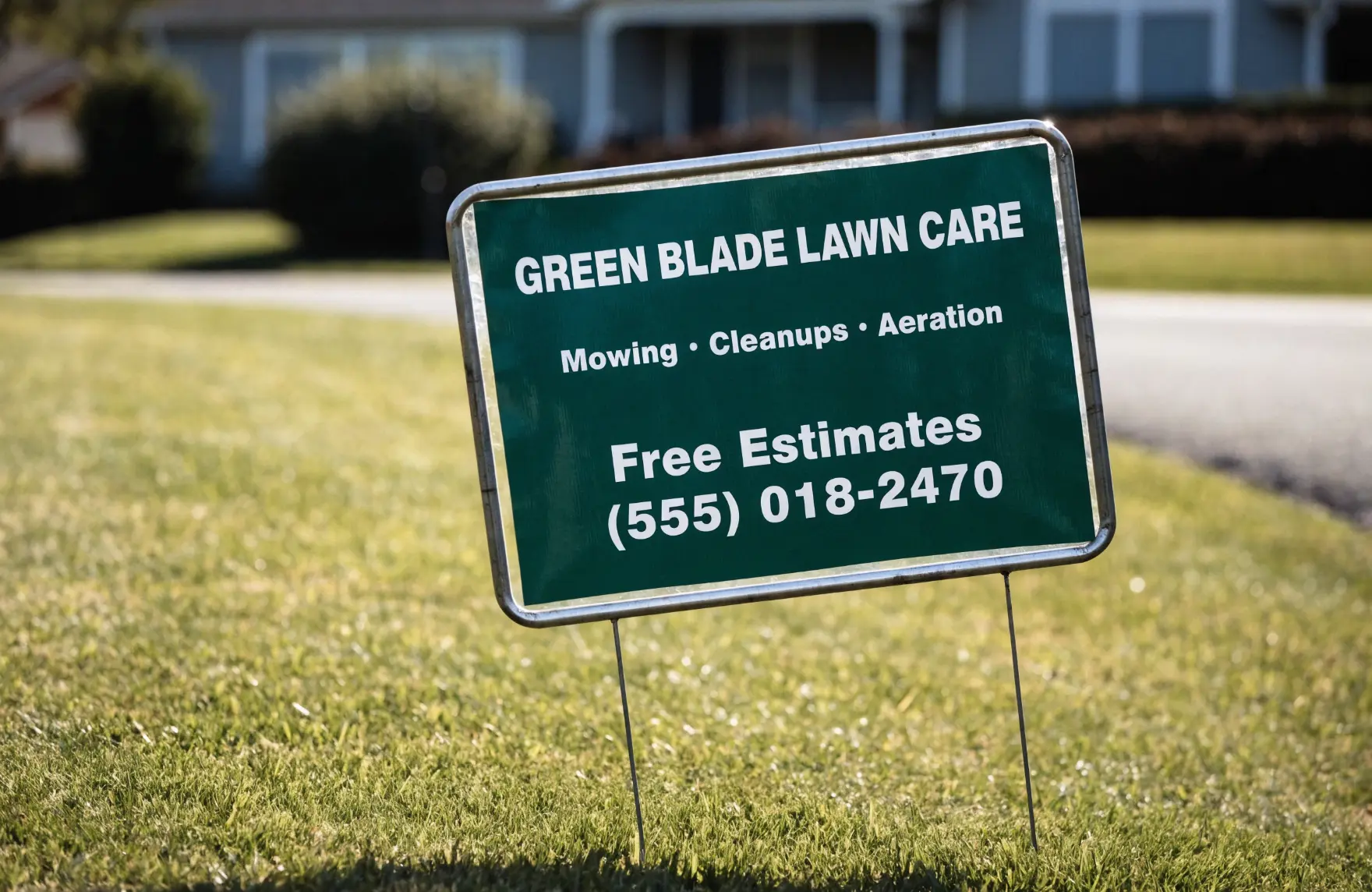
Leave a yard sign on every property you service, with a small discount for the customers who let you. It's free advertising to everyone who walks or drives past, and it quietly signals that a neighbor already trusts you with their lawn.
Flyers and direct mail
Keep the design simple: your service, a before-and-after photo, and one clear way to book. Put a trackable coupon code on every flyer and door hanger so you can see which drops actually brought calls. And set your expectations honestly: print rarely converts on the first touch. It takes several exposures before a homeowner picks up the phone, so consistency beats a single big mailing.
Every lawn care marketing channel at a glance

Now that you've seen how each channel actually works, here's the whole picture on one screen. Use it to match a channel to your budget and to how fast you need work, then pick the two or three that fit where your business is right now.
A note on the paid numbers. LocaliQ's 2025 Home Services Search Ad Benchmarks (based on 3,211 campaigns) put the average cost per lead for standard Google search ads at about $91, with landscaping specifically closer to $118. Lawn care tends to run lower because job values are smaller. Those costs have been climbing: roughly 69% of home services advertisers saw their cost per lead go up in a single year. Facebook leads come in cheaper per lead but convert at maybe half the rate, since a homeowner who tapped a video isn't as ready to buy as one who searched for you. Always judge a channel by cost per booked job, not cost per lead.
A season-by-season lawn care marketing calendar
Lawn care lives and dies by the seasons, yet most marketing advice treats it like a flat, year-round list. Here's a simple calendar built around how the work actually flows.
Late winter (February to March): pre-book the rush. Before spring hits, reach out to last year's customers and lock them in. A simple text works: "Spring's almost here, reply YES to get back on the mowing schedule." This is the highest-return marketing of the year, and it costs you nothing.
Spring (April to May): capture demand. This is when search and paid channels are hungriest, because everyone is looking for a provider right now. Turn on Local Services Ads, push your Google profile, and answer every lead fast.
Summer (June to August): upsell and refer. Your route is full, so shift from chasing new customers to squeezing more from the ones you have. Offer add-ons (aeration prep, mulching, cleanups) and run your referral push hard while customers are seeing weekly results.
Fall (September to November): renewals and cleanups. Sell aeration and leaf-cleanup packages, and start renewal conversations for next year. Lock in the customers you want back before winter.
Winter (December to January): build for spring. The slow season is when you fix what you ignored all year. Collect the reviews you forgot to ask for, refresh your website and photos, tidy your customer list, and set up your ads so you're ready the day spring demand returns.
Stop rebuilding your schedule every season
See how Tofu rebooks past customers, tracks recurring visits, and collects payments for you.
How to measure your lawn care marketing without a marketing degree
You don't need dashboards. You need to know two numbers and one question.
Cost per lead: what you spent on a channel divided by the leads it brought.
Cost per booked job: what you spent divided by the customers you actually landed. That second number is the one that matters, because a channel with cheap leads that never close is more expensive than it looks.
The one question: put "How did you hear about us?" on every quote or intake, and actually record the answer. When you have $200 a month for marketing, you can't afford to guess which channel is working. Tag the source, watch it for a season, and move money toward whatever books real jobs.
This is where keeping your customer records in one place pays off. If your jobs, estimates, and customer history live in a single system instead of scattered across a notebook and three apps, you can see at a glance where your best customers came from and which channel earns its keep. Tofu does this by keeping every customer, estimate, and invoice together, so the "where did you hear about us" answer sits right next to the job, not on a lost sticky note.
Speed helps too. The faster you get a quote in front of a lead, the more you close, because in lawn care whoever answers first usually wins the job. Being able to send a clean estimate from your phone while you're still standing in the yard is a marketing advantage, even though it doesn't feel like marketing.
When it's worth hiring a lawn care marketing agency
An agency makes sense when your time is worth more than the money you'd save doing marketing yourself, and not before.
Early on, the free foundation and a small Local Services Ads budget will carry you, and no agency will care about your business the way you do. Once you're established, have steady revenue, and every hour on marketing is an hour you're not running the business, paying someone to manage your ads and local presence can be worth it. A good one handles your Google profile, reviews, ads, and reporting, and shows you the numbers.
If you go that route, ask hard questions. Who owns the accounts, you or them? Do they report on booked jobs or just leads? Can you leave without losing your profile and data? Plenty of lawn care operators do fine for years without ever hiring an agency. It's an accelerator for a working machine, not a fix for a business that hasn't nailed the basics yet.
Bottom line
Marketing a lawn care business isn't complicated, it's just easy to overcomplicate. Get your Google profile and reviews right, make referrals worth something, add paid and offline channels when you need speed or volume, and track where your customers actually come from. Do those few things every season, keep your customers and jobs in one place so nothing slips, and your route stays full without you burning your evenings on 25 tactics that don't move the needle.